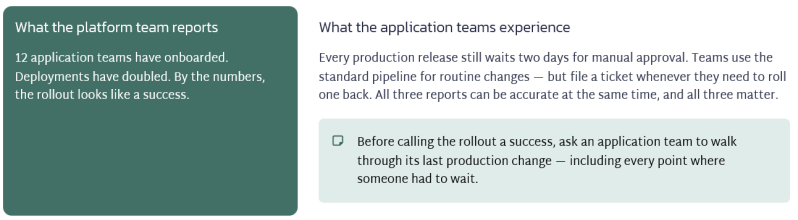
At a portfolio review, the platform team reports that 12 application teams have onboarded and deployments have doubled. Then an application lead mentions that every production release still waits two days for manual approval. Another team uses the standard pipeline for routine changes but files a ticket whenever it needs to roll one back.
All three reports can be accurate. More teams are using the platform and more changes are reaching production. The approval queue and rollback handoff still determine how quickly those teams can deliver or recover. Before I’d call the rollout a success, I’d ask an application team to walk me through its last production change, including every point where someone had to wait.
What DORA tells you about software delivery
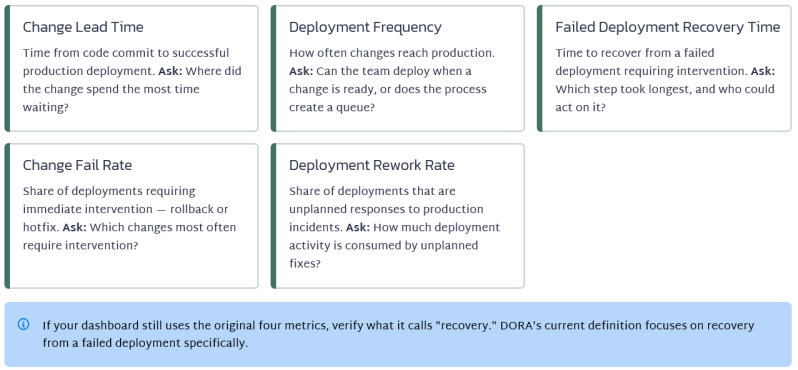
DORA stands for DevOps Research and Assessment. Its software delivery metrics show how quickly teams get changes into production and recover from failed deployments, and how often deployments lead to intervention or unplanned fixes. I’d look at the five measures together for the same application or service over time.

| DORA metric | What it measures | Question for the delivery review |
|---|---|---|
| Change lead time | Time from code commit to successful production deployment | Where did the change spend the most time waiting? |
| Deployment frequency | How often changes reach production | Can the team deploy when a change is ready? |
| Failed deployment recovery time | Time to recover from a failed deployment that requires intervention | Which step took longest, and who could act on it? |
| Change fail rate | Share of deployments that require immediate intervention, such as a rollback or hotfix | Which changes most often require intervention? |
| Deployment rework rate | Share of deployments that are unplanned responses to production incidents | How much of our deployment activity goes into unplanned fixes? |
The Gap Between Platform Adoption and Delivery Improvement
The Five DORA Metrics
Reading the Metrics Carefully – Context changes everything
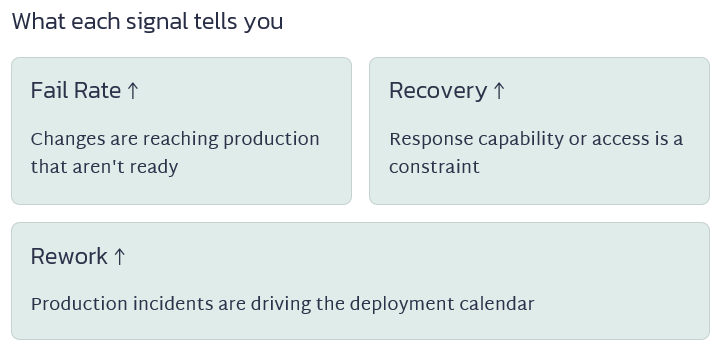
A Friday release that causes a customer-facing error counts toward change fail rate. A separate, unplanned Saturday hotfix counts toward deployment rework rate. Recovery time shows how long it took to restore service after the failed release. If the team has only a handful of deployments, show the counts beside the percentages. One failed change has a very different effect on a rate calculated from five deployments than from fifty.
If your dashboard still uses the original four metrics, check what it calls recovery. DORA’s current definition focuses on recovery from a failed deployment. A general incident metric can still help operations track outages from other causes. DORA’s software delivery performance metrics
Measure the platform from the application team’s side
An internal developer platform might help teams provision an environment, deploy a change, or restore a previous version through a standard workflow. The platform team can apply DORA to its own releases. To understand its effect on application delivery, I’d also look at what application teams can do through the platform and where they still need help.
| Platform measure | What I’d track | Decision it supports |
|---|---|---|
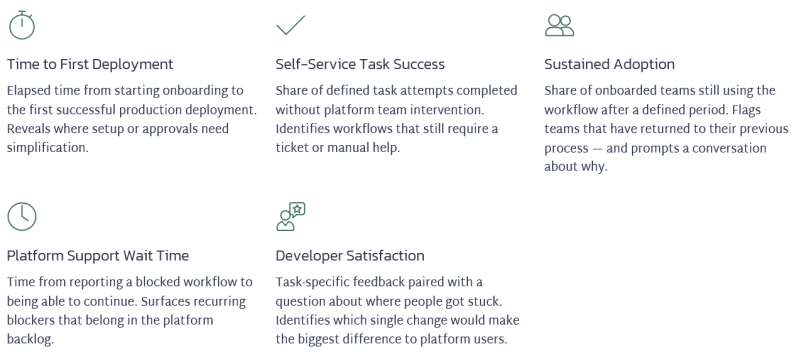
| Time to first deployment | Elapsed time from starting onboarding to the first successful production deployment through the platform | Where should we simplify setup or approvals? |
| Self-service task success | Share of attempts at a defined task completed without platform team intervention | Which workflows still require a ticket or manual help? |
| Sustained adoption | Share of eligible onboarded teams still using the workflow after a defined period | Which teams returned to their previous process, and why? |
| Platform support wait time | Time from reporting a blocked workflow to being able to continue | Which recurring blockers belong in the platform backlog? |
| Developer satisfaction | Task-specific feedback, paired with a question about where people got stuck | Which change would make the biggest difference to users of the platform? |
Five Platform-Side Measures
For self-service environment provisioning, count requests that end in errors or require manual help alongside the successful ones. For rollback, pair the completion rate with feedback from the last incident or recovery drill. A workflow can technically succeed while asking an engineer to look up the right version, find an approver, and check three different screens to confirm recovery.
Onboarding counts are a useful starting point. I’d also ask how many of those 12 teams still use the standard workflow and which tasks they bypass. A team that uses the platform to deploy and opens a ticket to roll back has adopted one workflow. The ticket tells us where to look next. DORA platform engineering guidance
Start with one service and follow the work
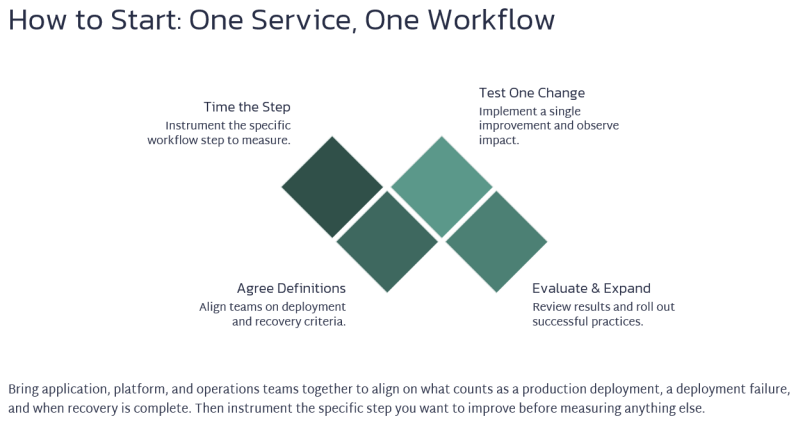
Agree on what counts. Bring the application, platform, and operations teams together to define a production deployment, a deployment failure, and when recovery is complete. Link source control and production deployment records to incident records where possible. For a service with low deployment volume, use a longer baseline and show the underlying counts.
Time the step you want to improve. If production changes routinely wait two days for approval, record when the change is ready and when approval is granted. Track that interval alongside overall change lead time. A faster build can leave users waiting just as long when the release queue is the constraint.
Test one change and review it with the team. Ask the approval owner and security to identify which evidence they need and whether the standard workflow can collect it before the request reaches the queue. If they agree to try it for one service, assign an owner and schedule the review. Compare approval wait and change lead time, then check change failures, recovery time, and unplanned fixes. Ask the application team whether people still needed to chase an approval outside the workflow.
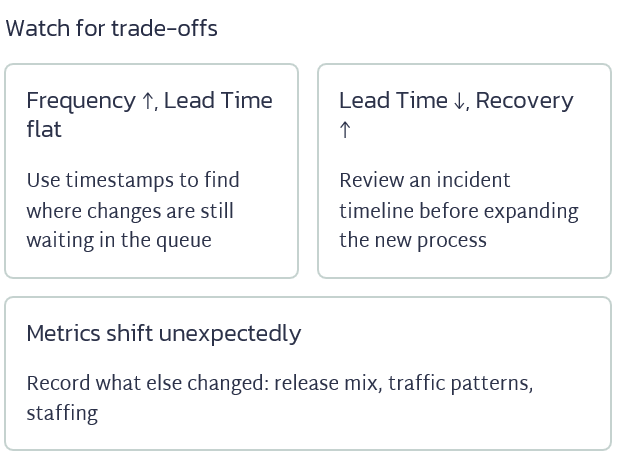
If frequency rises and lead time barely moves, use the timestamps to find the wait. If lead time falls while recovery gets slower, review an incident timeline before expanding the process. Changes in release mix, traffic, or staffing can affect the comparison, so record what else changed during the review period.
Practical Measurement: Timing the Right Step
Record when the change is ready — not just when it ships
If production changes routinely wait two days for approval, record when the change is ready and when approval is granted. Track that interval alongside overall change lead time. A faster build can leave users waiting just as long when the release queue is the constraint.
Test one change and review it
Ask the approval owner and security to identify which evidence they need and whether the standard workflow can collect it before the request reaches the queue. If they agree to try it for one service, assign an owner and schedule the review.
What this looks like on an AI program
Imagine a claims operations team piloting an AI tool that drafts denial summaries for staff review. After adopting a shared deployment pipeline, the team’s median change lead time falls from five days to two. Then a production prompt update produces inaccurate summaries. Operations pauses the workflow, and restoring the previous version takes four hours because the application team needs a platform engineer to perform the rollback.
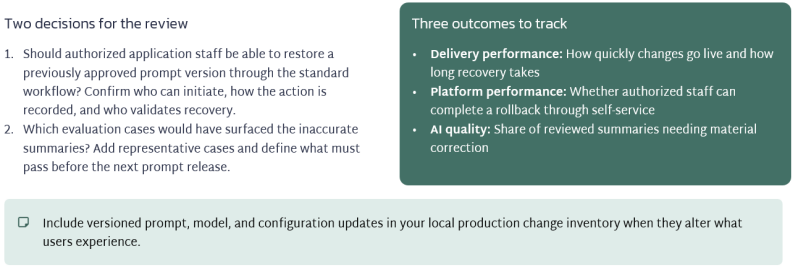
I’d take two decisions to the review. First, should authorized application staff be able to restore a previously approved prompt version through the standard workflow? If so, confirm who can initiate the rollback, how the action is recorded, and who validates the restored version before staff resume use. Second, which evaluation cases would have surfaced the inaccurate summaries? Add representative cases for the failure pattern and agree on what must pass before the next prompt release.
Track three outcomes for the pilot. Delivery performance shows how quickly changes go live and how long recovery takes. Platform performance shows whether authorized staff can complete a rollback through self-service. AI quality shows the share of reviewed summaries needing material correction. Define a material correction with operations, such as an incorrect denial reason or a missing fact that changes how staff handle the claim. Include versioned prompt, model, and configuration updates in your local production change inventory when they alter what users experience.
Patterns Across Program Types
What this looks like on a transformation program
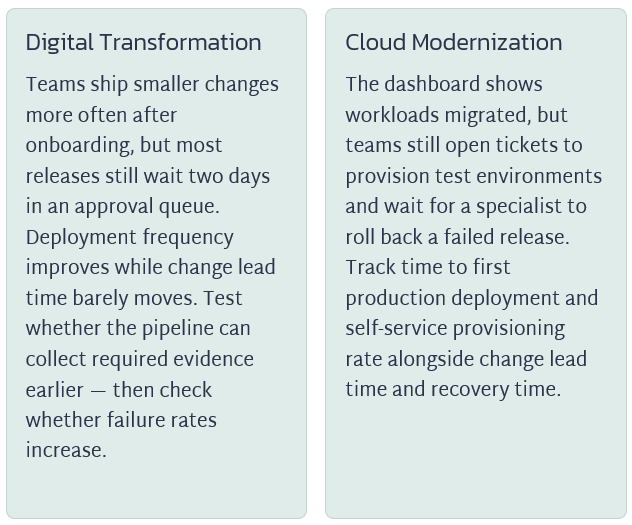
A company standardizes deployment across several business units as part of a digital transformation. Teams in one region ship smaller changes more often after onboarding, yet most releases still spend two days in an approval queue outside the pipeline. Deployment frequency improves while change lead time barely moves.
I’d compare lead time for the same service before and after onboarding, then measure how long release-ready changes sit in the queue. I’d also check whether teams keep using the standard workflow when they encounter delays. If several regions share the same bottleneck, I’d ask the approval owner and platform team to test whether the pipeline can collect the required evidence earlier. At the next review, I’d check whether the wait fell and whether change failures or unplanned fixes increased.
What this looks like on a cloud modernization program
A migration program moves applications into a cloud landing zone. The dashboard shows workloads migrated, but application teams still open tickets to provision test environments and wait for a specialist to roll back a failed release.
I’d track time to first production deployment and the share of test environments teams can provision without assistance. For live services, I’d review change lead time and failed deployment recovery time. If environment setup is still delaying releases, I’d ask the cloud platform owner to improve the standard template and check whether the next migration wave can provision environments with fewer tickets.
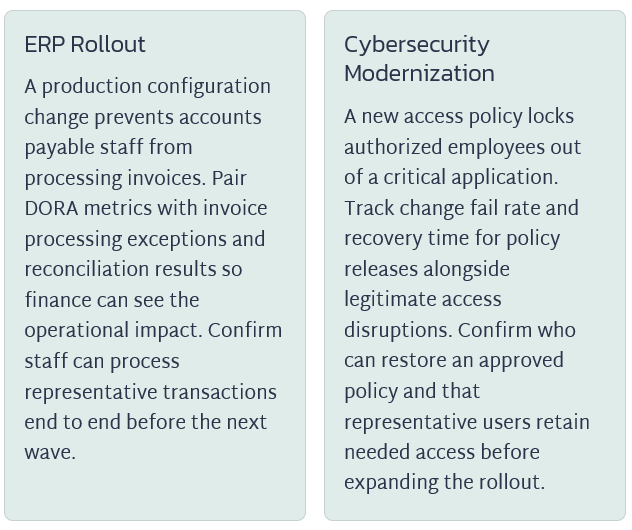
What this looks like on an ERP rollout
An ERP program rolls out a new finance system by region. A production configuration change goes live during the approved release window, but it prevents some accounts payable staff from processing invoices. The finance team uses a manual workaround while the release team restores the previous configuration.
I’d use DORA to track how often production releases need intervention and how long recovery takes. I’d pair those measures with invoice processing exceptions and reconciliation results so finance can see the operational impact. Before the next wave, I’d ask the process owner to confirm that staff can process representative invoices end to end and that balances reconcile after restoration.
What this looks like on a cybersecurity modernization program
An identity modernization program rolls out a new access policy to a pilot group. The change goes live on schedule, but some authorized employees lose access to a critical application. The service desk identifies the affected users and waits for the identity team to restore the previous policy.
I’d track change fail rate and failed deployment recovery time for production policy releases. I’d pair those measures with the number of legitimate access disruptions and time spent waiting for authorized recovery support. Before expanding the rollout, I’d ask the identity owner to confirm who can restore an approved policy and validate that representative users retain the access they need while the intended security control works.
The role of the program manager
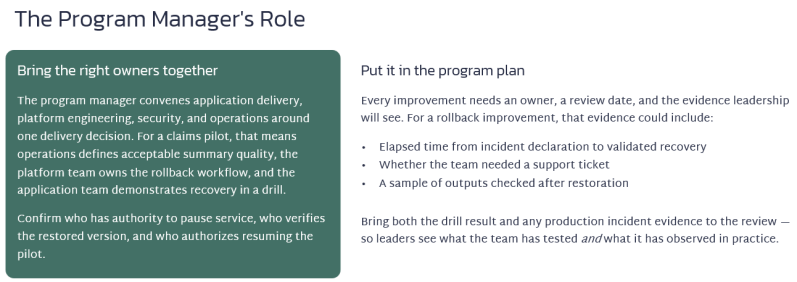
The program manager brings the owners of application delivery, platform engineering, security, and operations together around one delivery decision. For the claims pilot, I’d have operations define acceptable summary quality, the platform team own the rollback workflow, and the application team demonstrate recovery in a drill. I’d confirm who has authority to pause service, who verifies the restored version, and who authorizes resuming the pilot.
Put the improvement in the program plan with an owner, a review date, and the evidence leadership will see. For a rollback improvement, that could be the elapsed time from incident declaration to validated recovery, whether the team needed a support ticket, and a sample of summaries checked after restoration. Bring both the drill result and any production incident evidence to the review so leaders can see what the team has tested and what it has observed in practice.
Questions leadership should ask
- Where is work waiting? Can we see the time spent in review, approval, deployment, or recovery?
- Which tasks still require a ticket? What are application teams trying to do, and how often do they need help?
- How are speed and stability moving together? What happened to failed changes, recovery time, and unplanned deployments as frequency increased?
- Who can act when a release causes harm? Can the accountable team pause the workflow and restore an approved version within its authority?
- What decision will we make from the data? Which improvement will we fund or schedule, who owns it, and what evidence will we check next time?
At your next delivery review, pick one service and one platform workflow. Ask the people doing the work where they wait or reach for a ticket. Compare their account with the deployment and support records, then give someone ownership of one improvement you can evaluate at the next review.
What would your application teams say is the hardest part of getting a change into production or recovering when it goes wrong? Would your dashboard lead you to the same answer?
#DORAMetrics #PlatformEngineering #SoftwareDelivery #DeveloperExperience #DevOps #TechnicalProgramManagement #AIProgramManagement #ManagingProjectsTheAgileWay

About the Author
Kimberly Wiethoff, MBA, PMP, PMI-ACP is an AI Transformation Program Leader specializing in enterprise digital transformation, AI-enabled delivery, PMO leadership, AI governance, Agile program execution, cloud transformation, and complex portfolio delivery.
Through Managing Projects the Agile Way, she shares practical strategies for modernizing project and program delivery, strengthening PMO leadership, and preparing organizations and leaders for the future of AI-enabled program management.
Download Document, PDF, or Presentation
Author: Kimberly Wiethoff, MBA, PMP, PMI-ACP
Comments
Add comment