Your AI portfolio has one engineering team available and three competing requests. Operations wants an assistant that drafts claim denial summaries. The platform team wants a reusable evaluation workflow for AI releases. An integration lead needs to update an eligibility connection before a trading partner retires its current interface. Each request has a reasonable business case.
Before anyone argues for their project, I’d ask each sponsor the same question:
What happens if we wait six weeks?
The denial-summary pilot could save staff time, and every week of delay postpones the chance to test those savings. The evaluation workflow could help several teams test upcoming releases. The eligibility integration has a cutover date, and missing it could interrupt an existing workflow. Those are three different consequences of waiting. Once they’re visible, the portfolio has a better basis for deciding what goes first.
What is Weighted Shortest Job First?
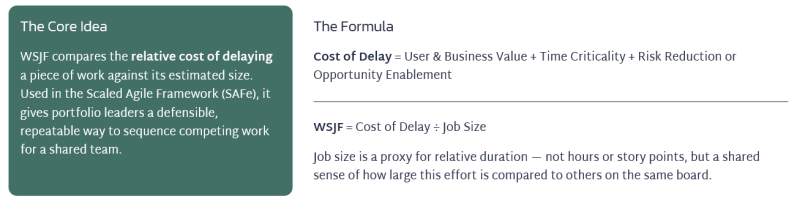
Weighted Shortest Job First (WSJF) compares the relative cost of delaying a piece of work with its estimated size. In the Scaled Agile Framework (SAFe), three factors make up the relative Cost of Delay. Job size serves as a proxy for relative duration.
Cost of Delay = User and Business Value + Time Criticality + Risk Reduction or Opportunity Enablement
WSJF = Cost of Delay ÷ Job Size

| Scoring factor | What I’d ask the team |
|---|---|
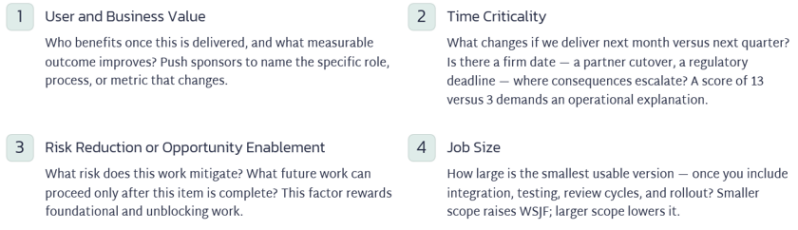
| User and business value | Who benefits, and what outcome improves once the work is delivered? |
| Time criticality | What changes if we deliver next month or next quarter? Is there a firm date when the consequences increase? |
| Risk reduction or opportunity enablement | What risk does this work reduce? What future work can proceed once it’s done? |
| Job size | How large is the smallest usable version once we include integration, testing, review, and rollout? |
Using a Relative Fibonacci Scale
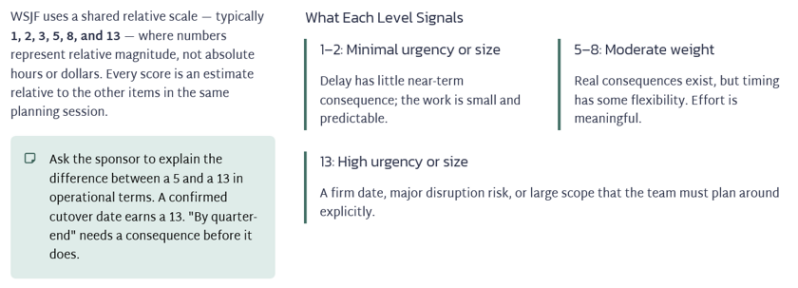
A time-criticality score of 13 signals more urgency than a 3 in the same scoring session. Ask the sponsor to explain the difference in operational terms. A confirmed partner cutover gives the team a date it can plan around. A request to finish “by quarter-end” needs a clear consequence if it slips.
Framework reference: Scaled Agile Framework’s WSJF guidance.
The Four Scoring Factors — and What to Ask
The Setup: One Team, Three Competing Requests
Your AI portfolio has one engineering team available and three requests arriving at the same time. Each has a reasonable business case — and each sponsor believes their project should go first.

How one AI portfolio might score the work
In this example, the three items compete for the same engineering team in the same planning window. The team uses a shared relative scale of 1, 2, 3, 5, 8, and 13. The scores are illustrative.
| Backlog item | Business value¹ | Time criticality | Risk or enablement | Cost of Delay | Job size | WSJF |
|---|---|---|---|---|---|---|
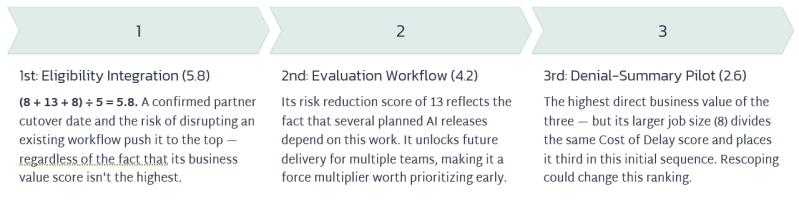
| Eligibility integration update | 8 | 13 | 8 | 29 | 5 | 5.8 |
| Reusable AI evaluation workflow | 5 | 3 | 13 | 21 | 5 | 4.2 |
| Denial-summary pilot with staff review | 13 | 5 | 3 | 21 | 8 | 2.6 |
¹ Business value includes user and business value. Scores are rounded to one decimal place.
The eligibility update scores (8 + 13 + 8) ÷ 5 = 5.8. Its deadline and the potential disruption to an existing workflow put it first. The evaluation workflow comes next because several planned releases could use it. The denial-summary pilot has the highest direct business value, but its larger scope puts it third in this initial sequence.
The Question Every Sponsor Must Answer

Before debating priorities, ask each project sponsor to answer this single question. The answers reveal consequences that a business case alone rarely surfaces — and those consequences are what should drive sequencing decisions in a constrained portfolio.
Three Projects, Three Different Costs of Waiting
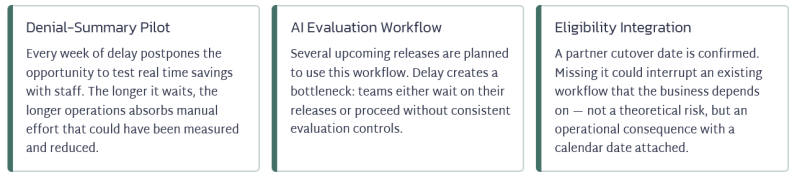
Once these consequences are visible side by side, the portfolio has a far better basis for deciding what goes first — and why.
Reading the Scores: Why This Sequence?
Turn the ranking into a delivery plan
Work backward from the partner cutover.
Confirm the date and reserve time for development, end-to-end testing, and cutover. If partner testing is available only during a specific window, put that window in the plan and identify the latest safe start date.
Check what the evaluation workflow actually unlocks.
Ask which releases will use it and when. If the denial-summary pilot requires evaluation before staff can use it, schedule that dependency explicitly. The pilot could need only a small set of evaluation checks upfront, with broader reuse added later.
Rescore the smallest usable pilot.
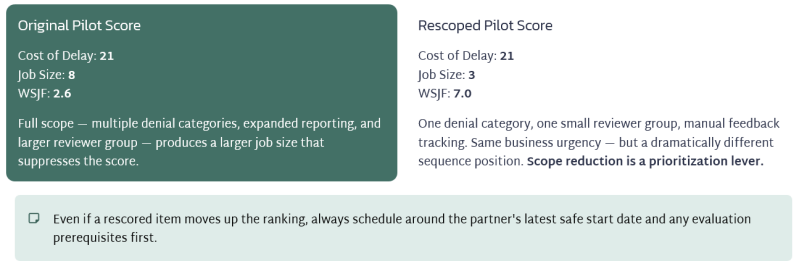
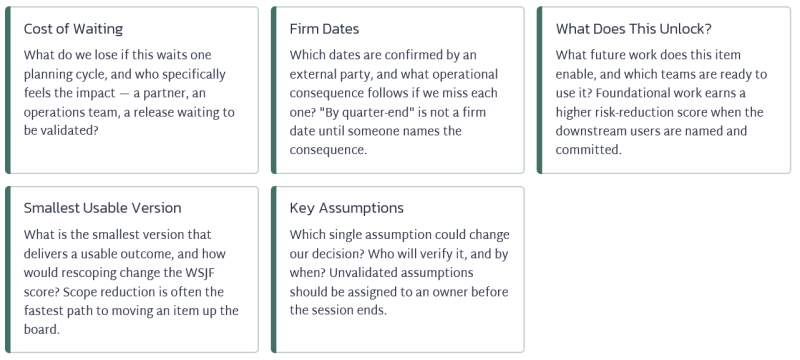
Start with one denial category and a small reviewer group. Keep staff review in scope and measure review time alongside drafting time. If the smaller pilot still scores 21 on Cost of Delay and engineering sizes it at 3, its WSJF rises to 7.0. Recheck the value and urgency assumptions when scope changes. Even if the score holds, schedule around the partner’s latest safe start date and any evaluation prerequisites.
Why Rescoping Can Change Everything
How WSJF compares with other prioritization methods
| Method | The decision it supports | Example |
|---|---|---|
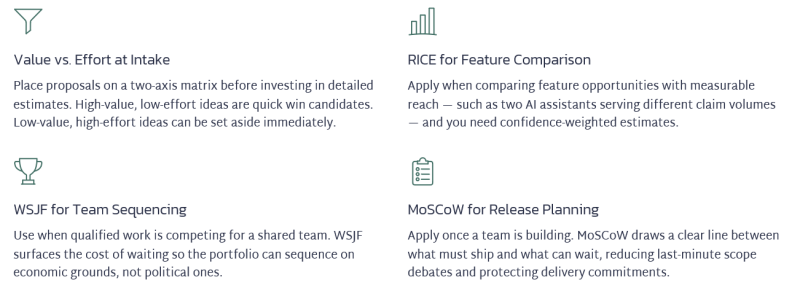
| WSJF | What should the shared team do first? | Sequence the eligibility update, evaluation workflow, and denial-summary pilot. |
| RICE | Which idea offers the strongest reach and impact relative to effort after accounting for confidence? | Compare two AI features by expected usage, impact on staff time, and confidence in the estimates. |
| MoSCoW | What must fit within the release? | Make staff review a Must Have for the pilot and expanded reporting a Could Have. |
| Value vs. effort | Which ideas deserve a closer look? | Screen a long list of proposed automations before asking engineering for detailed estimates. |
RICE stands for Reach, Impact, Confidence, and Effort.
Estimate how many people or transactions an idea will affect over a defined period, how much it will help each one, and how confident you are in those estimates. Multiply reach by impact and confidence, then divide by effort. For the denial-summary pilot, I’d use recent claim volumes to estimate reach and time a sample of reviews to estimate how many minutes the assistant could save per claim. If the time savings are still based on a guess, a lower confidence score reflects that uncertainty.
MoSCoW stands for Must Have, Should Have, Could Have, and Won’t Have this time.
Must Haves are essential for the release to be usable. Should Haves matter, and the team can proceed with a temporary workaround. Could Haves fit if capacity allows, and Won’t Haves are explicitly deferred for this release. For the denial-summary pilot, I’d make staff review a Must Have, treat a reviewer dashboard as a Should Have if the team can track feedback manually, put expanded reporting in Could Have, and defer additional denial categories.
Value vs. effort is a simple two-axis matrix.
Place each idea according to its expected benefit and the work needed to deliver it, including integration, testing, and rollout. High-value, low-effort ideas are candidates for quick wins. High-value, high-effort ideas warrant a closer look at costs and dependencies. Low-value, low-effort ideas can wait for spare capacity, and low-value, high-effort ideas can usually be set aside. I’d use this in intake to decide which proposals deserve more detailed estimates.
One portfolio can use all four. I’d screen ideas with value vs. effort, use RICE when comparing feature opportunities with measurable reach, apply WSJF when qualified work competes for a team, and use MoSCoW to agree what fits in the release.
Using All Four Together
The role of the program manager
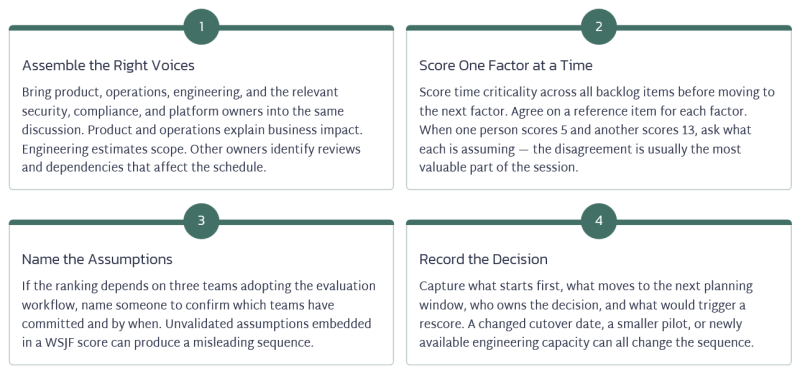
I’d bring product, operations, engineering, and the relevant security, compliance, and platform owners into the same discussion. Product and operations can explain the business impact. Engineering can estimate the smallest usable scope. The other owners can identify reviews, controls, or dependencies that affect the schedule.
Start with the items competing for the same capacity. Score one factor across the backlog at a time and agree on a reference item for each factor. When one person sees a 5 and another sees a 13, ask what each is assuming. If the ranking depends on three teams adopting the evaluation workflow, name someone to confirm which teams have committed to using it and by when.
Capture the decision in the program plan. Record what starts first, what moves to the next planning window, who owns the decision, and what would cause you to revisit it. A changed cutover date, a smaller pilot, or newly available engineering capacity can all change the sequence.
Facilitating a Productive Scoring Session
Questions leadership should ask
A Practical Exercise for Your Next Portfolio Review
At your next portfolio review, pick two items competing for the same team. Ask each sponsor to explain what happens if their item waits until the next planning cycle. If the answer changes the order, record the reason alongside the decision so the team knows when to revisit it.

#WSJF #CostOfDelay #AgilePrioritization #PortfolioManagement #ProgramManagement #AIProgramManagement #ProductManagement #ManagingProjectsTheAgileWay

About the Author
Kimberly Wiethoff, MBA, PMP, PMI-ACP is an AI Transformation Program Leader specializing in enterprise digital transformation, AI-enabled delivery, PMO leadership, AI governance, Agile program execution, cloud transformation, and complex portfolio delivery.
Through Managing Projects the Agile Way, she shares practical strategies for modernizing project and program delivery, strengthening PMO leadership, and preparing organizations and leaders for the future of AI-enabled program management.
Download Document, PDF, or Presentation
Author: Kimberly Wiethoff, MBA, PMP, PMI-ACP
Comments
Add comment