In the dynamic landscape of project management, Agile methodologies have become synonymous with adaptability, collaboration, and delivering value to stakeholders. As organizations continue to evolve and innovate, new topics are emerging within the realm of Agile project management, offering fresh insights and strategies for achieving success in today's fast-paced business environment. Let's dive into some of these exciting new topics and explore how they are reshaping the way we approach Agile project management.
Agile at Scale: Managing Large-Scale Projects
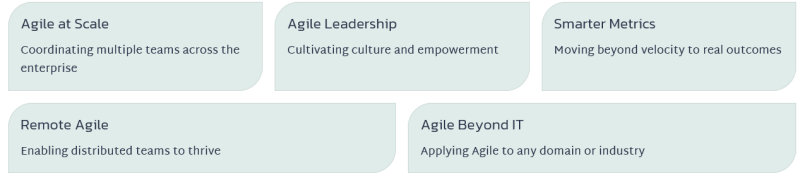
Agile methodologies have become synonymous with adaptability, collaboration, and delivering real value to stakeholders. But the discipline is far from static. As organizations grow more sophisticated in their Agile practice, new frontiers are emerging — reshaping how teams organize, measure, lead, and deliver across every type of project.
As Agile methodologies gain traction across organizations of all sizes, managing large-scale projects presents unique challenges and opportunities. Agile at Scale addresses the complexities of coordinating multiple teams, aligning priorities, and ensuring consistency while maintaining the flexibility and adaptability inherent in Agile principles. By leveraging frameworks such as SAFe (Scaled Agile Framework) or LeSS (Large-Scale Scrum), organizations can scale Agile practices effectively, foster collaboration, and accelerate delivery across the enterprise.
Coordinating Multiple Teams at Enterprise Scale
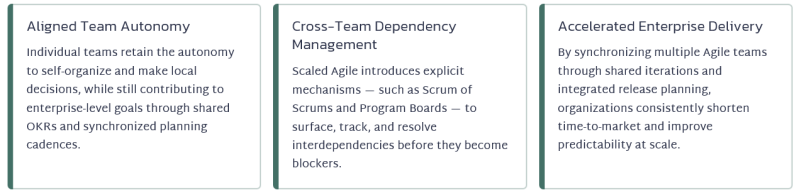
As Agile gains traction across organizations of all sizes, scaling beyond a single team introduces a new layer of complexity. Aligning priorities, maintaining strategic coherence, and preserving the speed and flexibility that make Agile valuable — all at once — is a significant challenge. The right frameworks make it achievable.
SAFe — Scaled Agile Framework
A comprehensive, prescriptive framework that organizes teams into Agile Release Trains (ARTs), aligning work to business value streams and Program Increments for enterprise-wide cadence.
LeSS — Large-Scale Scrum
A leaner approach that extends Scrum principles to multiple teams working on a single product, minimizing organizational overhead while maximizing team autonomy and direct customer focus.
Successful scaling is less about choosing the "right" framework and more about consistent application of Agile values: transparency, inspect-and-adapt, and relentless focus on customer value.
What Agile at Scale Looks Like in Practice
Agile Leadership and Culture: Fostering a Culture of Innovation
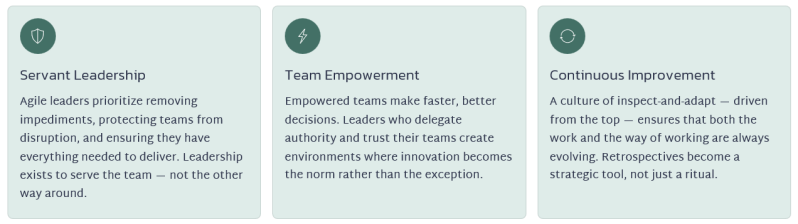
Agile project management is not just about processes and tools—it's about people and culture. Agile Leadership emphasizes servant leadership, empowerment, and fostering a culture of continuous improvement and innovation. Leaders play a crucial role in championing Agile values, removing impediments, and creating an environment where teams can thrive and innovate. By embracing Agile principles and practices at all levels of the organization, leaders can inspire collaboration, drive results, and unlock the full potential of Agile teams.
Agile Metrics and Performance Measurement: Beyond Velocity
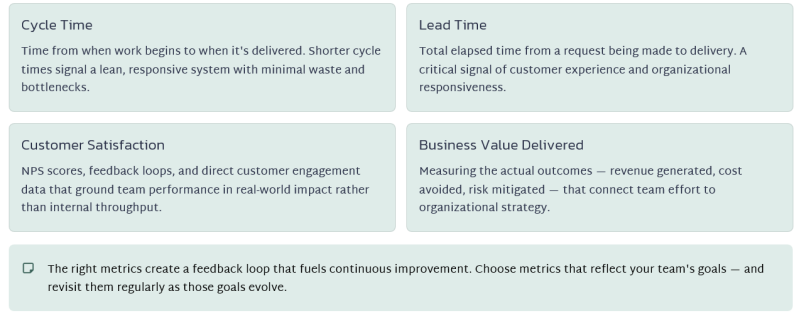
While velocity has long been a staple metric in Agile project management, organizations are increasingly recognizing the need for more holistic and meaningful measures of performance. Agile Metrics and Performance Measurement focus on outcomes rather than outputs, encompassing metrics such as cycle time, lead time, customer satisfaction, and business value delivered. By tracking these metrics, teams gain insights into their efficiency, effectiveness, and overall impact on organizational goals, enabling continuous improvement and informed decision-making.
Velocity has long been a default metric in Agile — but it measures output, not outcomes. Modern Agile teams are adopting richer, more meaningful metrics that reveal how efficiently value flows to customers and how well the team's work aligns with real business goals.
Measuring What Truly Drives Value
Agile Project Management in Remote Work Environments
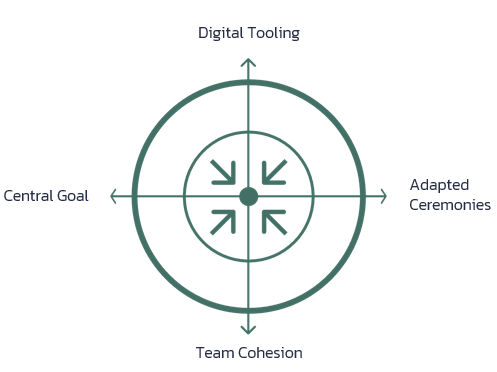
The shift to remote work has accelerated the adoption of Agile practices and tools to support distributed teams and remote collaboration. Agile Project Management in Remote Work Environments addresses the unique challenges of managing Agile projects in virtual settings, such as communication barriers, time zone differences, and maintaining team cohesion. By leveraging digital collaboration tools, asynchronous communication channels, and Agile ceremonies adapted for remote settings, organizations can foster productivity, engagement, and collaboration among remote teams.
The widespread shift to remote work has fundamentally changed the context in which Agile teams operate. While core Agile principles remain unchanged, their practical application requires deliberate adaptation to address the realities of virtual collaboration — from communication barriers to time zone coordination.
Organizations that invest in the right blend of tools, rituals, and intentional communication practices consistently see remote Agile teams match — and sometimes exceed — the productivity of co-located counterparts.
Agile for Non-Software Projects: Beyond IT
While Agile methodologies originated in software development, their principles and practices are increasingly being applied to non-software projects across industries. Agile for Non-Software Projects emphasizes flexibility, customer collaboration, and iterative delivery in diverse project contexts, from marketing campaigns and product launches to construction projects and organizational change initiatives. By tailoring Agile practices to suit the unique needs of non-software projects, organizations can increase adaptability, reduce risk, and deliver value more efficiently.
Agile originated in software development, but its underlying principles — iterative delivery, customer collaboration, rapid feedback, and adaptive planning — translate powerfully to virtually any domain. Forward-thinking organizations are applying Agile to drive results far beyond the engineering department.

Conclusion
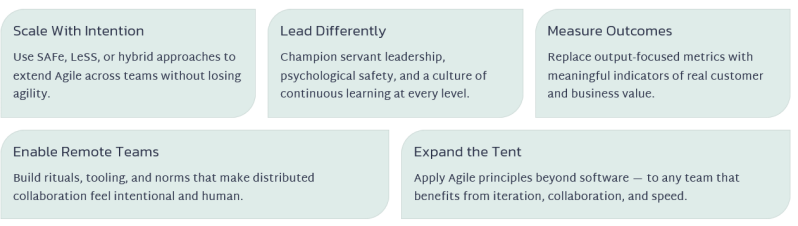
In conclusion, Agile project management continues to evolve and adapt to meet the changing needs and demands of today's business landscape. By embracing new topics such as Agile at Scale, Agile Leadership, Agile Metrics, remote work environments, and non-software projects, organizations can stay ahead of the curve, foster innovation, and drive success in an increasingly complex and dynamic world. As we continue to explore new frontiers in Agile project management, one thing is certain: the journey towards Agile excellence is an ongoing and rewarding endeavor.
The five frontiers explored here represent both the current edge of practice and a roadmap for what's ahead. Organizations that lean into these developments will be better equipped to innovate, adapt, and deliver lasting value.
#AgileInnovation #AgileProjectManagement #AgileLeadership #AgileAtScale #AgileMetrics #RemoteAgile #AgileTransformation #BusinessAgility #AgileMindset #AgileCulture #ContinuousImprovement #AgileTeams #AgilePractices #AgileFrameworks #AgileSuccess

About the Author
Kimberly Wiethoff, MBA, PMP, PMI-ACP is an AI Transformation Program Leader specializing in enterprise digital transformation, AI-enabled delivery, PMO leadership, AI governance, Agile program execution, cloud transformation, and complex portfolio delivery.
Through Managing Projects the Agile Way, she shares practical strategies for modernizing project and program delivery, strengthening PMO leadership, and preparing organizations and leaders for the future of AI-enabled program management.
Download Document, PDF, or Presentation
Author: Kimberly Wiethoff, MBA, PMP, PMI-ACP
Comments
Add comment