Great Scrum Masters aren't simply trained—they're mentored. While certifications provide a foundation, experience, coaching, and servant leadership transform Scrum Masters into trusted leaders who empower teams, drive continuous improvement, and guide organizational change. Investing in the next generation of Scrum Masters strengthens Agile maturity, builds resilient teams, and prepares organizations for the future of work—especially as AI becomes an integral part of Agile delivery.
As organizations continue to embrace Agile ways of working, the role of the Scrum Master has evolved significantly. Today's Scrum Masters are expected to do far more than facilitate daily stand-ups or schedule sprint ceremonies. They serve as servant leaders, coaches, facilitators, problem solvers, and change agents who help teams continuously improve while aligning delivery with business objectives.
Developing exceptional Scrum Masters doesn't happen by accident. It requires intentional mentoring, hands-on coaching, and opportunities to grow through experience. Agile Coaches play a vital role in shaping the next generation of Scrum Masters by helping them build not only technical knowledge but also the leadership skills needed to guide high-performing teams.
The organizations that invest in developing Scrum Masters today are building the Agile leaders who will drive tomorrow's digital transformation initiatives.
The Evolution of the Scrum Master Role
Early Agile implementations often viewed Scrum Masters primarily as meeting facilitators responsible for ensuring the Scrum framework was followed correctly.
Today, successful Scrum Masters have a much broader impact.
They help teams:
- Remove organizational impediments
- Foster collaboration
- Build trust and psychological safety
- Improve delivery predictability
- Coach Product Owners and stakeholders
- Facilitate difficult conversations
- Promote continuous improvement
- Drive organizational change
This expanded role requires a unique combination of technical understanding, emotional intelligence, communication skills, and servant leadership.
Mentoring helps Scrum Masters develop these capabilities more quickly and effectively.


Teaching the "Why" Behind Agile
One of the biggest challenges new Scrum Masters face is focusing too much on Agile practices and not enough on Agile principles.
It's easy to teach someone how to facilitate a sprint planning session.
It's much harder to teach them why Agile values transparency, customer collaboration, and iterative delivery.
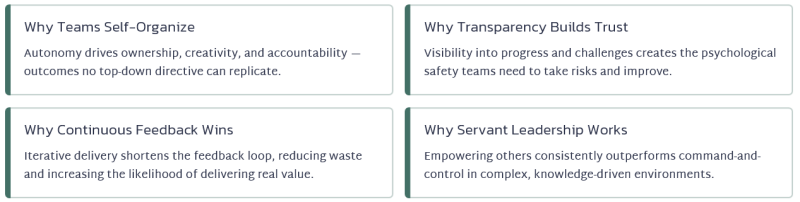
Effective mentoring helps Scrum Masters understand:
- Why teams self-organize
- Why transparency builds trust
- Why continuous feedback improves outcomes
- Why servant leadership outperforms command-and-control management
When Scrum Masters understand the purpose behind Agile practices, they become far more effective at adapting those practices to meet the needs of their teams.
Developing Leadership Through Coaching
Mentoring is about more than transferring knowledge—it is about developing leaders.
Great Scrum Masters learn how to:
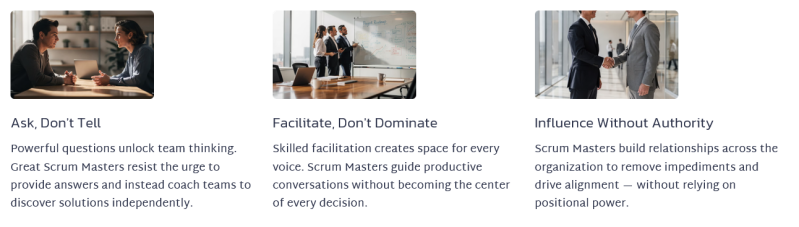
- Ask powerful questions instead of providing answers
- Facilitate productive discussions
- Resolve conflict constructively
- Influence without authority
- Build relationships across the organization
- Empower teams to solve their own problems
These coaching skills create lasting organizational impact because they help teams become increasingly self-sufficient.
Rather than becoming the center of every decision, great Scrum Masters help teams build the confidence to make decisions independently.
Learning to Navigate Organizational Challenges
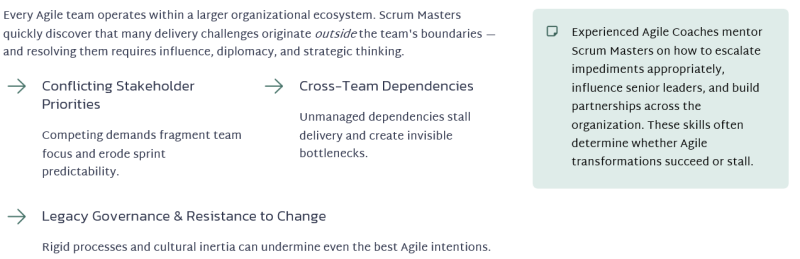
Every Agile team operates within a larger organizational environment.
Scrum Masters quickly discover that many delivery challenges stem from issues outside the team's control.
Common challenges include:
- Conflicting stakeholder priorities
- Cross-team dependencies
- Resource limitations
- Legacy governance processes
- Organizational resistance to change
Experienced Agile Coaches mentor Scrum Masters on how to influence leaders, escalate impediments appropriately, and build partnerships across the organization.
These skills often determine whether Agile transformations succeed or stall.
Measuring Success Beyond Velocity
Many new Scrum Masters focus heavily on delivery metrics such as velocity and sprint completion.
While these metrics provide useful information, they tell only part of the story.
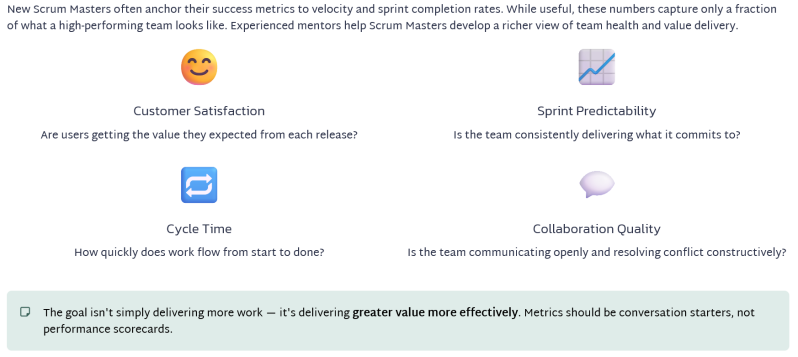
Experienced mentors encourage Scrum Masters to evaluate broader indicators of team health, including:
- Customer satisfaction
- Team engagement
- Sprint predictability
- Defect trends
- Cycle time
- Collaboration quality
- Stakeholder confidence
The goal isn't simply delivering more work. The goal is delivering greater value more effectively.
Successful Scrum Masters learn to use metrics as conversation starters rather than performance scorecards.
Mentoring Through Real-World Experience
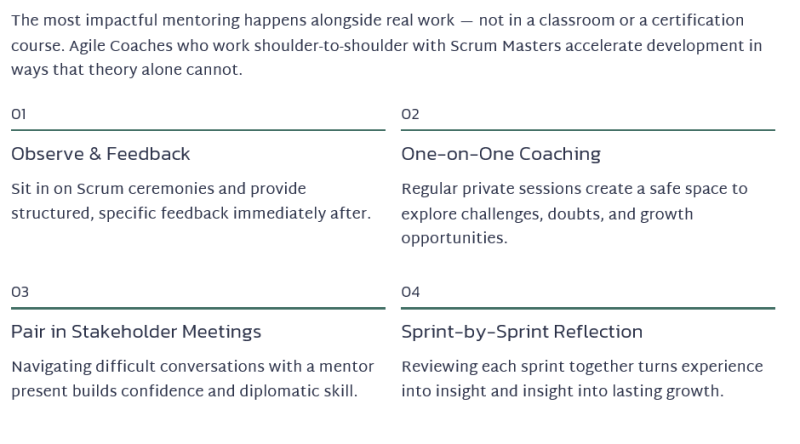
The best mentoring happens alongside real work.
Agile Coaches can accelerate development by:
- Observing Scrum ceremonies and providing feedback
- Conducting one-on-one coaching sessions
- Reviewing difficult situations together
- Pairing during stakeholder meetings
- Discussing leadership challenges after each sprint
- Encouraging reflective learning
These conversations help Scrum Masters develop confidence while learning how to handle increasingly complex situations.
Experience, combined with thoughtful coaching, creates lasting growth.
Leveraging AI to Support Scrum Masters
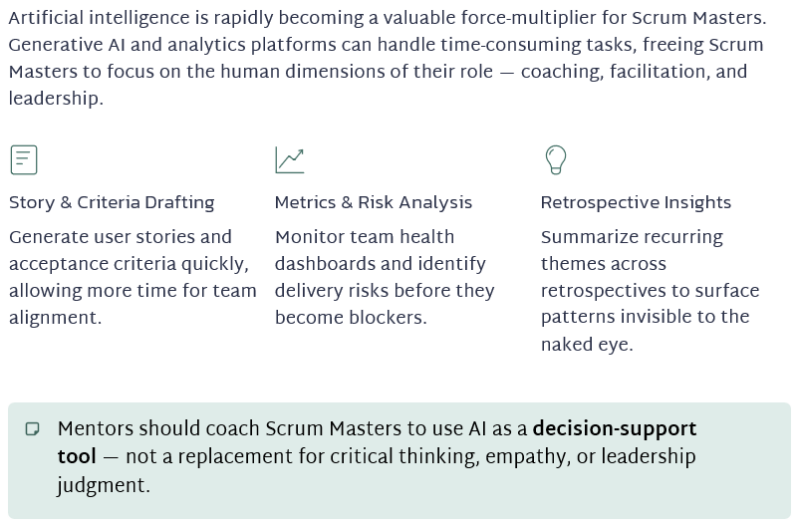
Artificial intelligence is becoming an increasingly valuable tool for Scrum Masters.
Generative AI and analytics platforms can help:
- Draft user stories
- Generate acceptance criteria
- Summarize sprint reviews
- Analyze retrospective themes
- Identify delivery risks
- Monitor team health
- Prepare stakeholder communications
- Generate Agile metrics dashboards
Agile Coaches should mentor Scrum Masters on how to use AI responsibly—as a decision-support tool rather than a replacement for leadership and critical thinking.
The future Scrum Master will combine strong interpersonal skills with AI-powered insights to make better decisions and coach teams more effectively.
Creating a Community of Practice
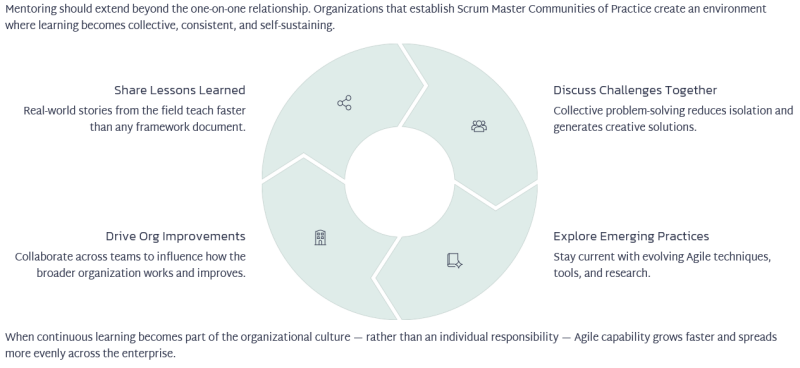
Mentoring should extend beyond one-on-one coaching.
Organizations benefit from establishing Scrum Master Communities of Practice where practitioners can:
- Share lessons learned
- Discuss challenges
- Exchange facilitation techniques
- Explore emerging Agile practices
- Learn from experienced coaches
- Collaborate on organizational improvements
These communities accelerate learning while creating consistency across Agile teams.
Continuous learning becomes part of the organizational culture rather than an individual responsibility.
The Qualities of an Exceptional Scrum Master
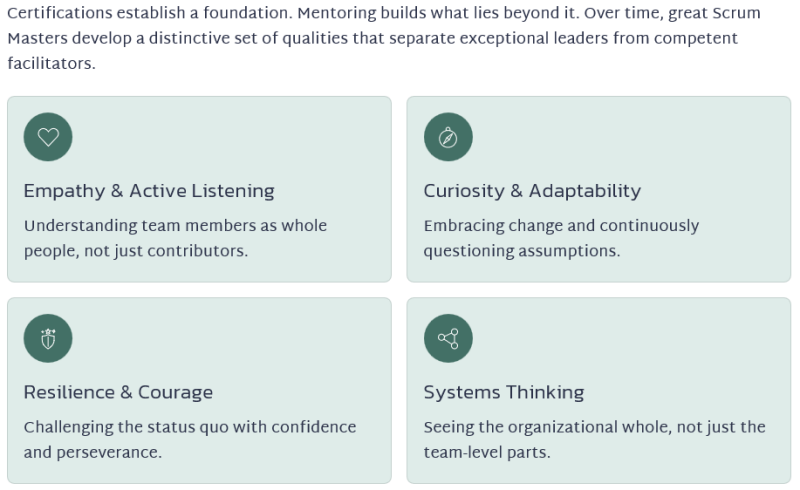
Over time, mentoring helps Scrum Masters develop characteristics that distinguish exceptional leaders from effective facilitators.
These include:
- Servant leadership
- Empathy
- Active listening
- Curiosity
- Adaptability
- Resilience
- Systems thinking
- Continuous learning
- Courage to challenge the status quo
- Commitment to team success
These qualities cannot be taught through certification courses alone. They are developed through coaching, experience, reflection, and ongoing mentorship.
Final Thoughts
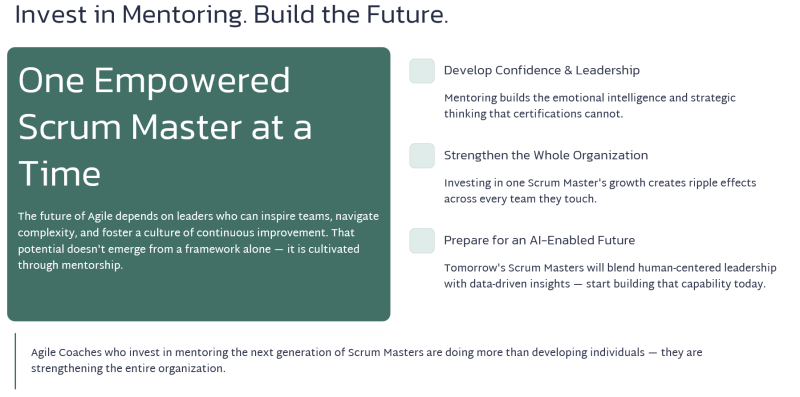
The future of Agile depends on developing leaders who can inspire teams, navigate complexity, and foster a culture of continuous improvement.
Scrum Masters are uniquely positioned to influence how organizations collaborate, innovate, and deliver value. But realizing that potential requires more than mastering Agile frameworks. It requires mentorship that builds confidence, leadership, emotional intelligence, and strategic thinking.
Agile Coaches who invest in mentoring the next generation of Scrum Masters are doing more than developing individuals—they are strengthening the entire organization.
As Agile continues to evolve alongside emerging technologies like artificial intelligence, tomorrow's Scrum Masters will need to blend human-centered leadership with data-driven insights. Organizations that prioritize mentoring today will be better prepared to meet the challenges of tomorrow, one empowered Scrum Master at a time.
#ScrumMaster #AgileCoaching #AgileLeadership #ServantLeadership #AgileTransformation #LeadershipDevelopment #ContinuousImprovement #EnterpriseAgility #Mentoring #ProfessionalDevelopment #Scrum #ProductManagement #TeamPerformance #AgileTeams #DigitalTransformation #ArtificialIntelligence #GenerativeAI #FutureOfWork #ProjectManagement #Leadership

About the Author
Kimberly Wiethoff, MBA, PMP, PMI-ACP is an AI Transformation Program Leader specializing in enterprise digital transformation, AI-enabled delivery, PMO leadership, AI governance, Agile program execution, cloud transformation, and complex portfolio delivery.
Through Managing Projects the Agile Way, she shares practical strategies for modernizing project and program delivery, strengthening PMO leadership, and preparing organizations and leaders for the future of AI-enabled program management.
Download Document, PDF, or Presentation
Author: Kimberly Wiethoff, MBA, PMP, PMI-ACP
Comments
Add comment