Not every AI initiative needs the same level of governance. An internal tool that summarizes meeting notes does not create the same exposure as an agent that authorizes payments, changes equipment settings, evaluates employees, or communicates directly with customers.
Yet many organizations govern both extremes in one of two ways. They either apply the same extensive review process to every AI use case, slowing low-risk experimentation, or allow each team to determine its own controls, leaving consequential applications without sufficient oversight. Neither approach scales.
Effective AI governance should be proportional to the consequences of the system’s decisions. Higher-risk applications require stronger evidence, tighter decision boundaries, more monitoring, and clearer human authority. Lower-risk applications should still meet minimum standards, but they should not be forced through controls designed for systems that can cause material harm.
A risk-tiering model gives the organization a consistent way to make that distinction. It also gives project teams an early answer to a practical question: What must be demonstrated before this capability can go live? Classification should happen when the use case is proposed, then be revisited as its authority and reach change.
Risk-Tiering Is More Than Use-Case Classification
It may be tempting to classify AI applications by function:
- Chatbot
- Forecasting model
- Recommendation engine
- Document generator
- Autonomous agent
- Computer-vision system
But the technology category does not determine the business risk. Two chatbots can have completely different consequences. One may answer general questions using public information. Another may provide customers with account-specific financial guidance.
Two predictive-maintenance models may use similar technology. One recommends an inspection that a technician can decline. The other automatically changes equipment settings in a safety-sensitive environment.
The risk depends on what the AI is allowed to do, what information it uses, who is affected, and how easily a harmful outcome can be stopped or reversed.
The Factors That Determine the Risk Tier
A practical model should evaluate several dimensions rather than relying on a single score.

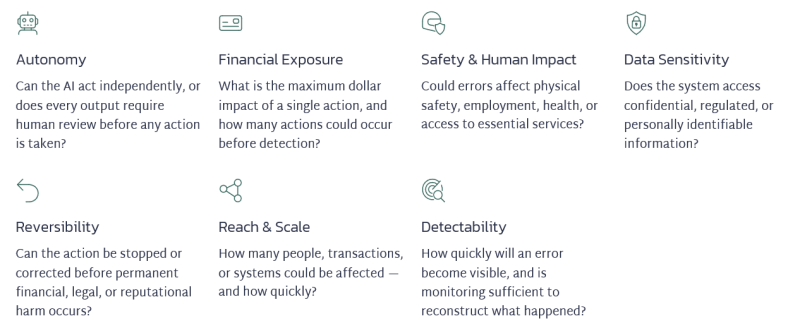
1. Autonomy
Autonomy measures how independently the AI can act. Ask:
- Does the AI only generate information?
- Does it recommend an action?
- Does a human review every recommendation?
- Can the AI execute an action within predefined limits?
- Can it coordinate other systems or agents?
- Can it initiate consequential actions without prior approval?
An advisory tool creates different exposure from an AI agent that can approve a transaction, change a schedule, contact a customer, or modify a business system. The greater the autonomy, the stronger the required controls should be.
2. Financial Exposure
Financial exposure includes both the amount of money involved and the speed at which losses could accumulate. Ask:
- Can the AI approve spending or payments?
- Can it create contractual commitments?
- Can it change prices, discounts, credits, or refunds?
- Can it affect revenue recognition or financial reporting?
- What is the maximum exposure from one action?
- How many actions could occur before someone detects a problem?
A $50 error that requires human approval is not equivalent to an autonomous process capable of executing thousands of transactions overnight.
Financial limits should be built into the system, not left only in policy documents.
3. Safety and Human Impact
Some AI decisions can affect physical safety, health, employment, access to services, or other significant human outcomes. Ask:
- Could an incorrect action create a safety hazard?
- Does the system affect working conditions?
- Could it influence hiring, performance, scheduling, or termination?
- Could it delay access to an important service?
- Are vulnerable individuals or groups affected?
- Could errors create discrimination or unfair treatment?
Safety and human impact should be treated as high-severity considerations even when the probability of failure appears low.
4. Data Sensitivity
Risk increases when an AI system accesses confidential, regulated, proprietary, or personally identifiable information. Ask:
- What data can the AI access?
- Is that access necessary for the intended task?
- Can sensitive data appear in prompts, outputs, logs, or vendor systems?
- Can the AI combine information across sources?
- Who can view the output?
- How long is the data retained?
- Could the model expose or infer restricted information?
Data sensitivity should influence access controls, approved platforms, testing requirements, logging, retention, and vendor due diligence.
5. Reversibility
Reversibility measures how easily the organization can correct or undo an AI-driven action. Ask:
- Can the action be stopped before execution?
- Can it be reversed after execution?
- How quickly can it be corrected?
- Will the affected person or customer know that an error occurred?
- Could the decision create permanent financial, legal, safety, or reputational consequences?
- Does reversal require another team, vendor, or customer?
A draft that can be edited before publication is highly reversible. A public communication, rejected application, equipment shutdown, or completed payment may be difficult or impossible to reverse fully.
Low reversibility should increase the risk tier.
6. Reach and Scale
An error affecting one internal user has a different consequence from the same error reaching thousands of employees or customers. Ask:
- How many people, transactions, assets, or sites could be affected?
- How quickly can the system operate?
- Can an incorrect output be distributed widely?
- Is the capability used across multiple business units or geographies?
- Could one failure propagate through connected systems?
Scale can turn a small individual error into a material enterprise event.
7. Detectability
Some AI errors are obvious. Others may continue unnoticed. Ask:
- How will the organization know that the AI is wrong?
- Is there an objective answer against which the output can be checked?
- How quickly will an error become visible?
- Are logs and monitoring sufficient to reconstruct what happened?
- Can employees and customers report a problem?
- Could the system produce plausible but incorrect output that is accepted as true?
Low detectability increases risk because exposure may accumulate before the organization intervenes.
A Four-Tier AI Risk Model
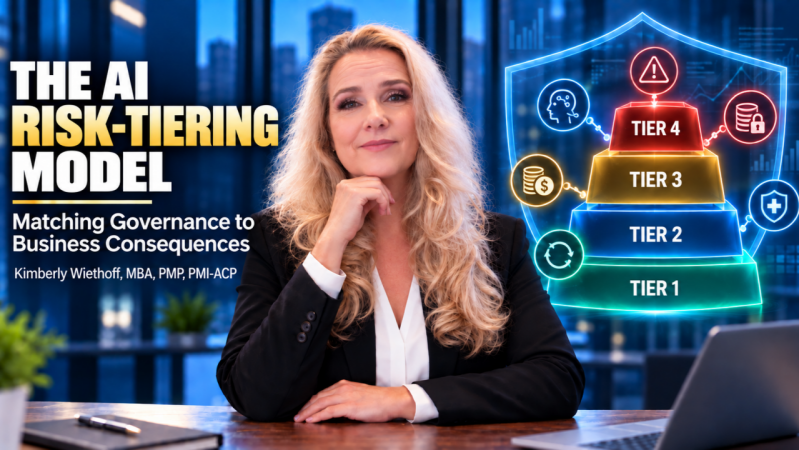
Organizations can translate these factors into four practical tiers. The seven risk dimensions translate into four tiers, each with a distinct control package, assessed when a use case is proposed and revisited as it evolves.
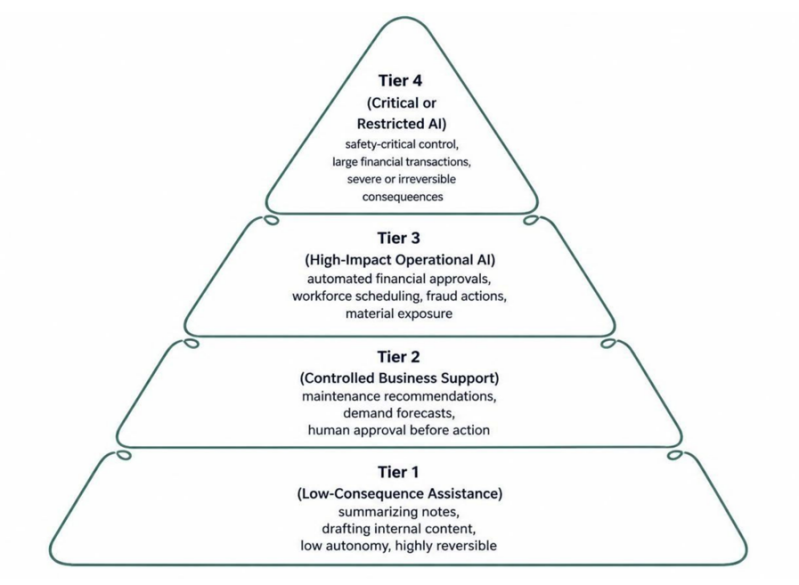
Tier 1: Low-Consequence Assistance
These capabilities support employees without making or executing consequential decisions.
| Examples might include: | Typical characteristics: | Appropriate controls may include: |
|---|---|---|
| Summarizing non-sensitive meeting notes | Low autonomy | Approved tools |
| Drafting internal communications | Limited or nonsensitive data | Basic acceptable-use requirements |
| Organizing public information | Low financial and safety exposure | Data-handling rules |
| Brainstorming content | Small number of affected users | Employee training |
| Reformatting documents | Easy human review | User responsibility for reviewing output |
| Supporting low-impact administrative work | Highly reversible output | Standard access and logging |
| Periodic inventory confirmation |
The process should be lightweight enough that employees are encouraged to use approved capabilities rather than turning to unapproved tools.
Tier 2: Controlled Business Support
These capabilities influence work or decisions but remain subject to meaningful human review.
| Examples might include: | Typical characteristics: | Appropriate controls may include: |
|---|---|---|
| Service-request categorization | Advisory or limited-action role | Documented use case and owner |
| Maintenance recommendations | Moderate operational or financial impact | Data and privacy assessment |
| Demand forecasts | Human approval before consequential action | Performance testing |
| Draft customer responses | Reversible decisions | Human-review requirements |
| Contract or document analysis | Manageable reach | Override and escalation paths |
| Scheduling recommendations | Defined business ownership | User training |
| Operational anomaly detection | Adoption and override monitoring | |
| Periodic performance evaluation | ||
| Standard incident reporting |
This tier often contains many enterprise AI use cases. The primary governance challenge is ensuring that human review is real, informed, and adequately staffed.
Tier 3: High-Impact Operational AI
These capabilities influence consequential decisions or take actions within defined boundaries.
| Examples might include: | Typical characteristics: | Appropriate controls may include: |
|---|---|---|
| Automated financial approvals within limits | Greater autonomy | Formal risk and impact assessment |
| Workforce scheduling that affects employee conditions | Material financial or operational exposure | Independent validation |
| Customer eligibility recommendations | Sensitive data | Documented decision rights |
| High-value procurement decisions | Significant customer or employee impact | Defined financial and operational limits |
| Automated equipment adjustments | Broader reach | Segregation of duties |
| Fraud or security actions | More difficult reversal | Strong access controls |
| AI agents that update business systems | Strong dependence on monitoring | Predeployment scenario and failure testing |
| Continuous monitoring | ||
| Human approval for defined thresholds | ||
| Automated stop conditions | ||
| Tested rollback capability | ||
| Detailed audit trails | ||
| Formal incident-response procedures | ||
| More frequent governance review |
A named executive or senior business owner should be accountable for accepting the residual risk.
Tier 4: Critical or Restricted AI
These capabilities can produce severe or irreversible consequences and may require exceptional controls—or may not be appropriate for autonomous use.
| Examples could involve: | Typical characteristics: | Appropriate controls may include: |
|---|---|---|
| Safety-critical control | High autonomy or authority | Executive and specialized risk approval |
| High-impact employment decisions | Severe human, financial, legal, or safety impact | Legal, compliance, security, privacy, and ethics review |
| Decisions affecting access to essential services | Low reversibility | Independent testing and assurance |
| Large or unrestricted financial transactions | Sensitive or regulated data | Strictly limited decision boundaries |
| Autonomous actions with legal consequences | Large-scale reach | Mandatory human authorization |
| Systems capable of affecting many people before intervention | Difficult-to-detect failure | Real-time monitoring |
| AI whose failure would create major regulatory or reputational exposure | Limited tolerance for error | Kill switches and automatic suspension |
| Red-team and adversarial testing | ||
| Business-continuity and fallback procedures | ||
| Formal audit evidence | ||
| Frequent recertification | ||
| Board or risk-committee visibility where appropriate | ||
| Prohibition of certain autonomous actions |
For some Tier 4 uses, the correct decision may be not to deploy the capability or to restrict it to an advisory role.
Do Not Let Averages Hide a Critical Risk
A simple scoring formula can help create consistency, but the total score should not be allowed to dilute severe exposure. For example, an AI application may score low on financial exposure, data sensitivity, and scale but still control safety-sensitive equipment. Averaging all factors could place it in a moderate tier even though one failure could cause serious harm.
Organizations should establish escalation rules such as:
- Any critical safety impact requires Tier 4 review.
- Use of highly sensitive data establishes minimum privacy and security requirements regardless of the total score.
- Low reversibility can raise the final tier.
- Autonomous execution above an approved financial threshold requires senior approval.
- A material change in reach or decision authority triggers reassessment.
The model should support judgment, not replace it. If a severe outcome is plausible, the team should document that exposure even when the estimated likelihood is low or uncertain. An override should record who made the decision, why, and which additional controls are required.
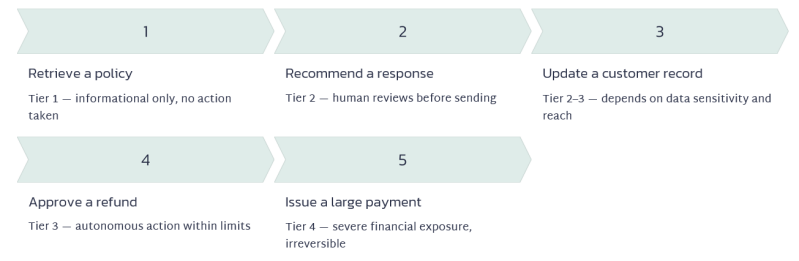
Classify the Decision, Not Just the Application
One AI system may perform tasks with different risk levels. An agent might:
- Retrieve a policy: Tier 1
- Recommend a response: Tier 2
- Update a customer record: Tier 2 or 3
- Approve a refund: Tier 3
- Issue a high-value payment: Tier 4
Classifying the entire application at one level may produce controls that are either too weak for the highest-risk action or unnecessarily restrictive for every low-risk task.
A more precise approach classifies the decisions and actions the AI is authorized to perform.
This also supports progressive autonomy. A capability can begin as an advisor, build evidence, and later receive limited authority within tested boundaries.
A Worked Example: An AI Refund Agent
Consider a customer-service assistant that retrieves a return policy and drafts a response. A representative checks the answer before sending it. That may fit Tier 2: it influences a customer interaction, but a person retains the decision and can correct the draft.
Now suppose the same assistant is connected to the payment system and may issue refunds up to $100 without review. The technology may be unchanged, but its decision authority is different. The organization must assess transaction volume, aggregate daily exposure, mistaken or fraudulent refunds, detection time, and the ability to recover funds. The refund action may warrant Tier 3 controls, including per-transaction and aggregate limits, exception alerts, audit records, and an automatic stop when patterns depart from expectations.
If the refund ceiling is raised substantially or the agent can modify customer records and authorize payments across several brands, the team should reassess it before enabling that authority. A high-impact action may require Tier 4 review. The point is to assign controls to the action and its consequences, not to the label “customer-service chatbot.”
Connect Each Tier to a Control Package
Risk classification has limited value if every initiative still negotiates its controls from the beginning. Each tier should map to a predefined control package covering areas such as:
- Required approvals
- Testing and validation
- Data protection
- Human oversight
- Decision limits
- Monitoring frequency
- Audit evidence
- Incident response
- Vendor review
- Change control
- Recertification
- Benefits and performance reporting
Teams should know what evidence is required to enter production before development is complete.
Standard control packages also reduce inconsistency among reviewers and allow governance teams to focus their attention on higher-risk capabilities.
| Control Area | Tier 1 | Tier 2 | Tier 3 | Tier 4 |
|---|---|---|---|---|
| Approvals | Basic AUP | Business owner | Formal + executive | Board/risk committee |
| Testing | Standard | Performance testing | Failure + scenario | Red-team + adversarial |
| Human Oversight | User review | Approval required | Defined thresholds | Mandatory authorization |
| Monitoring | Standard logging | Override tracking | Continuous + alerts | Real-time + kill switch |
| Recertification | Annual inventory | Periodic review | Frequent governance | Formal + frequent |
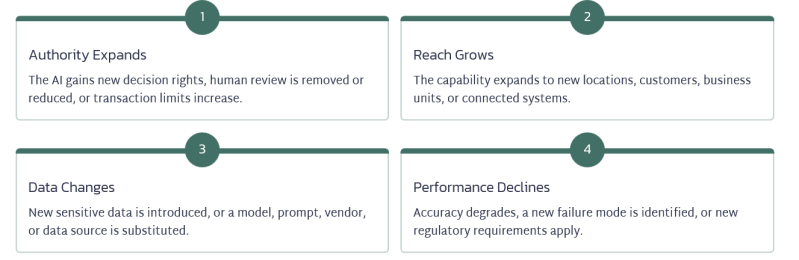
Reassess Risk When the System Changes
An AI risk tier should not be permanent. The classification may change when:
- The AI gains new decision authority.
- Human review is removed or reduced.
- The capability expands to new locations or customers.
- New sensitive data is introduced.
- Transaction limits increase.
- A model, prompt, vendor, or data source changes.
- The system becomes connected to additional applications.
- Performance declines.
- New regulatory or contractual requirements apply.
- The organization identifies a new failure mode.
A Tier 2 assistant can become a Tier 3 operational system without anyone formally recognizing the change.
Risk-tier reassessment should therefore be part of AI change control.
Putting the Model Into Practice
Start with a short intake that records the business purpose, owner, affected people, data sources, permitted actions, financial limits, human checkpoints, and expected scale. A cross-functional group can then assign an initial tier and identify any severe-impact override. The intake should be brief for Tier 1 and more detailed as exposure rises.
Next, link each tier to a published approval path and evidence checklist. A team should know before building whether it needs a privacy assessment, failure testing, independent validation, a rollback plan, or executive risk acceptance. Record the specific decision rights separately: permission to read a record is not permission to change it, and permission to recommend a payment is not permission to release one.
Finally, establish an operating review after launch. The business owner should see performance, overrides, incidents, near misses, usage volume, and any expansion of authority. Review dates and change triggers should be recorded alongside the original classification. This makes tiering a continuing management decision rather than a one-time form.
What Leaders Should See at the Portfolio Level
Executives do not need to review every technical detail, but they should understand the distribution of risk across the AI portfolio. An executive dashboard should show:
- Number of initiatives in each tier
- Investment by tier
- Business value forecast by tier
- High-tier initiatives approaching deployment
- Control gaps
- Risks awaiting acceptance
- Overdue reassessments
- Incidents and near misses
- Concentration in shared vendors or models
- Initiatives whose autonomy or reach has increased
- Decisions requiring executive attention
This allows leaders to determine whether governance capacity and risk exposure are aligned with the organization’s AI ambitions.
Proportionate Governance Enables Responsible Speed
The purpose of risk-tiering is to direct oversight where the consequences justify it.
Low consequence uses should have a clear, efficient path to approval. Higher-impact initiatives should receive the testing, evidence, authority limits, and monitoring their potential consequences demand. A useful model answers four questions:
- What can the AI do?
- What could happen if it is wrong?
- How quickly could the organization detect and stop the harm?
- What evidence and controls are required before granting that authority?
When governance is matched to business consequences, organizations can move quickly where the risk is low and deliberately where the consequences are high.
#AIGovernance #AIRiskManagement #ResponsibleAI #AITransformation #AgenticAI #AIPortfolioManagement #AIOperatingModel #EnterpriseAI #DigitalTransformation #ProjectManagement
About the Author

Kimberly Wiethoff, MBA, PMP, PMI-ACP is an AI Transformation Program Leader specializing in enterprise digital transformation, AI-enabled delivery, PMO leadership, AI governance, Agile program execution, cloud transformation, and complex portfolio delivery.
Through Managing Projects the Agile Way, she shares practical strategies for modernizing project and program delivery, strengthening PMO leadership, and preparing organizations and leaders for the future of AI-enabled program management.
Download Document, PDF, or Presentation
Author: Kimberly Wiethoff, MBA, PMP, PMI-ACP