Network segmentation divides an enterprise network into separate areas and controls communication between them. It helps organizations restrict unnecessary access, protect sensitive systems, and limit how far an attacker can move after compromising a device or account.
For the program manager, segmentation requires coordinating security objectives with application behavior, infrastructure dependencies, and business operations. A successful rollout strengthens protection while preserving the communication that legitimate work requires.
Why Segmentation Matters to Your Program
An enterprise network connects the systems people depend on to do their jobs — employee authentication, customer payments, and everything in between. Those same connections can also create pathways an attacker could exploit after compromising a single device or account.
Network segmentation helps organizations control those pathways by separating environments and restricting communication between them. For a program manager, delivering segmentation means coordinating security requirements, application dependencies, engineering changes, and business validation.
Your responsibility is to help the organization establish appropriate boundaries while maintaining the services it needs to operate.
Your Core Mission
- Establish appropriate security boundaries
- Maintain operational continuity
- Coordinate across security, engineering, and business teams
- Translate technical controls into trackable outcomes

Start with the business risk
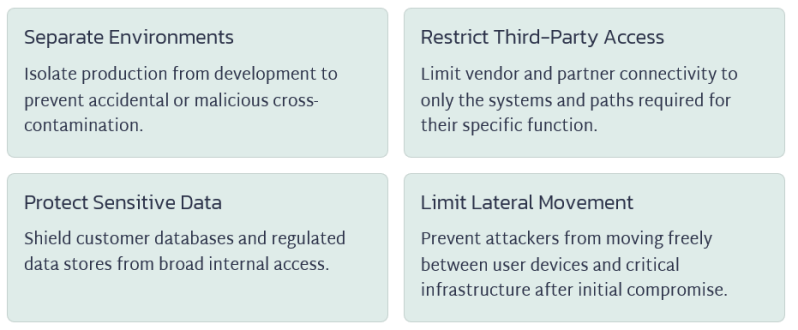
Before building the implementation schedule, establish why the organization needs segmentation. The objective might be to isolate sensitive customer data, separate production from development, restrict vendor access, or reduce the opportunity for ransomware to spread.
A useful objective describes the protection required: “Restrict access to the claims database so that only approved application services and authorized administrative pathways can reach it.”
That statement gives architects a design target and gives the program team something to validate. “Create five security zones” describes an activity. You still need to establish what those zones will protect and how their effectiveness will be demonstrated.
Ask the Right Questions First
Only approved application services and authorized administrative pathways should be able to connect to the customer database. That statement identifies a protection requirement the technical team can design and test. and gives the program manager a basis for tracking outcomes. Bring this discipline to every objective.
- Which business services or data are we protecting?
- Which access paths create unacceptable exposure?
- What communication must remain available?
- What evidence will demonstrate that the control works?
- Who can accept any remaining risk?
Direct these questions to the sponsor and security architect. Their answers should shape the charter, roadmap, and implementation priorities.
Understand the essential terminology
You don't need to configure firewall rules to lead this program. You do need enough technical fluency to recognize dependencies and ask productive questions in architecture reviews and delivery standups.
| Term | What it means | Why it matters to the program manager |
|---|---|---|
| Security zone | A group of resources with defined security requirements | Establishes boundaries, ownership, and implementation scope |
| East-west traffic | Communication between systems within an environment | Reveals application dependencies and potential lateral movement paths |
| North-south traffic | Communication entering or leaving an environment | Identifies external connections and ingress/egress requirements |
| Firewall policy | Rules that permit or deny communication | Requires review, testing, approval, and ongoing maintenance |
| Port and protocol | Technical details describing how services communicate | Help engineers specify the communication a rule permits |
| Lateral movement | An attacker moving from a compromised resource toward other resources | Explains a major risk segmentation is intended to reduce |
| Application dependency | A service or system an application needs to operate | Can become a source of disruption if overlooked |
| VLAN | A logical separation within a network | Can support network organization, but does not alone prove that access is appropriately restricted |
You do not need to configure these components yourself. You do need enough understanding to recognize incomplete requirements and ask useful questions.
A VLAN can support separation, but it doesn't guarantee restricted access. Always ask architects where controls are enforced and how they will be validated.
Follow the complete business workflow
Consider a claims-processing application.
Users access a web interface. The web server communicates with an application server, which retrieves and updates database records. The application also sends information to an external payment service.
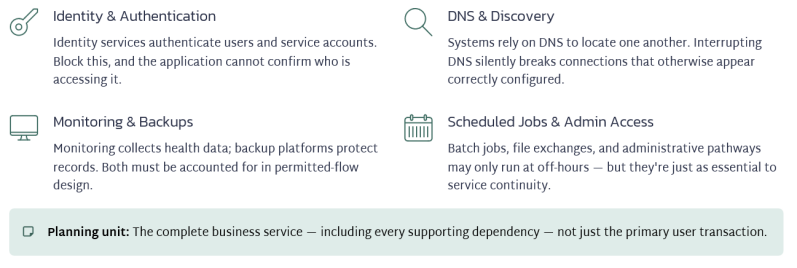
Those are the obvious connections. The application may additionally require:
- Identity services to authenticate users or service accounts.
- DNS to locate other systems.
- Time synchronization to support authentication and reliable logs.
- Monitoring and logging services.
- Backup and recovery services.
- Scheduled integrations or batch-processing platforms.
- Approved administrative access.
Blocking any critical dependency can affect the service even when the main application connections remain available.
That is why segmentation planning needs both technical traffic discovery and validation by application and infrastructure owners. Mapping workload interconnections, communication flows, ports, and protocols is also reflected in NSA implementation guidance. media.defense.gov
Turn Traffic Data into Validated Requirements
Observed communication is a discovery input, not a final answer. A connection might support a critical workflow, an obsolete integration, a temporary workaround, or unwanted activity. Automatically preserving every observed connection carries unnecessary access into the new design.
Bring application owners and technical specialists together to validate the business purpose of every required flow before it enters the approved policy.
Assign owners to every unresolved dependency and include their resolution dates in the integrated plan. Unowned items become blockers.
| Information | Decision It Supports |
|---|---|
| Source and destination | Which resources need to communicate? |
| Port, protocol, and direction | What specific communication is required? |
| Business purpose | Why should this connection remain available? |
| Frequency or trigger | When does the dependency become active? |
| Accountable owner | Who can validate the requirement? |
| Exception status | What uncertainty or exposure remains? |
The engineers determine the technical rule. The program manager makes sure ownership, evidence, and approval are traceable.
Separate observed traffic from approved requirements
A traffic log indicates that communication occurred. It does not establish that the communication is necessary, secure, or appropriate. An old integration might still be connecting to a server nobody uses. A temporary troubleshooting rule might have become permanent. A compromised system could also generate traffic.
Ask owners to explain the business purpose of significant connections before treating them as approved requirements. A practical flow record might include:
| Field | Example |
|---|---|
| Source | Claims application server |
| Destination | Claims database |
| Required communication | Database connection using an approved protocol and port |
| Business purpose | Retrieve and update claim records |
| Accountable owner | Claims application owner |
| Validation evidence | Transaction testing and reviewed connection logs |
| Review status | Approved, pending validation, or exception required |
Plan for the Business Calendar
A short observation window may capture daily transactions while missing month-end reconciliation, quarterly reporting, disaster recovery tests, or scheduled vendor maintenance. Each of these involves distinct communication flows that may not appear in standard traffic data.
Ask application owners: What happens outside ordinary daily operations?
For example, a finance application may pass standard transaction testing, then fail when its month-end batch job connects to a reporting service omitted from the approved policy.
Plan implementation around readiness
A practical delivery sequence is:
- Define scope and outcomes. Identify the business services, environments, and risks being addressed.
- Discover assets and dependencies. Confirm inventory, ownership, communication patterns, and visibility gaps.
- Develop the design and policies. Have technical authorities review proposed boundaries and permitted flows.
- Validate through a pilot. Select a manageable scope that exercises meaningful dependencies.
- Enforce in controlled waves. Apply agreed readiness criteria and monitor business and technical results.
- Transfer ownership to operations. Establish support, policy maintenance, exception handling, and review responsibilities.
Some activities can overlap, but each enforcement wave needs sufficient evidence to proceed.
Build Readiness into Every Rollout Wave
Organize implementation waves around both risk and readiness. An application's business importance does not make it a suitable first pilot — complexity, recovery options, and dependency confidence matter equally.
What "Ready" Actually Looks Like
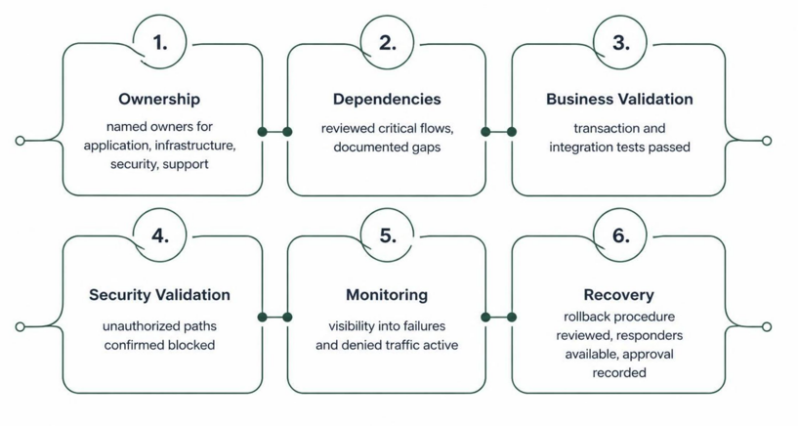
Make the go/no-go decision explicit
Before a production change, bring the responsible teams together around these questions:
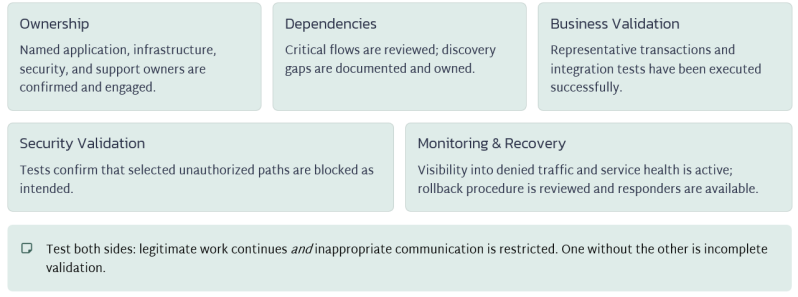
| Readiness question | Evidence to request |
|---|---|
| Do we understand the critical dependencies? | Reviewed flow records and documented discovery gaps |
| Will legitimate business activity work? | Representative transaction and integration test results |
| Will the restriction provide the intended protection? | Tests demonstrating that selected unauthorized paths are blocked |
| Can we recognize a problem quickly? | Monitoring, alerting, and named responders |
| Can we recover within an acceptable period? | A reviewed rollback procedure, estimated recovery time, and available staff |
| Who authorizes proceeding? | Named decision authority and recorded approval |
A proposed decision rule is to defer enforcement when a critical dependency remains unvalidated and there is no approved way to manage the uncertainty.
That does not necessarily mean delaying the entire program. Other applications may be ready to proceed independently.
Example: the month-end processing gap
Suppose a finance application has been observed for two weeks. Daily transactions work during testing, but the observation period did not include month-end processing.
The team discovers that month-end reconciliation connects to another system that is absent from the proposed rules.
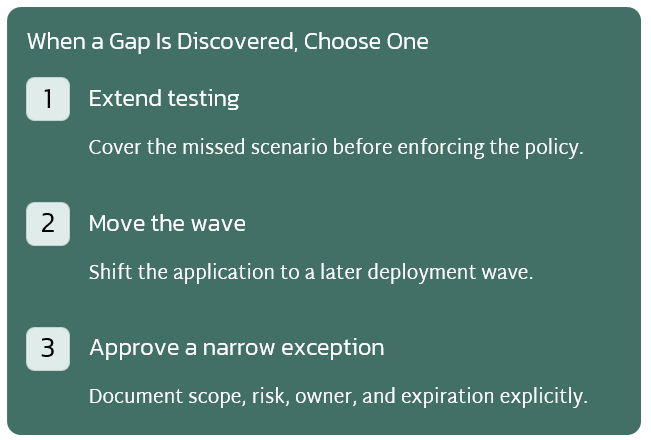
You now have several options:
- Run representative reconciliation tests before the change.
- Move the application to a later wave.
- Seek approval for a narrowly defined temporary exception, with an owner and expiration date.
Your recommendation should explain the security exposure, potential business disruption, schedule impact, and evidence supporting each option.
Measure protection and business continuity
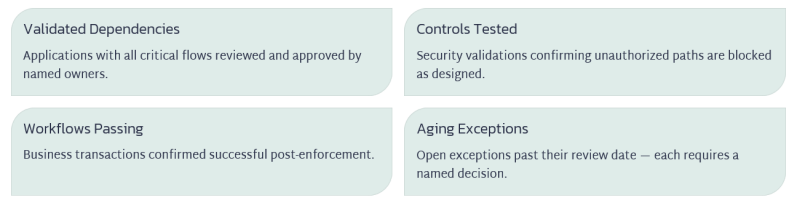
Track progress using more than completed firewall changes. Useful measures include:
- Applications with validated dependencies and named owners.
- In-scope policies enforced and tested.
- Required business workflows passing validation.
- Unauthorized paths correctly blocked during testing.
- Incidents and rollbacks associated with changes.
- Open exceptions, their age, and remediation status.
Report Outcomes Leaders Can Assess
Completed rule changes show activity. Leadership needs evidence of protection and service stability — not just task completion. Present measures alongside the decisions they require.
The program manager’s contribution
Your contribution is to connect the security design with the people, dependencies, evidence, and decisions required for safe delivery.
A strong question to carry into every review is:
“What must remain connected for the business to operate, what should be restricted, and how will we prove both outcomes?”
This question is the program manager's compass throughout delivery. It bridges the technical work of firewall policy with the business accountability of service continuity and security assurance. Keep it at the center of every stakeholder review, wave gate, and status report.
#NetworkSegmentation #Cybersecurity #CybersecurityProgramManagement #NetworkSecurity #ProgramManagement #RiskManagement #EnterpriseSecurity #ITLeadership #ManagingProjectsTheAgileWay

About the Author
Kimberly Wiethoff, MBA, PMP, PMI-ACP is an AI Transformation Program Leader specializing in enterprise digital transformation, AI-enabled delivery, PMO leadership, AI governance, Agile program execution, cloud transformation, and complex portfolio delivery.
Through Managing Projects the Agile Way, she shares practical strategies for modernizing project and program delivery, strengthening PMO leadership, and preparing organizations and leaders for the future of AI-enabled program management.
Download Document, PDF, or Presentation
Author: Kimberly Wiethoff, MBA, PMP, PMI-ACP
Comments
Add comment