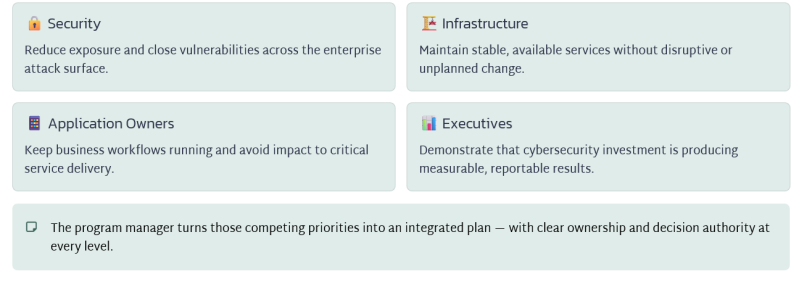
An enterprise cybersecurity program brings together teams with different priorities. Security wants to reduce exposure. Infrastructure needs stable services. Application owners need business workflows to remain available. Executives need evidence that the investment is producing results.
The program manager turns those priorities into an executable plan with clear ownership and decision authority.
NIST’s Cybersecurity Framework 2.0 emphasizes establishing cybersecurity responsibilities, authorities, policies, and oversight. That makes governance part of the security effort itself. NIST

Competing Priorities, One Coherent Plan
Every stakeholder in an enterprise cybersecurity program brings a legitimate but distinct agenda. The program manager's job is to hold all of them in balance and translate competing priorities into an executable plan with clear ownership.
Governance Is Part of the Security Effort
NIST's Cybersecurity Framework 2.0 explicitly emphasizes establishing cybersecurity responsibilities, authorities, policies, and oversight. Governance is not an administrative formality — it is a core security discipline
What CSF 2.0 Requires
- Defined cybersecurity responsibilities at every level
- Clear authority structures for security decisions
- Formal policies that reflect organizational risk tolerance
- Ongoing oversight mechanisms with accountability
What This Means for the PM
The program manager does not simply track task completion. Under CSF 2.0 governance expectations, the PM is responsible for ensuring the right roles hold the right authorities — and that those authorities are exercised at the right moments in the delivery lifecycle.
Establish ownership before committing to delivery
Before the program makes commitments on scope, schedule, or cost, every accountability must be assigned to a named role. The structure below is a practical starting point — exact titles vary by organization, but the accountabilities are consistent.
A program manager can coordinate a risk decision but cannot substitute for the authority delegated to the authorized risk owner.
The exact structure varies by organization, but this is a useful starting point:
| Role | Typical accountability |
|---|---|
| Executive sponsor | Business objectives, funding, and organizational support |
| Security architect | Security design and alignment with architecture standards |
| Engineering leads | Implementation, technical testing, and engineering estimates |
| Application or service owner | Business requirements and service validation |
| Authorized risk owner | Acceptance of residual risk within delegated authority |
| Change authority | Production change authorization |
| Program manager | Integrated delivery, dependencies, governance, financials, and escalation |
Own the connections between workstreams
Individual teams will report progress against their own plans. But integrated readiness is a different question, and it belongs to the program manager.
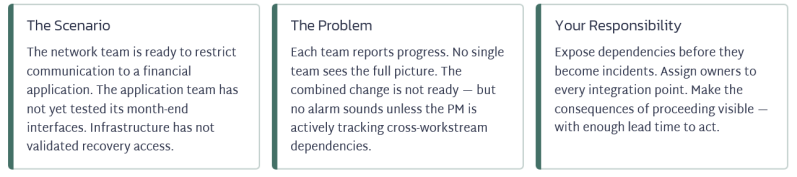
Suppose the network team is ready to restrict communication to a financial application. The application team has not tested its month-end interfaces, and infrastructure has not validated recovery access.
Each team may report progress, but the combined change is not ready.
Your responsibility is to expose those dependencies, assign owners, and make the consequences visible before the change window.
Make decisions concrete
When escalating an issue, provide:
- The decision required and its deadline.
- Available options.
- Security, operational, cost, and schedule implications.
- Your recommendation.
- The person authorized to decide.
Escalation is only effective when decision-makers receive the right information in the right format. Vague escalations produce delayed or uninformed decisions. Structure every escalation around five elements:

An Escalation in Practice
For example: “Proceeding Friday leaves the month-end interface unvalidated. I recommend moving this application to the next wave while releasing the other applications that meet readiness criteria.”
This example demonstrates what a well-structured escalation looks like. It is specific about the risk, proposes a concrete path forward, and separates the application with the unresolved dependency from those that are cleared to proceed — protecting both the security program and business operations.

Questions to ask
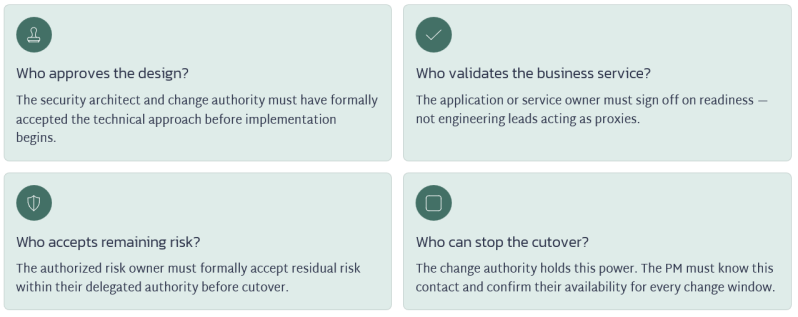
At any point in the program lifecycle, the program manager should have clear, documented answers to these four governance questions. If any answer is "unclear" or "TBD," that is a program risk — not an open action item.
- Who approves the design?
- Who validates the business service?
- Who accepts remaining risk?
- Who can stop the cutover?
“I own the integrated delivery process and make sure technical and business decisions reach the right authority with enough evidence to act.”
What "I Own This" Actually Means
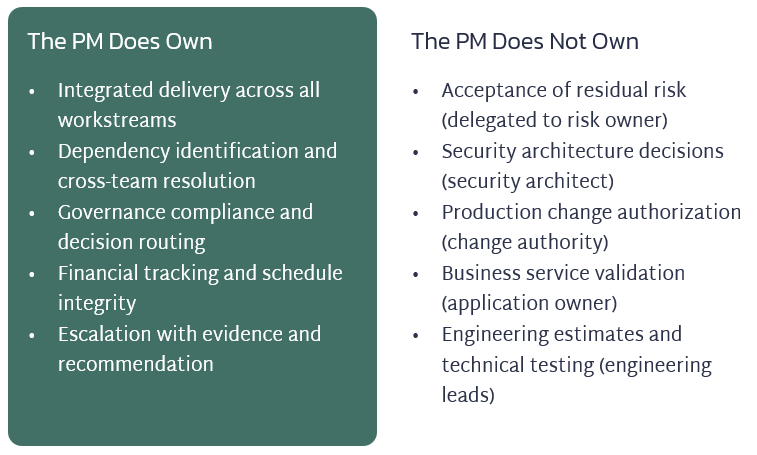
The program manager's ownership is integrative, not technical. It spans delivery, dependencies, governance, financials, and escalation — across every workstream simultaneously.
Key Takeaways for Enterprise Program Managers
Cybersecurity program management at enterprise scale is a governance discipline as much as a delivery discipline. These are the principles that separate effective PMs from coordinators.
Establish accountability before making commitments
Every role, authority, and decision right must be named before scope and schedule are locked. Gaps discovered mid-delivery become incidents.
Manage the integrations, not just the tasks
Individual workstream progress does not equal combined readiness. The PM's unique value is seeing — and resolving — what no single team can see alone.
Escalate with structure and a recommendation
Decision-makers need options, implications, deadlines, and a named authority — not status updates. Own the framing, not just the alert.
Know your interview answer
"I own the integrated delivery process and make sure technical and business decisions reach the right authority with enough evidence to act."

About the Author
Kimberly Wiethoff, MBA, PMP, PMI-ACP is an AI Transformation Program Leader specializing in enterprise digital transformation, AI-enabled delivery, PMO leadership, AI governance, Agile program execution, cloud transformation, and complex portfolio delivery.
Through Managing Projects the Agile Way, she shares practical strategies for modernizing project and program delivery, strengthening PMO leadership, and preparing organizations and leaders for the future of AI-enabled program management.
Download Document, PDF, or Presentation
Author: Kimberly Wiethoff, MBA, PMP, PMI-ACP
Comments
Add comment