The digital marketing landscape is experiencing its most seismic shift since the invention of the modern search engine. For over two decades, Search Engine Optimization (SEO) served as the unchallenged foundation of organic digital growth. Enterprise marketing strategies, multi-million-dollar content budgets, and inbound demand generation models were designed around a single, predictable goal: rank high on a Search Engine Results Page (SERP), earn the organic click, and guide visitors through a carefully constructed on-site conversion funnel.
Guest Author: Barbara Williams - Digital marketing strategist at EProfileTech, specializing in B2B lead generation, account-based marketing, and SaaS growth strategies. Industry Specific Email List
The Collapse of the Ten Blue Links
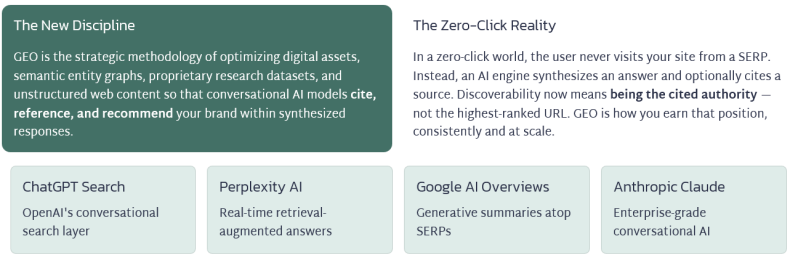
That legacy model is rapidly collapsing under the weight of generative artificial intelligence. The rapid adoption of AI-native search engines and conversational synthesis environments—including OpenAI’s ChatGPT Search, Perplexity AI, Anthropic’s Claude, and Google’s AI Overviews—has fundamentally transformed consumer and B2B buyer search behaviors. Rather than clicking through a fragmented list of ten blue external links and manually cross-referencing information across multiple browser tabs, searchers now receive direct, structured, highly contextualized answers generated dynamically by Large Language Models (LLMs).
To remain discoverable in this zero-click digital reality, content strategists, SaaS founders, and enterprise marketers must adapt to a new technical discipline: Generative Engine Optimization (GEO). GEO represents the strategic methodology of optimizing digital assets, semantic entity graphs, proprietary research datasets, and unstructured web content so that conversational AI models cite, reference, and recommend your brand within synthesized responses. Brands that master GEO will dominate digital mindshare, while those clinging exclusively to legacy keyword tactics will slowly vanish from user discovery.
Traditional SEO vs. Generative Engine Optimization: The Core Paradigm Shift
To successfully execute GEO, organizations must unlearn the foundational mechanics of legacy search engine optimization. Traditional SEO relies heavily on reverse-engineering index crawlers and algorithm signals. It prioritizes static keyword density, backlink volume, domain authority scores, and user behavioral signals like click-through rates (CTR). The underlying goal of traditional search engines is document retrieval—matching a user's literal keyword string to an indexed webpage.
Generative engines, by contrast, do not operate as static retrieval indexes; they function as high-dimensional dynamic context engines. They process raw user intent through semantic vector spaces, evaluating unstructured web data and synthesizing multi-source insights into a unified, conversational narrative.

| Optimization Factor | Traditional SEO Approach | Generative Engine Optimization (GEO) |
|---|---|---|
| Primary Goal | Rank #1–#3 on Search Engine Result Pages (SERPs). | Secure authoritative citations inside AI-generated answers. |
| User Interaction | Query → Blue Links → Website Click → Funnel. | Intent Prompt → Synthesized Answer → Citation Click. |
| Optimization Target | Keywords, Metadata, Page Speed, Crawlability. | Knowledge Graphs, Semantic Entities, Brand Consensus. |
| Content Structure | Skimmable posts with keyword-heavy headings. | Information-dense, factual content with high source authority. |
| Success Metrics | Impressions, Click-Through Rate (CTR), Organic Traffic. | Brand Share of Voice (SoV), Referral Traffic, Citation Frequency. |
What Is Generative Engine Optimization?
How Generative AI Models Select, Synthesize, and Cite Sources
Understanding how conversational engines select sources requires examining their underlying technical architecture. While individual AI platforms utilize proprietary retrieval algorithms, most modern retrieval-augmented generative systems rely on a sophisticated multi-stage pipeline:
Retrieval-Augmented Generation (RAG)
Standard Large Language Models operate on static pre-trained datasets with strict knowledge cutoff dates. To deliver real-time accuracy and eliminate factual hallucinations, platforms like Perplexity, ChatGPT Search, and Google AI Overviews leverage RAG technology. When a user enters a prompt, the RAG system queries a live web index in real time, extracts candidate web documents, and injects that text directly into the LLM's active working context window for immediate synthesis.
Semantic Vector Matching and Embedding Distance
Traditional search engines search for exact keyword string matches. Generative engines convert both user prompts and web content into multidimensional vector embeddings. The engine evaluates semantic closeness using mathematical cosine similarity—understanding that queries like 'scale enterprise SaaS sales pipeline' and 'expand B2B software annual recurring revenue' inhabit virtually identical semantic coordinates within vector space.
Fact-Density and Co-Occurrence Scoring
Once candidate context pages are retrieved, the generative engine evaluates the information density of each source. LLMs heavily favor sources with high 'fact density'—content rich in quantitative data points, proprietary statistics, precise definitions, and expert citations. Pages packed with generic commentary, opinion, or promotional filler are systematically discarded during the synthesis phase.

The Technical Pillars of Generative Engine Optimization
Building a scalable GEO strategy requires executing across four core technical pillars designed specifically for machine readability and semantic authority:
Pillar 1: Advanced Entity Mapping & Knowledge Graph Integration
Generative models map the digital world using Entities (people, places, software tools, organizations) and Relationships. To achieve consistent citation, your brand must exist as a verified entity within global Knowledge Graphs (such as Google’s Knowledge Graph, Wikidata, and Crunchbase). Standardize brand naming conventions, executive author profiles, and core product terminology across every external digital channel to establish strong entity clarity.
Pillar 2: Schema Markup & Structural Scaffolding
While human readers focus on visual design, LLMs rely on structured code to interpret page hierarchies instantly. Implement granular JSON-LD schema markup beyond standard blog schemas—utilizing Organization, TechArticle, SoftwareApplication, Dataset, and FAQPage schemas to validate core brand attributes directly to search crawlers.
Pillar 3: High Fact-Density and Statistical Grounding
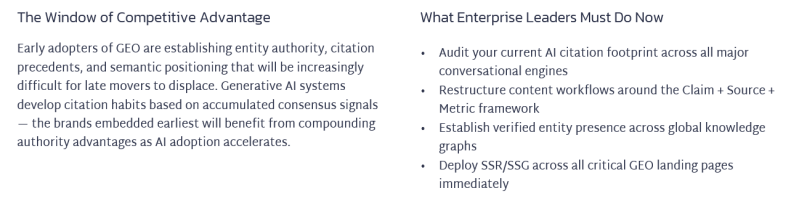
Publishing proprietary statistics, industry benchmark studies, and original survey research creates high-value magnet assets for GEO. Generative models regularly pull verifiable metrics to substantiate their synthesized outputs. Frame core content around a strict 'Claim + Source + Metric' structure rather than publishing unverified subjective assertions.
Pillar 4: Conversational Copywriting & Query Alignment
Modern conversational prompts are complex, multi-variable queries. Structure main content sections to provide immediate, high-density direct answers in the first two sentences, followed by structured supporting sub-points and bulleted summaries that LLMs can easily extract.
AI Crawlers, Web Scraping Dynamics, and Technical Governance
A critical, often overlooked dimension of GEO is managing how AI web crawlers access, index, and render your website content. Unlike traditional Googlebot crawlers that primarily index pages for search ranking, AI crawlers inspect site content to train foundational models and power real-time RAG search features.
Managing User-Agent Access for RAG vs. Model Training
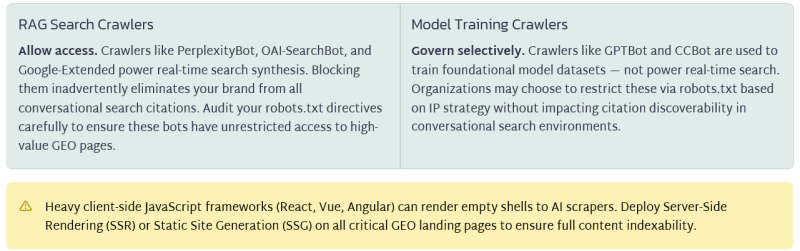
Organizations must maintain precise governance over their robots.txt directives. Web teams must distinguish between crawlers used for real-time search synthesis (e.g., PerplexityBot, OAI-SearchBot, Google-Extended) and those used strictly for model training datasets (e.g., GPTBot, CCBot). Blocking search-focused AI crawlers in an attempt to protect IP inadvertently eliminates your brand from appearing in conversational search citations altogether.
Optimizing DOM Rendering and Client-Side JavaScript for AI Indexers
Many modern SaaS websites rely heavily on heavy client-side JavaScript frameworks (React, Vue, Angular). However, many automated AI scrapers and lightweight RAG crawlers do not execute complex JavaScript files or wait for dynamic client-side DOM rendering. If your key data, product statistics, or structured schemas rely exclusively on client-side rendering, AI crawlers will index an empty page shell. Ensure server-side rendering (SSR) or static site generation (SSG) is deployed across all critical GEO landing pages.
Operationalizing GEO: Step-by-Step Execution Workflow
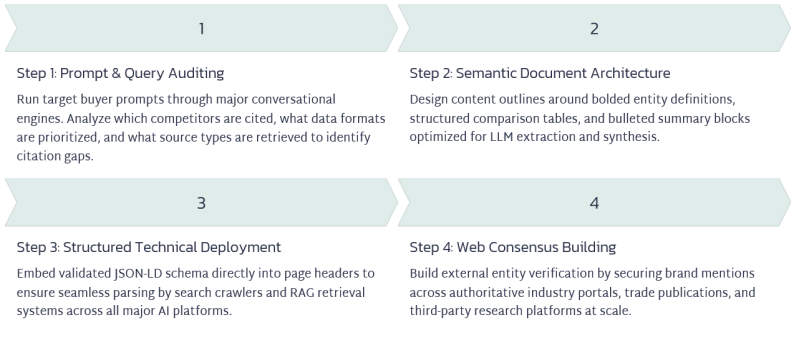
Marketing teams should adopt a standardized four-step workflow to operationalize GEO across every published asset:
- Prompt & Query Auditing: Run target buyer prompts through major conversational engines to analyze which competitors are cited, what data formats are prioritized, and what source types are retrieved.
- Semantic Document Architecture: Design content outlines around clear bolded entity definitions, structured comparison tables, and bulleted summary blocks.
- Structured Technical Deployment: Embed validated JSON-LD schema directly into page headers to ensure seamless parsing by search crawlers.
- Web Consensus Building: Build external entity verification by securing brand mentions across authoritative industry portals, trade publications, and third-party research platforms.
Targeted B2B Enterprise Prospecting & Executive Outreach
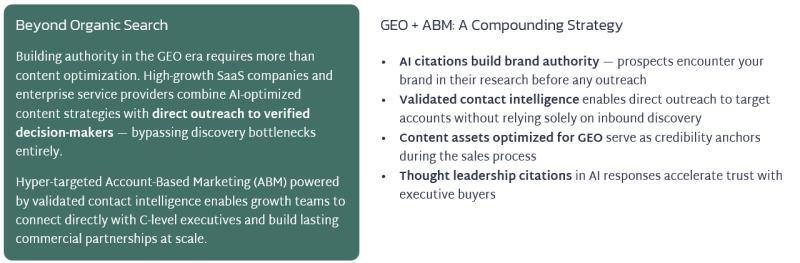
Building authority in the era of Generative Engine Optimization requires going beyond organic search strategies. To drive targeted enterprise demand, establish direct communication channels with key B2B buyers and decision-makers.
High-growth SaaS companies, digital agencies, and enterprise service providers rely on validated decision-maker contact intelligence to scale their revenue pipelines. Utilizing specialized outreach resources like an industry specific email list from EprofileTech empowers growth teams to execute hyper-targeted account-based outreach, connect directly with C-level executives, and build lasting commercial partnerships.
Measuring GEO Performance and Key Metrics
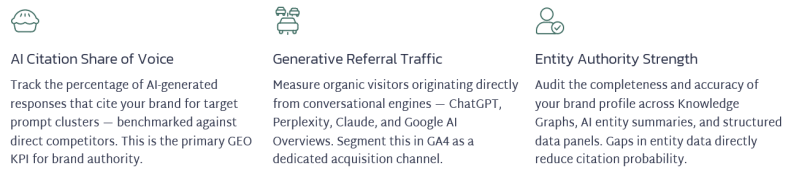
Evaluating GEO success requires tracking metrics specifically suited for generative search environments:
- AI Citation Share of Voice (SoV): The percentage of AI-generated responses that cite your brand for target prompt clusters compared to competitors.
- Generative Referral Traffic: Organic visitors originating directly from conversational engines like ChatGPT, Perplexity, and Claude.
- Entity Authority Strength: The completeness and accuracy of your brand profile across Knowledge Graphs and AI entity summaries.
Conclusion: The Future of Content Strategy in an AI-First World
Generative Engine Optimization is not a temporary trend; it represents a fundamental evolution in how information is indexed, synthesized, and consumed globally. As conversational AI tools become the primary search interface for consumers and executives alike, adopting GEO frameworks ensures your brand remains the primary authoritative answer.
Authoritative Industry References & Strategic Resources
To further explore enterprise content strategy, digital marketing research, and AI search developments, consult these industry resource platforms:
- MarketingProfs - Marketing Strategy & Content Insights: https://www.marketingprofs.com/
- Gartner - Enterprise AI Trends & Search Technology Research: https://www.gartner.com/
- Forrester - Emerging Technology & Market Dynamics: https://www.forrester.com/
#GenerativeEngineOptimization #GEO #AISEO #SearchOptimization #GenerativeAI #AISearch #ContentStrategy #DigitalMarketing #SEOStrategy #ConversationalAI #AIVisibility #ContentMarketing #RetrievalAugmentedGeneration #KnowledgeGraphs #B2BMarketing #MarketingInnovation #FutureOfSearch #EnterpriseAI #ManagingProjectsTheAgileWay
About the Author

Barbara Williams - EprofileTech LLC
Digital marketing strategist at EProfileTech, specializing in B2B lead generation, account-based marketing, and SaaS growth strategies.