Artificial intelligence is creating a new technology-management problem: organizations are investing faster than they can measure value. The cost of an AI solution is not limited to a model subscription or a monthly cloud invoice. It can include experimentation, GPUs, training and fine-tuning, inference, tokens, vector databases, data pipelines, orchestration, monitoring, security, human review, and ongoing model evaluation. Agentic AI makes the economics even less predictable because one user request may initiate several model calls, tool invocations, retries, and validation steps.
That is why FinOps is becoming increasingly relevant to AI careers. The discipline connects technology consumption with financial accountability and business outcomes. But as the FinOps Foundation expands its training portfolio, professionals face a practical question:
Which FinOps certification should I pursue—and which one best supports my career path?
The answer depends less on which credential sounds most advanced and more on the decisions you are expected to make.
Note: Certification names, prices, prerequisites, and bundles can change. The paths described below reflect the FinOps Foundation catalog available in August 2026. Candidates should confirm current requirements before enrolling.
The CSCP certification is designed for professionals who want to understand and manage the entire end-to-end supply chain—from suppliers and procurement to manufacturing, logistics, customer delivery, and reverse logistics. Unlike certifications that focus on only one operational area, CSCP emphasizes strategic integration, cross-functional collaboration, global supply chain thinking, and business optimization.
For project managers, program managers, transformation leaders, operations managers, procurement professionals, and technology leaders, the CSCP certification provides a strong foundation for understanding how organizations deliver value through interconnected supply chain ecosystems.

First, Understand the FinOps Certification Landscape
The FinOps Foundation, a program of the Linux Foundation, is a global nonprofit organization dedicated to advancing FinOps—the practice of maximizing the business value of technology through collaboration among engineering, finance, procurement, product, and business teams. It develops the FinOps Framework, industry standards, community resources, training programs, and professional certifications covering areas such as cloud financial management, AI value, technology value, engineering, and cost-data analysis. Through its learning platform, professionals can develop role-specific skills and earn credentials that demonstrate their ability to connect technology consumption and investment with financial accountability and measurable business outcomes.
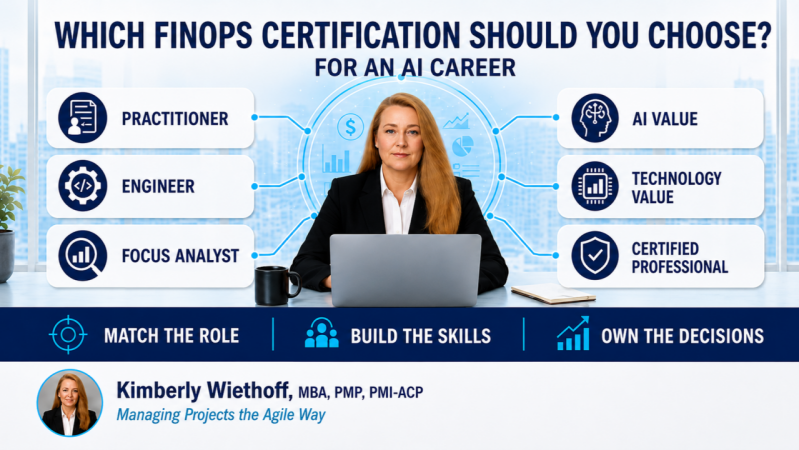
The current FinOps learning ecosystem includes several credentials with different purposes. See table below.
The Foundation also offers targeted education such as FinOps for Containers. These courses can be valuable, but a targeted course or trained badge should not automatically be treated as equivalent to a full certification. Always confirm what credential is awarded.
| Certification | Link | Primary focus | Best aligned with |
|---|---|---|---|
| FinOps Certified Practitioner | https://learn.finops.org/path/finops-certified-practitioner-self-paced | FinOps principles, personas, lifecycle, capabilities, collaboration, and foundational cost management | Program managers, product leaders, finance, procurement, cloud leaders, and professionals new to FinOps |
| FinOps Certified Engineer | https://learn.finops.org/path/finops-certified-engineer | Applying FinOps within engineering, architecture, automation, and cloud operations | Cloud engineers, platform engineers, DevOps, SRE, architects, and technical leads |
| FinOps Certified FOCUS Analyst | https://learn.finops.org/finops-certified-focus-analyst-certification | Normalizing and analyzing cost and usage data using the FinOps Open Cost and Usage Specification | FinOps analysts, data analysts, BI teams, cloud-cost analysts, and reporting specialists |
| FinOps Certified: AI Value | https://learn.finops.org/path/certified-finops-for-ai | Managing and optimizing AI costs while connecting AI consumption to measurable business value | AI leaders, AI program managers, product managers, architects, finance partners, and AI governance professionals |
| FinOps Certified: Technology Value | https://learn.finops.org/path/technology-value | Applying FinOps across public cloud, data centers, SaaS and licensing, data platforms, and organizational scopes | Technology portfolio leaders, CIO organizations, enterprise architects, IT finance, and vendor-management leaders |
| FinOps Certified Professional | https://learn.finops.org/path/finops-certified-professional | Advanced FinOps leadership, strategy, contribution, and enterprise practice maturity | Experienced FinOps leaders, heads of FinOps, consultants, and professionals building enterprise-wide practices |
Career Path 1: AI Program Managers and AI Transformation Leaders
Recommended path: Practitioner → AI Value
For AI program managers, transformation directors, AI PMO leaders, and portfolio managers, the most useful starting combination is usually:
- FinOps Certified Practitioner
- FinOps Certified: AI Value
The Practitioner certification establishes the operating foundation: shared accountability, cross-functional collaboration, allocation, budgeting, forecasting, optimization, governance, and continuous improvement.
AI Value then applies those ideas to the economics of AI. It addresses questions leaders increasingly need to answer:
- What is the complete cost of an AI use case?
- How should shared AI-platform costs be allocated?
- Which unit metric best represents value: cost per inference, transaction, user, case resolved, or successful outcome?
- When should an experiment receive additional funding?
- When should a pilot be scaled, redesigned, paused, or stopped?
- How should cost, accuracy, latency, risk, and customer experience be balanced?
For this career path, the value is not in becoming the person who manages every cloud invoice. It is in becoming the leader who can connect AI investment, delivery decisions, governance, adoption, and measurable outcomes.
When to add Technology Value
Add FinOps Certified: Technology Value if your role extends beyond AI into an enterprise portfolio containing cloud infrastructure, SaaS, data platforms, licensing, and data centers. This is particularly relevant for directors of digital transformation, technology portfolio leaders, and PMO executives.
Career Path 2: AI Product Managers and Product Owners
Recommended path: Practitioner → AI Value
AI product leaders must make tradeoffs among user experience, model quality, latency, reliability, and cost. A technically impressive feature may still fail economically if every customer interaction requires expensive model calls or extensive manual review.
The Practitioner and AI Value combination helps product leaders:
- Define AI unit economics early
- Include cost in product requirements and acceptance criteria
- Compare model and architecture options
- Establish product-level budgets and forecasts
- Measure value by feature, customer, transaction, or outcome
- Prevent usage growth from destroying the business case
Product leaders working across several technology categories may also benefit from Technology Value, but it is normally a secondary step rather than the starting point.
Career Path 3: Cloud, AI, Platform, DevOps, and MLOps Engineers
Recommended path: Engineer → AI Value
Technical professionals are often the people who can change the architecture that drives consumption. For that reason, FinOps Certified Engineer is usually the strongest foundation.
It connects FinOps with engineering decisions involving:
- Architecture and workload placement
- Automation and policy enforcement
- Observability and cost telemetry
- Usage optimization
- Cloud resource efficiency
- Engineering feedback loops
Adding AI Value makes the path more relevant to AI and machine-learning workloads, including inference behavior, token consumption, model selection, GPU capacity, data services, and AI-specific unit economics.
Useful optional additions
- FOCUS Analyst if the engineer owns cost-data pipelines, dashboards, or chargeback data
- FinOps for Containers when Kubernetes economics are central to the environment
- Technology Value for enterprise architects responsible for hybrid and multi-category technology portfolios
Career Path 4: FinOps Analysts, Cloud-Cost Analysts, and BI Professionals
Recommended path: Practitioner → FOCUS Analyst → AI Value
Analysts need both conceptual understanding and reliable data. Practitioner explains how the FinOps practice works; FOCUS Analyst develops the ability to work with normalized, vendor-neutral cost and usage data.
This path is particularly useful for professionals responsible for:
- Multi-cloud cost reporting
- Allocation and showback or chargeback
- Forecasting and variance analysis
- Cost anomaly analysis
- Executive dashboards
- Unit-cost reporting
- Combining billing data with product or business-outcome data
AI Value should follow when the analyst will report on AI models, GPUs, APIs, tokens, AI SaaS products, or shared AI platforms. The central challenge will be correlating technical consumption with outcomes such as revenue, productivity, case resolution, cycle-time reduction, or customer satisfaction.
Career Path 5: Finance, FP&A, IT Finance, and Procurement
Recommended path: Practitioner → AI Value or Technology Value
Finance and procurement professionals do not necessarily need the Engineer certification. They need to understand the operating model, the purchasing structures, and the economic risks.
Choose AI Value when your responsibilities include:
- AI investment governance
- AI business cases and funding gates
- Model, platform, or AI-vendor economics
- Forecasting AI consumption
- Evaluating AI return on investment
- Establishing financial guardrails for experimentation
Choose Technology Value when your responsibilities are broader and include SaaS agreements, public cloud, enterprise licensing, data platforms, and data-center costs.
Professionals who negotiate AI contracts may eventually benefit from both. AI pricing can involve token tiers, provisioned throughput, GPU commitments, per-seat licensing, consumption minimums, API rates, and marketplace purchases. The lowest advertised rate is not always the best economic choice once volume, utilization, flexibility, performance, and switching costs are considered.
Career Path 6: Data Scientists and Machine-Learning Professionals
Recommended path: AI Value, with Practitioner as the stronger foundation
Data scientists and ML professionals do not need to become accounting specialists. They do, however, influence many of the choices that determine AI cost and value:
- Model size and selection
- Training versus retrieval or prompt-based approaches
- Fine-tuning strategy
- Evaluation frequency
- Context-window usage
- Inference patterns
- Accuracy and latency targets
- Experiment duration and resource consumption
AI Value is the most directly relevant credential. Practitioner should be added when the individual participates in budgeting, product decisions, governance, or cross-functional leadership.
For an individual contributor focused primarily on model development, AI Value alone may be sufficient. For a lead data scientist or AI platform owner, the combined path is more valuable.
Career Path 7: CIOs, CTOs, Technology Portfolio Leaders, and Enterprise Architects
Recommended path: Practitioner → Technology Value → AI Value
Executives and enterprise architects rarely manage AI in isolation. They must decide how AI fits within the organization’s full technology portfolio.
Technology Value helps broaden the conversation beyond cloud cost to include public cloud, data centers, SaaS and licensing, data platforms, and organizational scopes. AI Value then provides the specialization needed to evaluate AI investments and their distinct consumption patterns.
This combination supports decisions such as:
- Build versus buy
- Public cloud versus private or hosted infrastructure
- Model API versus self-hosted model
- Shared enterprise AI platform versus decentralized purchasing
- On-demand usage versus capacity commitments
- Funding experimentation without creating uncontrolled production costs
- Comparing AI investments with other technology priorities
The objective is not simply cost control. It is portfolio optimization: directing limited capital, capacity, and leadership attention toward the initiatives that create the most value.
Career Path 8: Heads of FinOps and FinOps Consultants
Recommended path: Build toward FinOps Certified Professional
FinOps Certified Professional is intended for experienced practitioners who want to demonstrate advanced leadership and enterprise practice maturity. It should be treated as a destination rather than an entry point.
The current path requires candidates to enter with an active Practitioner or Engineer credential. Before taking the Professional exam, candidates must also hold active certifications in:
- FinOps Certified FOCUS Analyst
- FinOps Certified: AI Value
- FinOps Certified: Technology Value
Candidates must also complete a Professional Contribution requirement. These prerequisites reflect the expanding scope of FinOps—from cloud-cost management to the broader management of technology value.
This route makes the most sense for:
- Heads or directors of FinOps
- Enterprise FinOps practice leaders
- Senior consultants
- FinOps center-of-excellence leaders
- Professionals responsible for organization-wide strategy, adoption, and maturity
It is probably excessive for someone who only needs enough FinOps knowledge to improve AI program decisions.
A Simple Career-Path Decision Guide
| If your primary responsibility is… | Start with… | Then consider… |
|---|---|---|
| Leading AI programs or transformation | Practitioner | AI Value; then Technology Value if portfolio scope is broad |
| Managing an AI product | Practitioner | AI Value |
| Designing or operating cloud and AI platforms | Engineer | AI Value, Containers, or FOCUS Analyst |
| Analyzing cost and usage data | Practitioner | FOCUS Analyst; then AI Value |
| Governing AI funding and business cases | Practitioner | AI Value |
| Managing enterprise technology spend | Practitioner | Technology Value; then AI Value |
| Building ML models and influencing architecture | AI Value | Practitioner or Engineer, depending on responsibilities |
| Leading an enterprise FinOps practice | Practitioner or Engineer | FOCUS Analyst + AI Value + Technology Value → Professional |
Should You Begin With Practitioner or Go Directly to AI Value?
The AI Value program currently has no formal prerequisite, so professionals can enroll directly. That does not mean direct entry is always the best learning strategy.
Start with Practitioner when:
- You are new to FinOps
- You need the language of the FinOps Framework
- Your role is cross-functional or leadership-oriented
- You want a credential recognized across more than AI-specific work
Go directly to AI Value when:
- You already understand FinOps principles
- Your immediate responsibility is AI investment, AI architecture, or AI cost management
- You need focused knowledge more than a broad foundation
- Time or budget allows only one certification and AI is clearly your specialization
For most AI program and transformation leaders, I would still recommend Practitioner followed by AI Value. The first explains how FinOps operates; the second explains how to apply it to AI.
Avoid Collecting Certifications Without a Career Narrative
A certification is most useful when it strengthens a clear professional story.
“I completed several FinOps courses” is less compelling than:
“I help organizations govern AI investment from use-case selection through production by connecting consumption, unit economics, risk, adoption, and business outcomes.”
The credential should support the work you want to be hired to perform. It should also lead to tangible portfolio evidence, such as:
- An AI total-cost-of-ownership model
- A cost-per-outcome framework
- An AI use-case investment scorecard
- A pilot-to-production funding gate
- An AI FinOps dashboard
- A model-selection decision matrix
- A forecasting and anomaly-management process
These artifacts demonstrate that you can apply the knowledge rather than merely pass an exam.
Final Recommendation
There is no single “best” FinOps certification for everyone.
- Practitioner is the strongest general foundation.
- Engineer is the better technical starting point.
- FOCUS Analyst is best for cost and usage data specialists.
- AI Value is the most relevant specialization for AI economics, governance, and value realization.
- Technology Value is best for leaders managing a broader technology portfolio.
- Professional is the advanced destination for enterprise FinOps leaders.
The right choice is the credential that matches the decisions you want to own.
As AI adoption accelerates, organizations will need professionals who can do more than launch pilots. They will need leaders, engineers, analysts, and finance partners who understand what AI costs, what value it creates, and when an investment deserves to scale.
That is the real opportunity behind AI FinOps.
Which AI FinOps decisions do you want to be qualified to own?
#FinOps #AIFinOps #ArtificialIntelligence #AITransformation #AIValue #AIGovernance #TechnologyLeadership #ProgramManagement #CloudFinOps #FinancialOperations #AIProgramManagement #DigitalTransformation
Official Resources

About the Author
Kimberly Wiethoff, MBA, PMP, PMI-ACP is an AI Transformation Program Leader specializing in enterprise digital transformation, AI-enabled delivery, PMO leadership, AI governance, Agile program execution, cloud transformation, and complex portfolio delivery.
Through Managing Projects the Agile Way, she shares practical strategies for modernizing project and program delivery, strengthening PMO leadership, and preparing organizations and leaders for the future of AI-enabled program management.
Pricing
| Certification | Course + exam | Course only | Exam only | Primary focus |
|---|---|---|---|---|
| FinOps Certified Practitioner | $500 self-paced | $250 | $325 | Foundational FinOps principles, capabilities, personas, allocation, forecasting, optimization, and collaboration |
| FinOps Certified Engineer | $500 self-paced | $250 | $325 | Applying FinOps through engineering, architecture, automation, and cloud operations |
| FinOps Certified FOCUS Analyst | $400 | Not separately listed | Not separately listed | Analyzing normalized, vendor-neutral cost and usage data using FOCUS |
| FinOps Certified: AI Value | $500 | Not separately listed | Not separately listed | Managing AI costs and connecting AI consumption to measurable business value |
| FinOps Certified: Technology Value | $500 | Modules may be taken individually; prices vary | Not separately listed | Applying FinOps across cloud, data centers, SaaS, licensing, and data platforms |
| FinOps Certified Professional | $500 | Not separately listed | Exam unlocks after course and prerequisite completion | Advanced FinOps leadership, strategy, practice maturity, and enterprise value |
Important pricing notes
The Professional certification costs more than $500 in practice for someone starting from the beginning. Candidates must enter the program with an active Practitioner or Engineer credential. Before taking the Professional exam, they must also hold active certifications in FOCUS Analyst, AI Value, and Technology Value.
Based on individual prices, a Practitioner-based path would cost approximately:
| Required credential | Price |
|---|---|
| Practitioner course and exam | $500 |
| FOCUS Analyst | $400 |
| AI Value | $500 |
| Technology Value | $500 |
| Professional | $500 |
| Total purchased separately | $2,400 |
Bundles can reduce the total considerably. Current examples include:
| Required credential | Price |
|---|---|
| Practitioner + FOCUS Analyst: | $600 |
| Engineer + FOCUS Analyst: | $600 |
| AI Value + Technology Value: | $700 |
| FOCUS Analyst + Technology Value + Professional: | $1050 |
| Full certification catalog: including Practitioner, Engineer, FOCUS Analyst, AI Value, and Technology Value | $2495 |
Download the Document, PDF, or Presentation
Author: Kimberly Wiethoff