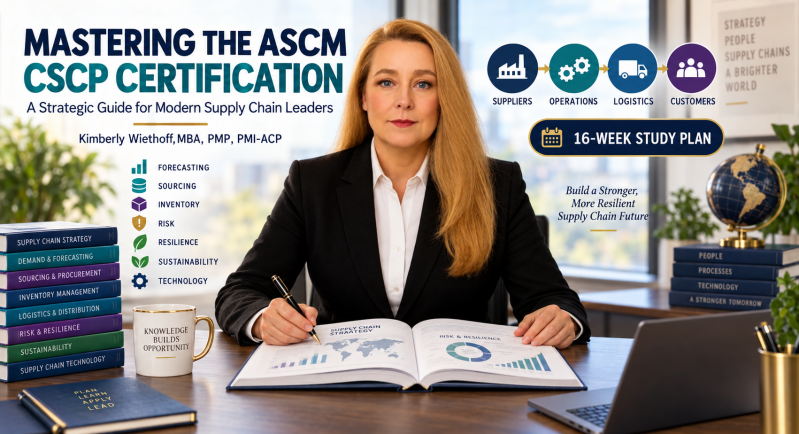
Mastering the ASCM CSCP Certification: A Strategic Guide for Modern Supply Chain Leaders

Published on 23 May 2026 at 13:32

In today’s rapidly evolving global economy, supply chains have become far more than operational support functions—they are now strategic business drivers. Organizations are under constant pressure to improve resilience, reduce costs, increase visibility, manage global disruptions, and leverage emerging technologies such as AI, automation, and predictive analytics. For professionals looking to lead in this environment, the Association for Supply Chain Management Certified Supply Chain Professional (CSCP) certification has become one of the most respected credentials in the industry.

The CSCP certification is designed for professionals who want to understand and manage the entire end-to-end supply chain—from suppliers and procurement to manufacturing, logistics, customer delivery, and reverse logistics. Unlike certifications that focus on only one operational area, CSCP emphasizes strategic integration, cross-functional collaboration, global supply chain thinking, and business optimization.

For project managers, program managers, transformation leaders, operations managers, procurement professionals, and technology leaders, the CSCP certification provides a strong foundation for understanding how organizations deliver value through interconnected supply chain ecosystems.

Why the CSCP Certification Matters

Supply chains today face challenges that did not exist a decade ago:

  • Global geopolitical instability
  • Cybersecurity threats
  • Port congestion and transportation disruptions
  • Rapidly shifting customer expectations
  • Sustainability and ESG pressures
  • AI-driven digital transformation
  • Demand volatility and forecasting uncertainty

Organizations need leaders who can think strategically across the entire supply chain rather than optimizing individual departments in isolation.

The CSCP certification helps professionals develop expertise in:

  • Demand planning and forecasting
  • Global supply chain networks
  • Strategic sourcing and procurement
  • Inventory optimization
  • Logistics and distribution
  • Supplier relationship management
  • Risk management and resilience
  • Sustainability and digital transformation

The certification also aligns exceptionally well with professionals involved in:

  • ERP implementations
  • Digital transformation initiatives
  • AI and analytics programs
  • PMO governance
  • Operational excellence
  • Enterprise modernization efforts

What Does the CSCP Certification Cost?

One of the most common questions professionals ask before starting the CSCP journey is whether the certification is worth the investment. While pricing can vary slightly by region and promotional offerings, candidates should generally expect the following costs:

Item Estimated Cost
CSCP Exam (ASCM PLUS Member) ~$1,420–$1,450 USD
CSCP Exam (Non-Member) ~$1,975–$2,015 USD
Retake Fee ~$400–$500 USD
Learning System Bundle + Exam ~$2,620–$3,650 USD
Instructor-Led Prep Courses ~$2,750–$3,000+ USD

In many cases, purchasing an ASCM membership actually lowers the overall cost because member discounts on exams and learning systems are often greater than the membership fee itself. Some employers also fully or partially reimburse certification and training expenses as part of professional development programs. (ASCM)

While the upfront investment may initially seem significant, many professionals view the CSCP certification as a long-term career investment because it strengthens expertise in:

  • Supply chain strategy
  • Procurement
  • Logistics
  • Risk management
  • Digital transformation
  • Global operations

For professionals pursuing leadership roles in operations, transformation, procurement, logistics, or enterprise program management, the certification can provide strong ROI through expanded career opportunities, salary growth, and broader strategic business knowledge.

What Makes the CSCP Different?

One of the biggest differences between the CSCP certification and many other operational certifications is its emphasis on end-to-end thinking.

The exam consistently reinforces a core principle:

The best decision is usually the one that improves the entire supply chain—not just one department.

This mindset is increasingly critical in modern organizations where disconnected optimization often creates unintended consequences elsewhere in the business.

For example:

  • Reducing inventory too aggressively may harm customer service.
  • Choosing the lowest-cost supplier may increase geopolitical risk.
  • Optimizing manufacturing without transportation visibility may create downstream bottlenecks.

The CSCP certification teaches professionals how to balance:

  • Cost
  • Responsiveness
  • Resilience
  • Service levels
  • Risk
  • Sustainability

This strategic balancing act is what separates tactical managers from enterprise supply chain leaders.

Key Topics Covered in the CSCP Certification

The CSCP program covers eight major domains:

Module Focus Area
1 Supply Chains, Demand Management, and Forecasting
2 Global Supply Chain Networks
3 Sourcing Products and Services
4 Internal Operations and Inventory
5 Forward and Reverse Logistics
6 Supply Chain Relationships
7 Supply Chain Risk
8 Optimization, Sustainability, and Technology

Some of the most heavily tested topics include:

  • S&OP (Sales & Operations Planning)
  • Forecast accuracy
  • Bullwhip effect
  • Lean vs Agile supply chains
  • Inventory management
  • Supplier collaboration
  • Business continuity planning
  • Supply chain resilience
  • ESG and sustainability
  • AI, IoT, blockchain, and digital supply chains

The exam is highly scenario-based and focuses heavily on strategic decision-making and tradeoff analysis.

The CSCP and Digital Transformation

One of the most valuable aspects of the CSCP certification is how relevant it has become in the era of digital transformation.

Modern supply chains are increasingly powered by:

  • AI-driven forecasting
  • Real-time analytics
  • IoT-enabled visibility
  • Automation platforms
  • Cloud ERP systems
  • Digital twins
  • Predictive risk management

Organizations are no longer simply moving products—they are managing complex digital ecosystems.

Professionals who combine supply chain expertise with transformation leadership, AI strategy, cybersecurity awareness, analytics, and enterprise governance are becoming extremely valuable in the market.

This is especially true for leaders working in:

  • Healthcare
  • Manufacturing
  • Energy
  • Retail
  • Logistics
  • Technology
  • Financial services

The CSCP certification provides a strong strategic framework for understanding how operational decisions connect directly to enterprise performance and customer value.

Biggest Takeaway While Studying

One of the most important lessons from studying for the CSCP certification is realizing how interconnected every supply chain decision truly is.

The certification constantly reinforces themes such as:

  • Visibility
  • Collaboration
  • End-to-end optimization
  • Strategic alignment
  • Resilience
  • Customer-centric thinking

Many exam questions are intentionally designed to test whether you are thinking:

  • Departmentally
    or
  • Enterprise-wide

The “best” answer is often the one that improves communication, collaboration, visibility, and long-term supply chain performance rather than delivering a short-term operational fix.

This mindset applies far beyond supply chain management—it applies to digital transformation, PMO leadership, Agile delivery, enterprise governance, and organizational strategy overall.

Recommended Study Strategy

For professionals preparing for the CSCP exam, I recommend focusing on:

  1. Understanding concepts—not memorizing definitions only
  2. Learning how supply chain tradeoffs work
  3. Practicing scenario-based questions
  4. Building strong forecasting and inventory fundamentals
  5. Understanding global supply chain risk
  6. Relating concepts back to real-world business operations

If you already have experience in:

  • Project management
  • ERP implementations
  • Vendor governance
  • Agile transformation
  • Risk management
  • Technology leadership

You will likely find many strategic concepts familiar. The biggest learning curve is usually:

  • Supply chain terminology
  • Forecasting calculations
  • Inventory formulas
  • Logistics operations
  • Global trade concepts

    Consistency matters more than cramming. A structured 12–16 week study plan with regular practice questions is usually far more effective than trying to memorize everything quickly.

    Final Thoughts

    The CSCP certification is more than a supply chain credential—it is a strategic business certification focused on operational excellence, resilience, collaboration, and enterprise optimization.

    As organizations continue to navigate global uncertainty, AI-driven disruption, sustainability expectations, and digital transformation, professionals who understand end-to-end supply chain strategy will continue to be in high demand.

    Whether you are a supply chain professional, program manager, transformation leader, operations manager, or technology executive, the CSCP certification can significantly strengthen your ability to lead complex business ecosystems and deliver long-term organizational value.

    #CSCP #ASCM #SupplyChain #SupplyChainManagement #DigitalTransformation #AI #Forecasting #Procurement #Logistics #InventoryManagement #OperationsManagement #BusinessTransformation #SupplyChainRisk #ESG #AgileLeadership #ProjectManagement #ERP #SupplyChainStrategy #Leadership #ManagingProjectsTheAgileWay

    What Each Section Covers

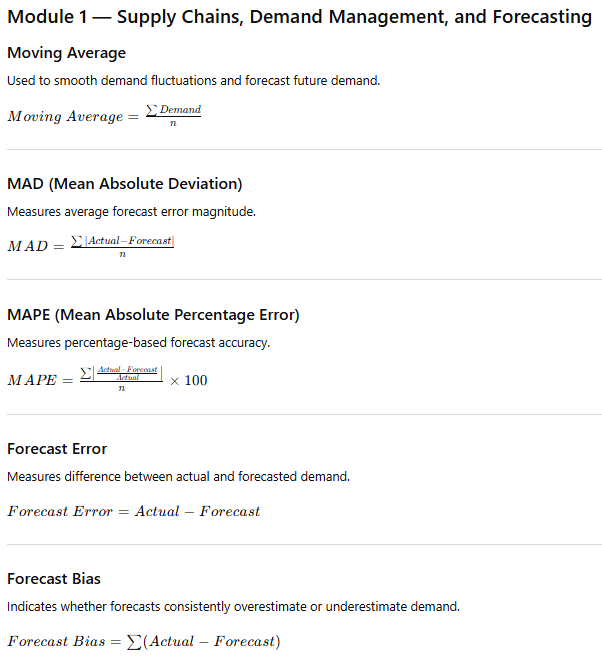
    Module 1 — Supply Chains, Demand Management, and Forecasting

    Focus Areas

    • Supply chain fundamentals
    • Demand planning
    • Forecasting
    • S&OP
    • Push vs pull systems
    • Bullwhip effect

    Important Concepts

    • Forecast accuracy
    • MAD/MAPE
    • Supply chain strategy
    • Lean vs agile

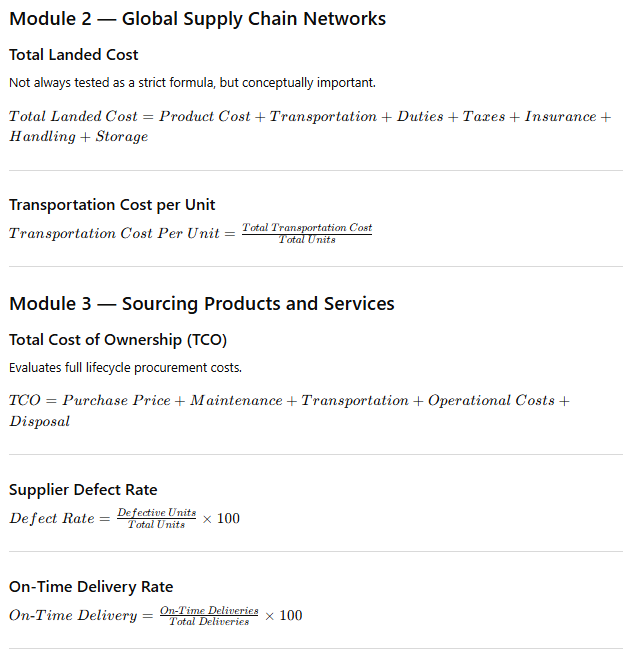
    Module 2 — Global Supply Chain Networks

    Focus Areas

    • Global trade
    • Supply chain design
    • Incoterms
    • Tariffs
    • Nearshoring/offshoring
    • Trade compliance

    Important Concepts

    • Total landed cost
    • Global sourcing
    • Network optimization
    • Supply chain resilience

    Module 3 — Sourcing Products and Services

    Focus Areas

    • Procurement
    • Supplier selection
    • Strategic sourcing
    • Supplier relationship management

    Important Concepts

    • RFI/RFP/RFQ
    • TCO
    • Supplier scorecards
    • Make vs buy analysis

    a description for this subheader or change it to your liking.

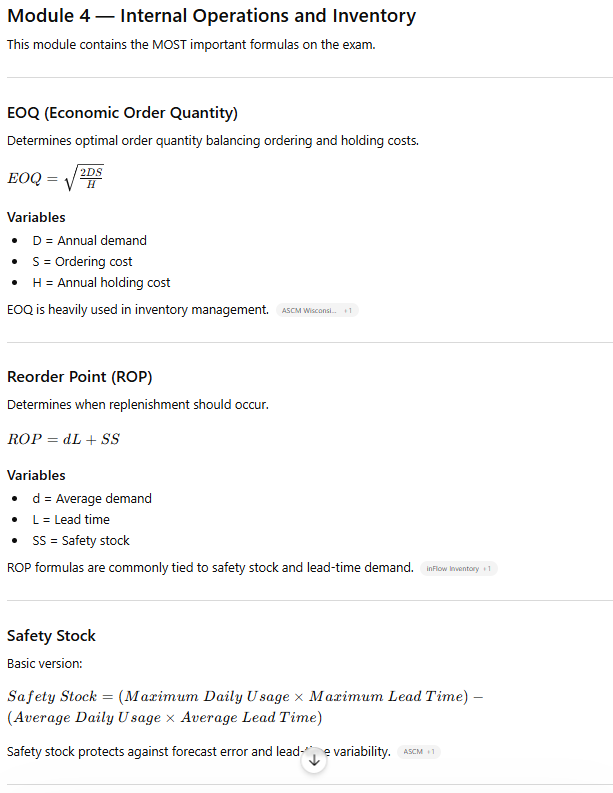
    Module 4 — Internal Operations and Inventory

    Focus Areas

    • Manufacturing operations
    • Inventory management
    • Lean
    • Six Sigma
    • Capacity planning

    Important Concepts

    • EOQ
    • Safety stock
    • Reorder point
    • MRP/ERP
    • Constraints

    Module 5 — Forward and Reverse Logistics

    Focus Areas

    • Transportation
    • Warehousing
    • Distribution
    • Reverse logistics

    Important Concepts

    • 3PL/4PL
    • Cross docking
    • Last-mile delivery
    • Transportation modes

    Module 6 — Supply Chain Relationships

    Focus Areas

    • Collaboration
    • Customer relationships
    • Supplier partnerships
    • Organizational alignment

    Important Concepts

    • CPFR
    • Stakeholder management
    • Communication
    • Customer service

    Module 7 — Supply Chain Risk

    Focus Areas

    • Risk management
    • Business continuity
    • Cybersecurity
    • Geopolitical risk
    • Supply chain disruption

    Important Concepts

    • Resilience
    • Mitigation strategies
    • Diversification
    • Contingency planning

    Module 8 — Optimization, Sustainability, and Technology

    Focus Areas

    • ESG
    • Sustainability
    • AI
    • IoT
    • Blockchain
    • Automation

    Important Concepts

    • Circular economy
    • Digital supply chain
    • Analytics
    • Continuous improvement

    Most Heavily Tested Sections

    The most heavily weighted sections are:

    1. Module 6 — Supply Chain Relationships (15%)
    2. Module 7 — Supply Chain Risk (15%)
    3. Module 8 — Optimization, Sustainability, and Technology (15%)

    These three sections alone make up nearly half the exam.

    Exam Structure

    The CSCP exam contains:

    • 150 multiple-choice questions
    • 3.5 hours
    • Mostly scenario-based questions
    • Some formula/calculation questions

    The exam tests:

    • Decision-making
    • Best practices
    • Tradeoff analysis
    • End-to-end supply chain thinking

    More than pure memorization.

    ASCM CSCP Study Guide & Preparation

    The Association for Supply Chain Management Certified Supply Chain Professional (CSCP) certification is one of the top global supply chain credentials for end-to-end supply chain management. The exam currently covers 8 modules, includes 150 multiple-choice questions, and allows 3.5 hours to complete the test. (ASCM)

    Given your strong project/program management and transformation background, you already have transferable strengths in:

    • Cross-functional leadership
    • Risk management
    • Process optimization
    • Governance
    • Vendor/stakeholder management
    • Agile transformation
    • Data-driven decision making

    Your biggest learning curve will likely be:

    • Supply chain terminology
    • Forecasting calculations
    • Inventory formulas
    • Logistics/network design
    • Procurement specifics
    • International trade concepts

    Recommended 16-Week CSCP Study Plan

    This plan assumes:

    • ~8–10 hours/week
    • Working professional schedule
    • Goal = first-attempt pass

    Phase 1 — Foundation (Weeks 1–4)

    Goal

    Build core supply chain vocabulary and concepts.

    Week 1 — Supply Chain Fundamentals

    Focus Areas

    • End-to-end supply chains
    • Supply chain strategy
    • Supply chain drivers
    • Demand planning
    • Forecasting basics
    • SCOR model overview

    Study Tasks

    • Read Module 1
    • Create glossary flashcards
    • Learn forecasting terminology

    Key Concepts

    • Bullwhip effect
    • Push vs pull systems
    • Forecast error
    • Supply chain segmentation
    • S&OP

    Study Time

    8 hours

    Week 2 — Forecasting & Demand Management

    Focus Areas

    • Quantitative forecasting
    • Qualitative forecasting
    • MAD/MAPE calculations
    • Demand shaping
    • Collaborative planning

    Important Calculations

    • Moving average
    • Exponential smoothing
    • Forecast accuracy

    Recommendation

    Practice calculations daily.

    Study Time

    10 hours

    Week 3 — Global Supply Chain Networks

    Focus Areas

    • Global sourcing
    • International trade
    • Incoterms
    • Trade compliance
    • Supply chain network design

    Key Topics

    • Free trade agreements
    • Tariffs
    • Nearshoring vs offshoring
    • Total landed cost

    Study Time

    8 hours

    Week 4 — Sourcing & Procurement

    Focus Areas

    • Supplier selection
    • Supplier relationship management
    • Procurement strategies
    • Contract management
    • Make vs buy analysis

    Key Topics

    • RFQ/RFP/RFI
    • Strategic sourcing
    • Category management
    • Supplier scorecards

    Study Time

    8 hours

    Phase 2 — Operations & Logistics (Weeks 5–8)

    Week 5 — Inventory Management

    Focus Areas

    • Inventory strategies
    • Safety stock
    • EOQ
    • Reorder point
    • ABC analysis

    Important Formulas

    • EOQ
    • Inventory turns
    • Fill rate
    • Safety stock calculations

    Critical Exam Area

    Inventory is heavily tested.

    Study Time

    10 hours

    Week 6 — Internal Operations

    Focus Areas

    • Lean operations
    • Six Sigma
    • Capacity planning
    • Constraints
    • Manufacturing strategies

    Key Topics

    • MRP
    • ERP
    • JIT
    • TOC
    • Kaizen

    Study Time

    8 hours

    Week 7 — Logistics & Distribution

    Focus Areas

    • Transportation modes
    • Warehousing
    • Reverse logistics
    • Distribution networks

    Key Topics

    • 3PL vs 4PL
    • Cross docking
    • Last-mile delivery
    • Transportation optimization

    Study Time

    8 hours

    Week 8 — Midpoint Review

    Activities

    • Complete 1 full practice exam
    • Identify weak areas
    • Review formulas
    • Revisit Modules 1–7 weak spots

    Target Score

    65–70%

    Study Time

    10 hours

    Phase 3 — Strategy & Risk (Weeks 9–12)

    Week 9 — Supply Chain Relationships

    Focus Areas

    • Customer collaboration
    • Supplier partnerships
    • Stakeholder alignment
    • Organizational structures

    Key Topics

    • CPFR
    • Relationship management
    • Organizational culture
    • Communication models

    Study Time

    8 hours

    Week 10 — Supply Chain Risk

    Focus Areas

    • Risk identification
    • Business continuity
    • Cybersecurity
    • Geopolitical risk
    • Resilience

    Key Topics

    • Risk mitigation
    • Risk response
    • Scenario planning
    • Supply chain visibility

    Recommendation

    This section aligns very well with your FDA cybersecurity and governance experience.

    Study Time

    8 hours

    Week 11 — Sustainability & Technology

    Focus Areas

    • ESG
    • Sustainability
    • Digital supply chains
    • AI/automation
    • Blockchain
    • IoT

    Key Topics

    • Circular economy
    • Carbon footprint
    • Supply chain analytics
    • Emerging technologies

    Recommendation

    Your AI transformation background will help significantly here.

    Study Time

    8 hours

    Week 12 — Integration Review

    Activities

    • Cross-module review
    • Practice mixed questions
    • Build concept maps
    • Memorize formulas

    Target Score

    75%

    Study Time

    10 hours

    Phase 4 — Exam Readiness (Weeks 13–16)

    Week 13 — Practice Exam Intensive

    Tasks

    • 2 full-length timed exams
    • Analyze incorrect answers
    • Focus on weak domains

    Goal

    Improve test endurance.

    Study Time

    10 hours

    Week 14 — Scenario-Based Questions

    Focus Areas

    • Best-next-step questions
    • Supply chain tradeoffs
    • Strategic decision making

    Important

    CSCP is heavily scenario-based, not memorization-focused. (Delphi Star Training)

    Study Time

    8 hours

    Week 15 — Final Review

    Tasks

    • Formula review
    • Flashcards
    • Key terminology
    • Process flow reviews

    Focus

    High-frequency topics:

    • Inventory
    • Risk
    • Sourcing
    • Forecasting
    • Logistics

    Study Time

    8 hours

    Week 16 — Exam Week

    3–4 Days Before Exam

    • Light review only
    • No cramming
    • Sleep optimization

    Day Before

    • Formula sheet review
    • Relax
    • Prepare testing setup

    Exam Strategy

    • Flag difficult questions
    • Eliminate obvious wrong answers
    • Manage time carefully
    • Avoid overthinking

    Most Important CSCP Topics to Master

    High Priority Areas

    1. Inventory management
    2. Forecasting
    3. Risk management
    4. Supplier management
    5. Logistics
    6. Supply chain strategy
    7. Sustainability
    8. Technology enablement

    Recommended Study Resources

    Official ASCM Resources

    Best Primary Resource

    Exam Content Manual

    Official Organization

    Recommended Supplemental Resources

    Practice Questions

    • Pocket Prep CSCP App
    • Quizlet Flashcards
    • YouTube CSCP practice exams

    Video Learning

    • YouTube CSCP walkthroughs
    • LinkedIn Learning supply chain courses

    Good Companion Topics

    Given your background:

    • ERP systems
    • AI in supply chain
    • Risk governance
    • Digital transformation
    • Data analytics

    These will strengthen your understanding faster than most candidates.

    Key Exam Tips

    The Exam Tests:

    • Decision making
    • Tradeoffs
    • Best practices
    • End-to-end thinking
    • Strategic alignment

    The Exam Does NOT Primarily Test:

    • Memorization only
    • Pure calculations
    • Definitions alone

    ASCM CSCP Glossary of Key Terms

    Supply Chain Fundamentals

    Supply Chain - The network of organizations, people, activities, information, and resources involved in producing and delivering a product or service to customers.

    End-to-End Supply Chain - Management of the entire product lifecycle from raw materials to final customer delivery and reverse logistics.

    Supply Chain Management (SCM) - Planning and managing sourcing, procurement, conversion, logistics, and collaboration across supply chain partners.

    Supply Chain Strategy - Long-term plan aligning supply chain capabilities with business objectives.

    Value Chain - Activities that create value for customers across production and delivery processes.

    Bullwhip Effect - Demand fluctuations become amplified as they move upstream in the supply chain.

    Push System - Production based on forecasted demand.

    Pull System - Production based on actual customer demand.

    Lean - Methodology focused on eliminating waste and improving flow.

    Agile Supply Chain - Flexible supply chain designed to respond rapidly to demand changes.

    Resilience - Ability of the supply chain to recover from disruptions.

    Supply Chain Visibility - Ability to track products, inventory, orders, and shipments throughout the supply chain.

    Planning & Forecasting

    Forecast - Prediction of future demand.

    Demand Planning - Process of forecasting customer demand to support operations and inventory decisions.

    Quantitative Forecasting - Forecasting using historical data and statistical methods.

    Qualitative Forecasting - Forecasting based on expert judgment or market insights.

    Moving Average - Forecasting technique using the average of past periods.

    Exponential Smoothing - Forecasting method that gives greater weight to recent data.

    MAD (Mean Absolute Deviation) - Average forecast error magnitude.

    MAPE (Mean Absolute Percentage Error) - Percentage-based forecast accuracy measure.

    Forecast Error - Difference between forecasted and actual demand.

    S&OP (Sales and Operations Planning) - Cross-functional process balancing supply and demand.

    IBP (Integrated Business Planning) - Advanced form of S&OP integrating financial and strategic planning.

    Capacity Planning - Determining production capability needed to meet demand.

    Inventory Management

    Inventory - Goods and materials held for production or sale.

    Safety Stock - Extra inventory held to reduce stockout risk.

    Cycle Stock - Inventory used to satisfy normal demand during replenishment cycles.

    Buffer Stock - Inventory maintained to absorb uncertainty.

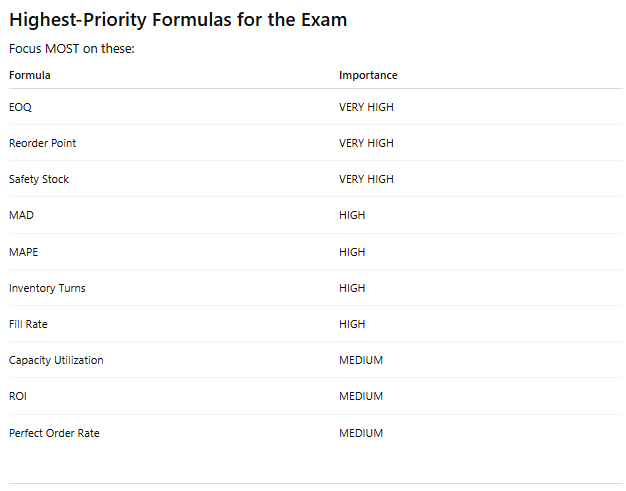
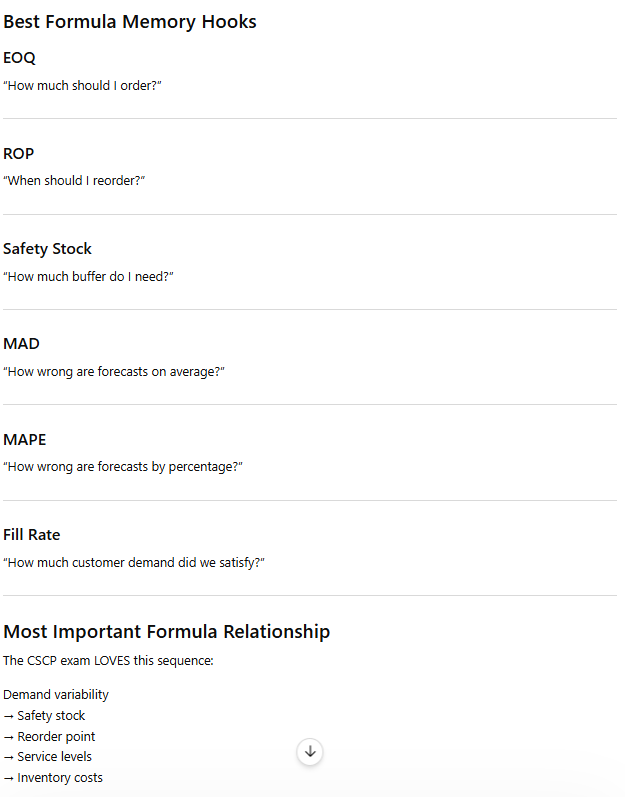
    EOQ (Economic Order Quantity) - Optimal order quantity minimizing inventory and ordering costs.

    EOQ = \sqrt{\frac{2DS}{H}}

    Reorder Point (ROP) - Inventory level triggering replenishment.

    ROP = dL + SS

    ABC Analysis - Inventory classification method prioritizing high-value items.

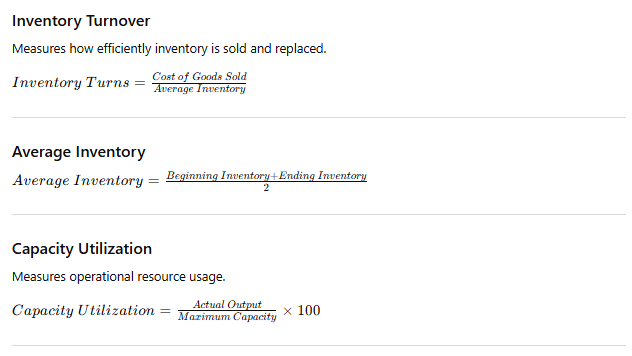
    Inventory Turns - Measure of how often inventory is sold/replaced.

    Stockout - Inventory shortage causing inability to fulfill demand.

    Carrying Cost - Cost of holding inventory over time.

    Obsolescence - Inventory becoming outdated or unusable.

    Procurement & Sourcing

    Procurement - Process of obtaining goods and services.

    Strategic Sourcing - Long-term procurement strategy optimizing supplier relationships and costs.

    Supplier Relationship Management (SRM) - Managing supplier interactions and performance.

    RFQ (Request for Quote) - Document requesting pricing from suppliers.

    RFP (Request for Proposal) - Document requesting detailed supplier solutions.

    RFI (Request for Information) - Document gathering supplier capabilities information.

    Make-or-Buy Analysis - Decision whether to produce internally or outsource.

    Supplier Scorecard - Tool measuring supplier performance.

    Category Management - Strategic management of groups of related purchases.

    Total Cost of Ownership (TCO) - Total lifecycle cost of acquiring and using a product/service.

    Manufacturing & Operations 

    MRP (Material Requirements Planning) - System calculating material needs for production.

    ERP (Enterprise Resource Planning) - Integrated software managing core business processes.

    BOM (Bill of Materials) - Structured list of components needed to produce an item.

    Work-in-Process (WIP) - Partially completed products in production.

    JIT (Just-in-Time) - Inventory strategy minimizing stock through precise timing.

    Kaizen - Continuous improvement philosophy.

    Six Sigma - Data-driven quality improvement methodology.

    TOC (Theory of Constraints) - Methodology identifying and managing system bottlenecks.

    Bottleneck - Constraint limiting system throughput.

    Throughput - Rate at which a system generates output.

    Logistics & Distribution 

    Logistics - Movement and storage of goods through the supply chain.

    Transportation Management - Planning and optimizing shipment movement.

    Warehousing - Storage and handling of goods.

    Distribution Center (DC) - Facility supporting product storage and distribution.

    Cross Docking - Direct transfer of products without long-term storage.

    Reverse Logistics - Movement of returned goods back through the supply chain.

    Last-Mile Delivery - Final delivery step to the customer.

    3PL (Third-Party Logistics) - Outsourced logistics provider.

    4PL (Fourth-Party Logistics) - Provider managing entire logistics network.

    Freight Consolidation - Combining shipments to reduce transportation costs.

    Lead Time - Time between order placement and receipt.

    Global Supply Chain

    Incoterms - International trade rules defining buyer/seller responsibilities.

    Tariff - Tax imposed on imported goods.

    Customs - Government authority regulating imports/exports.

    Free Trade Agreement (FTA) - Agreement reducing trade barriers between countries.

    Nearshoring - Relocating operations closer to the home market.

    Offshoring - Moving operations to distant countries for cost advantages.

    Total Landed Cost - Complete cost of delivering goods to the customer.

    Global Trade Compliance - Adherence to international trade regulations.

    Risk & Compliance

    Risk Management - Identification and mitigation of supply chain risks.

    Business Continuity Planning (BCP) - Preparation for operational disruptions.

    Disaster Recovery - Restoration of operations after disruption.

    Cybersecurity - Protection of digital systems and supply chain data.

    Compliance - Adherence to laws, regulations, and standards.

    ESG (Environmental, Social, Governance) - Framework measuring sustainability and ethical practices.

    Sustainability - Operating in a way that preserves environmental and social resources.

    Circular Economy - Economic model emphasizing reuse and recycling.

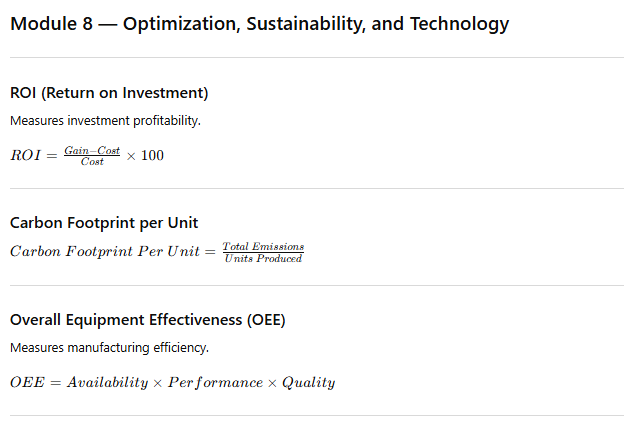
    Carbon Footprint - Total greenhouse gas emissions associated with activities.

    Technology & Digital Transformation

    Digital Supply Chain - Supply chain enabled by digital technologies and automation.

    IoT (Internet of Things) - Connected devices sharing operational data.

    Blockchain - Distributed ledger technology providing secure transaction tracking.

    AI (Artificial Intelligence) - Technology simulating human decision-making and learning.

    Machine Learning - AI subset using algorithms to improve through data analysis.

    Predictive Analytics - Using data models to forecast future outcomes.

    Automation - Technology reducing manual tasks.

    Control Tower - Centralized platform providing supply chain visibility and monitoring.

    Cloud Computing - Delivery of computing services over the internet.

    Customer & Relationship Management

    Customer Service Level - Ability to meet customer expectations.

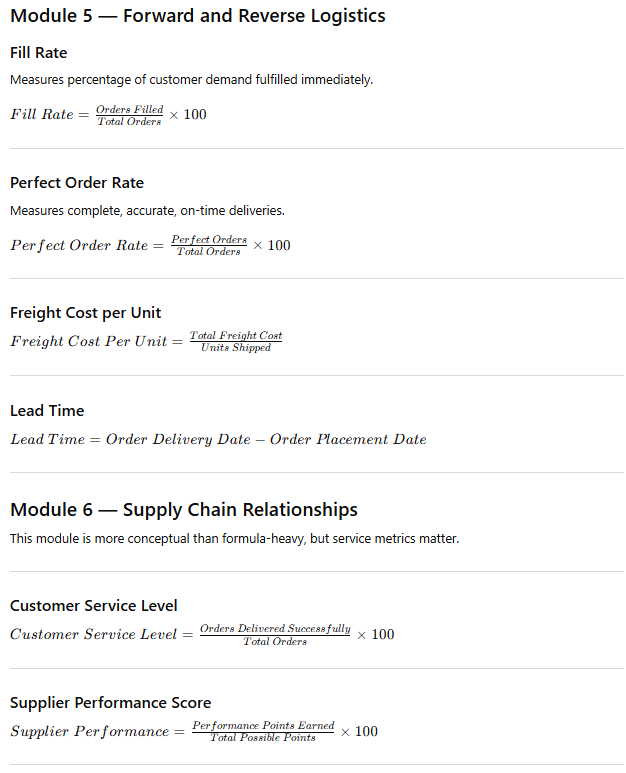
    Fill Rate - Percentage of customer demand fulfilled from available inventory.

    Fill\ Rate = \frac{Orders\ Filled}{Total\ Orders} \times 100

    Perfect Order - Order delivered complete, accurate, on time, and damage-free.

    CPFR (Collaborative Planning, Forecasting, and Replenishment) - Collaborative process improving supply chain coordination.

    Customer Experience (CX) - Customer perception of interactions with a company.

    Stakeholder - Individual or group affected by supply chain activities.

    Financial & Performance Metrics

    KPI (Key Performance Indicator) - Metric used to measure performance.

    Cash-to-Cash Cycle Time - Time between paying suppliers and receiving customer payments.

    Gross Margin - Revenue minus cost of goods sold.

    ROI (Return on Investment) - Profitability measure comparing gains to costs.

    ROI = \frac{Gain - Cost}{Cost} \times 100

    Working Capital - Current assets minus current liabilities.

    Cost-to-Serve - Total cost of delivering products/services to customers.

    Most Important Terms to Memorize First

    Focus on these early because they appear frequently on the exam:

    1. Bullwhip Effect
    2. EOQ
    3. Safety Stock
    4. Reorder Point
    5. S&OP
    6. Lead Time
    7. Fill Rate
    8. Total Landed Cost
    9. CPFR
    10. Supplier Relationship Management
    11. Lean vs Agile Supply Chain
    12. Push vs Pull Systems
    13. Forecast Error
    14. Inventory Turns
    15. Resilience
    16. Business Continuity Planning
    17. ESG
    18. Control Tower
    19. JIT
    20. Perfect Order

    Udemy Courses

    1. Certified Supply Chain Professional (CSCP) – YouAccel Training

    Best For

    • Comprehensive CSCP overview
    • Beginners to intermediate learners
    • Structured video-based learning

    Why It’s Popular

    • Bestseller course
    • Covers core CSCP domains
    • Good supplement to official ASCM materials
    • Includes practice-style questions

    Covers Topics Such As

    • Demand planning
    • Global supply chains
    • Procurement
    • Inventory management
    • Logistics
    • Risk management
    • Sustainability


    2. APICS Certified Supply Chain Professional (CSCP) | 2026 Practice Exams

    Best For

    • Practice testing
    • Exam readiness
    • Scenario-based question preparation

    Why It Helps

    The CSCP exam is heavily scenario-based, so practice questions are extremely important for:

    • Understanding question wording
    • Learning tradeoff analysis
    • Building exam endurance

    Recommended Use

    Use this after:

    • Completing core study modules
    • Reviewing formulas and terminology

    Supplemental Udemy Courses That Pair Well With CSCP

    These are not official CSCP prep courses, but they strongly reinforce key exam topics.


    3. Supply Chain Analytics Courses on Udemy

    Best For

    • Module 1 (Forecasting)
    • Module 8 (Optimization & Technology)

    Helpful Topics

    • Predictive analytics
    • KPI dashboards
    • Inventory analytics
    • Demand forecasting
    • Excel/Power BI supply chain reporting

    Given your Power BI and AI transformation background, these courses will likely accelerate your understanding significantly.


    4. SAP Supply Chain / SAP MM / SAP EWM Courses on Udemy

    Best For

    • ERP concepts
    • Procurement workflows
    • Inventory management
    • Warehouse operations

    Helpful for Modules

    • Module 3
    • Module 4
    • Module 5

    Since you already have ERP implementation experience, these courses can help connect CSCP concepts to real-world systems.


    5. Logistics & Transportation Courses on Udemy

    Best For

    • Module 5
    • Transportation tradeoffs
    • Warehousing
    • Reverse logistics

    Helpful Topics

    • Freight optimization
    • Distribution networks
    • Last-mile delivery
    • 3PL vs 4PL


    Important Reality About CSCP Prep

    Most successful candidates use:

    • The official ASCM materials as the foundation
      PLUS
    • Supplemental video/practice resources like Udemy

    This is because the official material is very comprehensive but can feel dense and academic at times.

    The Udemy courses help by:

    • Explaining concepts visually
    • Simplifying terminology
    • Providing real-world examples
    • Reinforcing exam patterns

    Additional Helpful Communities

    Youtube Learning

    APICS CSCP Module 1 Supply Chains, demand management and forecasting Full Course (95 min)

    Reddit Discussion

    Many professionals discuss CSCP study approaches here:

    CSCP Using Udemy? – Reddit Discussion

    Several users noted they successfully supplemented or prepared with Udemy-style materials, especially for reinforcing concepts and practice testing.


    Download the Document, PDF, or Presentation

    Mastering The Ascm Cscp Certification A Strategic Guide For Modern Supply Chain Leaders Docx

    Word – 23.1 KB 0 downloads

    Mastering The Ascm Cscp Certification Pdf

    PDF – 832.4 KB 0 downloads

    Mastering The Ascm Cscp Certification Pptx

    PowerPoint – 20.3 MB 0 downloads

    Ascm Cscp Study Guide Docx

    Word – 27.4 KB 0 downloads

    Ascm Cscp Glossary Of Key Terms Docx

    Word – 23.4 KB 0 downloads

    Ascm Cscp Memory Hooks Docx

    Word – 58.8 KB 0 downloads

    Recommended Udemy Cscp Courses Docx

    Word – 19.9 KB 0 downloads

    ASCM CSCP Memory Hooks

    Module 1 Memory Hooks

    ASCM CSCP Module 1 Memory Hooks

    “When the Exam Says ___ → Look for ___”

    These are designed specifically for CSCP-style scenario questions. The exam often hides the correct answer behind business wording, so recognizing trigger phrases is extremely valuable.


      Demand Planning & Forecasting

      When the Question Says…-Look For…

      “No historical data available” - Qualitative forecasting

      “New product launch” - Delphi method / market research

      “Stable historical demand” - Quantitative forecasting

      “Recent demand changes” - Exponential smoothing

      “Need faster forecast responsiveness” - Exponential smoothing

      “Long-term stable demand” - Moving average

      “Forecast accuracy declining” - Better collaboration & demand signals

      “Sales and operations misaligned” - S&OP

      “Departments working in silos” - Cross-functional collaboration

      “Conflicting forecasts” - S&OP process

      “Demand fluctuations increasing upstream” - Bullwhip effect

      “Large order batching” - Bullwhip effect

      “Poor information sharing” - Bullwhip effect

      “Need to reduce forecast error” - Visibility + collaboration


        Forecast Accuracy Metrics

        When the Question Says… - Look For…

        “Average forecast error magnitude” - MAD

        “Percentage forecast error” - MAPE

        “Forecast consistently too high/low” - Forecast bias

        “Measure forecasting performance” - Forecast accuracy metrics

        Push vs Pull Systems

        When the Question Says… - Look For…

        “Forecast-driven production” - Push system

        “Build inventory ahead of demand” - Push system

        “Customer-order-driven production” - Pull system

        “Reduce inventory levels” - Pull system

        “Respond directly to customer demand” - Pull system

        “High customization” - Pull system / Agile

        “Mass production efficiency” - Push system / Lean

        Lean vs Agile Supply Chains

        When the Question Says… - Look For…

        “Stable predictable demand” - Lean

        “Waste reduction” - Lean

        “Lowest cost” - Lean

        “Efficiency focus” - Lean

        “Rapidly changing demand” - Agile

        “Short product life cycles” - Agile

        “High variability” - Agile

        “Fast response needed” - Agile

        “Hybrid strategy” - Lean + Agile balance

        Supply Chain Strategy

        When the Question Says… - Look For…

        “Balance responsiveness and efficiency” - Supply chain strategy alignment

        “End-to-end optimization” - Integrated supply chain thinking

        “One department optimizing itself” - Usually NOT best answer

        “Best for entire organization” - Cross-functional optimization

        “Customer service vs cost tradeoff” - Strategic balancing

        “Improve overall supply chain performance” - Visibility + collaboration

        Supply Chain Visibility

        When the Question Says… - Look For…

        “Lack of real-time information” - Visibility tools

        “Cannot track inventory/orders” - Visibility issue

        “Need proactive decision making” - Shared information

        “Improve coordination” - Visibility + integration

        “Delayed demand information” - Bullwhip risk

        “Real-time supply chain monitoring” - Control tower / visibility systems

        Demand Variability

        When the Question Says… - Look For…

        “Predictable yearly spikes” - Seasonal demand

        “Unexpected fluctuations” - Demand variability

        “Promotions causing unstable demand” - Demand shaping effects

        “Need to smooth operations” - Better forecasting/S&OP

        Collaboration & S&OP

        Collaboration & S&OP

        When the Question Says… - Look For…

        “Finance, sales, and operations disagree” - S&OP

        “Operations cannot meet sales commitments” - S&OP

        “Need alignment across departments” - Integrated planning

        “Executive balancing demand and supply” - S&OP

        “Single version of the forecast” - Collaborative planning

        Exam Elimination Tricks

        If You See:

        • “Improve entire supply chain”
        • “Cross-functional”
        • “Visibility”
        • “Collaboration”
        • “Customer demand”
        • “End-to-end”

        The correct answer is usually:
        ✅ Collaborative
        ✅ Integrated
        ✅ Strategic
        ✅ Visibility-focused

        NOT:
        ❌ Department silo solutions
        ❌ Large inventory increases
        ❌ Short-term fixes

        Common CSCP Exam Traps

        Trap Answer - Why It’s Usually Wrong

        “Increase inventory” - Treats symptoms, not root cause

        “Add more safety stock” - Often expensive band-aid

        “Optimize one department” - CSCP favors end-to-end thinking

        “Reduce communication” - Collaboration is almost always better

        “Choose lowest supplier cost” - Total value matters more

        “Use only historical data” - CSCP favors responsiveness

        High-Probability Module 1 Concepts

        These appear repeatedly on practice exams and the real exam:

        Topic - Importance

        S&OP - VERY HIGH

        Bullwhip effect - VERY HIGH

        Lean vs Agile - VERY HIGH

        Push vs Pull - VERY HIGH

        Forecast accuracy - HIGH

        Visibility - HIGH

        Collaboration - HIGH

        Exponential smoothing - MEDIUM

        MAD/MAPE - MEDIUM

        Quick Mental Models

        “Customer demand changing quickly”  → Agile + responsiveness

        “Stable demand + low cost”  → Lean + efficiency

        “Departments disconnected” → S&OP + collaboration

        “Upstream chaos” → Bullwhip effect

        “No data available” → Qualitative forecasting

        “Need better forecasting” → Visibility + collaboration + recent demand signals

        The BIG CSCP Rule for Module 1

        The exam usually rewards answers that:

        • Improve visibility
        • Increase collaboration
        • Optimize the entire supply chain
        • Align demand and supply
        • Reduce variability
        • Improve responsiveness strategically

        NOT answers that:

        • Create silos
        • Overbuild inventory
        • Optimize only one function
        • Ignore customer demand signals

        Most Important Phrase to Remember

        “The BEST answer usually improves the ENTIRE supply chain — not just one department.”

        Module 2 Memory Hooks

        Global Supply Chain Networks

        “When the Exam Says ___ → Look for ___”

        Module 2 focuses heavily on:

        • Global trade
        • International sourcing
        • Supply chain network design
        • Trade compliance
        • Total landed cost
        • Resilience and globalization tradeoffs

        The exam often tests whether you understand the balance between:

        • Cost
        • Speed
        • Risk
        • Compliance
        • Visibility
        • Geographic strategy

        Total Landed Cost

        When the Question Says… → Look For…

        “Lowest supplier price” → NOT always best answer

        “Hidden international costs” → Total landed cost

        “Import duties and transportation” → Landed cost analysis

        “True overall sourcing cost” → Total landed cost

        “Evaluate global sourcing options” → Landed cost comparison

        “Unexpected international expenses” → Duties/tariffs/logistics

        Memory Hook

        “Cheapest supplier ≠ Cheapest supply chain.”

        The exam LOVES testing this concept.

        Nearshoring vs Offshoring

        When the Question Says… → Look For…

        “Reduce transportation time” → Nearshoring

        “Lower geopolitical risk” → Nearshoring

        “Improve responsiveness” → Nearshoring

        “Lowest labor cost” → Offshoring

        “Global manufacturing cost savings” → Offshoring

        “Long lead times but lower costs” → Offshoring

        Memory Hook

        “Near = Faster & safer”

        “Offshore = Cheaper but riskier”

        Supply Chain Risk & Resilience

        When the Question Says… → Look For…

        “Single supplier dependency” → High supply chain risk

        “Port congestion” → Supply chain disruption

        “Geopolitical instability” → Diversification

        “Natural disasters affecting suppliers” → Resilience planning

        “Pandemic disruption” → Business continuity

        “Improve recovery capability” → Resilience

        “Reduce dependency risk” → Dual sourcing

        Memory Hook

        “The exam rewards resilience over fragile efficiency.”

        Trade Compliance

        When the Question Says… → Look For…

        “Import/export regulations” → Trade compliance

        “Government restrictions” → Compliance requirements

        “Cross-border shipments delayed” → Customs/compliance issue

        “International documentation errors” → Compliance process

        “Regulatory penalties” → Non-compliance

        Memory Hook

        “Global supply chains must obey local rules.”

        Incoterms

        When the Question Says… → Look For…

        “Who owns transportation responsibility?” → Incoterms

        “Transfer of risk between buyer and seller” → Incoterms

        “Seller responsible until delivery” → DDP

        “Buyer responsible almost immediately” → EXW

        “Seller pays freight and insurance” → CIF

        “Responsibility transfers at shipping point” → FOB

        Important Exam Concept

        The exam often tests:

        • Who owns risk
        • Who pays transportation
        • Where ownership transfers

        NOT memorization alone.

        Global Network Design

        When the Question Says… → Look For…

        “Optimize warehouse locations” → Network design

        “Balance cost and responsiveness” → Network optimization

        “Reduce transportation distance” → Distribution network analysis

        “Customer service improvements” → Strategic placement

        “Multi-country operations” → Global network design

        Memory Hook

        “The best network balances cost, speed, and risk.”

        Transportation Tradeoffs

        When the Question Says… → Look For…

        “Fastest transportation method” → Air freight

        “Lowest transportation cost” → Ocean freight

        “Large international shipments” → Ocean/rail

        “Urgent customer demand” → Air transportation

        “Balance speed and cost” → Transportation optimization

        Exam Tip

        The exam frequently tests:

        • Cost vs speed
        • Efficiency vs responsiveness

        Supplier Diversification

        When the Question Says… → Look For…

        “Reduce disruption risk” → Multiple suppliers

        “Single geographic dependency” → Diversification

        “Business continuity concern” → Dual sourcing

        “Supply interruptions” → Alternative sourcing

        Memory Hook

        “Single source = single point of failure.”

        Globalization Tradeoffs

        When the Question Says… → Look For…

        “Expanded global operations” → Increased complexity

        “Lower international production costs” → Offshoring benefits

        “Longer lead times” → Global sourcing tradeoff

        “Greater disruption exposure” → Globalization risk

        “Need better visibility” → Global coordination

        Visibility & Technology

        When the Question Says… → Look For…

        “Cannot track global shipments” → Visibility tools

        “Real-time shipment monitoring” → Technology enablement

        “Need end-to-end visibility” → Control tower/analytics

        “Delayed supply chain information” → Visibility gap

        Memory Hook

        “Global complexity requires visibility.”

        Common CSCP Module 2 Exam Traps

        Trap Answer → Why It’s Usually Wrong

        “Choose lowest supplier cost” → Ignores landed cost/risk

        “Single sourcing only” → Creates risk exposure

        “Maximize efficiency only” → May reduce resilience

        “Ignore trade compliance” → Compliance always matters

        “Centralize everything globally” → May hurt responsiveness

        “Focus only on transportation cost” → Ignores total network impact

        High-Probability Module 2 Concepts

        Topic → Importance

        Total landed cost → VERY HIGH

        Nearshoring vs offshoring → VERY HIGH

        Resilience → VERY HIGH

        Diversification → HIGH

        Trade compliance → HIGH

        Incoterms → HIGH

        Global risk → HIGH

        Transportation tradeoffs → HIGH

        Network optimization → HIGH

        Quick Mental Models

        “Global disruption”   →  Resilience + diversification

        “Cheapest supplier overseas”   →  Check total landed cost

        “Faster customer response”  →  Nearshoring/regionalization

        “Customs delays”  →  Trade compliance issue

        “Single overseas supplier”  →  High risk exposure

        “International complexity”  →  Visibility + coordination

        BIG Module 2 Rule

        The exam usually rewards answers that:

        • Improve resilience
        • Balance cost and responsiveness
        • Increase visibility
        • Reduce dependency risk
        • Consider total landed cost
        • Improve global coordination

        NOT answers that:

        • Optimize only for lowest cost
        • Ignore compliance
        • Create single points of failure
        • Ignore geopolitical risk

        Most Important Phrase to Remember

        “The BEST global supply chain decision balances cost, responsiveness, compliance, and resilience.”

        Module 3 Memory Hooks

        Sourcing Products and Services

        “When the Exam Says ___ → Look for ___”

        Module 3 focuses heavily on:

        • Procurement
        • Strategic sourcing
        • Supplier management
        • Supplier relationships
        • Contracting
        • Total cost thinking
        • Supplier performance and risk

        The exam typically tests whether you understand:

        • Long-term supplier value
          vs
        • Short-term purchasing cost

        Strategic Sourcing

        “Long-term procurement strategy” → Strategic sourcing
        “Improve supplier relationships” → Strategic sourcing
        “Optimize supplier value” → Strategic sourcing
        “Reduce total procurement cost” → Strategic sourcing
        “Cross-functional sourcing decisions” → Strategic sourcing

        Memory Hook

        “Strategic sourcing = long-term value, NOT lowest price.”

        Total Cost of Ownership (TCO)

        “Hidden supplier costs” → TCO
        “Maintenance, transportation, quality costs” → TCO
        “Supplier with lowest price causing problems” → TCO analysis
        “Lifecycle costs” → TCO
        “Evaluate overall supplier value” → TCO

        Memory Hook

        “Cheap purchases can become expensive operations.”

        The exam LOVES this concept.

        Supplier Relationship Management (SRM)

        “Collaborative supplier partnership” → SRM
        “Improve supplier performance” → SRM
        “Long-term supplier collaboration” → SRM
        “Innovation with suppliers” → Strategic supplier relationships
        “Mutual business improvement” → SRM

        Memory Hook

        “The exam favors partnership over transactional purchasing.”

        RFI vs RFP vs RFQ

        “Gather supplier capabilities” → RFI
        “Need detailed supplier solution” → RFP
        “Need supplier pricing only” → RFQ
        “Compare solution approaches” → RFP
        “Early supplier research” → RFI

        Quick Memory Trick

        RFI → Information
        RFP → Proposal
        RFQ → Quote

        Supplier Selection

        “Evaluate supplier reliability” → Supplier selection criteria
        “Financially unstable supplier” → Supplier risk
        “Quality and delivery concerns” → Supplier performance evaluation
        “Need long-term strategic supplier” → Multi-factor evaluation
        “Supplier scorecard” → Performance measurement

        Memory Hook

        “Best supplier ≠ Lowest bid.”

        Make vs Buy Decisions

        “Core competency” → Make internally
        “Lack internal capacity” → Buy/outsource
        “Protect intellectual property” → Make decision
        “Specialized expertise unavailable internally” → Buy decision
        “Evaluate outsourcing” → Make vs buy analysis

        Memory Hook

        “Keep strategic capabilities close.”

        Supplier Risk

        “Single supplier dependency” → Supplier risk
        “Supplier bankruptcy concern” → Risk mitigation
        “Need supply continuity” → Diversification
        “Critical supplier disruption” → Contingency planning
        “Supplier geographic instability” → Risk analysis

        Exam Tip

        The exam often favors:

        • Diversification
        • Collaboration
        • Supplier visibility
        • Risk mitigation

        over:

        • Pure cost optimization

        Category Management

        “Manage groups of related purchases” → Category management
        “Enterprise procurement strategy” → Category management
        “Standardize procurement” → Category management
        “Consolidate purchasing power” → Category management

        Memory Hook

        “Category management = strategic purchasing by groups.”

        Supplier Performance

        “Measure supplier effectiveness” → Supplier scorecard
        “Track supplier KPIs” → Performance management
        “Delivery, quality, responsiveness metrics” → Supplier evaluation
        “Continuous supplier improvement” → Supplier collaboration

        Common Supplier KPIs

        • On-time delivery
        • Quality defects
        • Responsiveness
        • Cost performance
        • Lead time reliability

        Procurement Ethics & Compliance

        “Conflict of interest” → Procurement ethics
        “Supplier favoritism” → Ethical violation
        “Regulatory procurement requirements” → Compliance
        “Transparent sourcing process” → Ethical procurement

        Memory Hook

        “Fairness and transparency matter in procurement.”

        Negotiation

        “Long-term supplier agreement” → Collaborative negotiation
        “Mutual value creation” → Win-win negotiation
        “Strategic supplier partnership” → Relationship focus
        “Pure price pressure” → Usually NOT best answer

        Memory Hook

        “CSCP prefers collaboration over adversarial negotiations.”

        Outsourcing

        “Reduce operational burden” → Outsourcing
        “Specialized external expertise” → Outsourcing
        “Focus on core competencies” → Outsourcing
        “Need supplier oversight” → Governance

        Exam Tip

        The exam often tests:

        • Outsourcing benefits
          vs
        • Loss of control/risk

        Common Module 3 Exam Traps

        “Choose lowest supplier cost” → Wrong because it ignores TCO/risk
        “Use only one supplier” → Wrong because it creates risk exposure
        “Focus only on short-term savings” → Wrong because CSCP favors long-term value
        “Transactional purchasing only” → Wrong because collaboration is preferred
        “Ignore supplier relationship quality” → Wrong because SRM is highly valued
        “Price-only negotiations” → Wrong because it is too tactical

        High-Probability Module 3 Concepts

        Strategic sourcing → VERY HIGH importance
        TCO → VERY HIGH importance
        SRM → VERY HIGH importance
        Supplier risk → HIGH importance
        RFI/RFP/RFQ → HIGH importance
        Supplier scorecards → HIGH importance
        Make vs buy → HIGH importance
        Procurement ethics → MEDIUM importance
        Category management → MEDIUM importance

        Quick Mental Models

        “Lowest supplier bid” → Check TCO and risk

        “Long-term supplier success” → SRM + collaboration

        “Need supplier pricing” → RFQ

        “Need supplier capabilities” → RFI

        “Need supplier solution” → RFP

        “Critical supplier dependency” → Diversification

        “Strategic business capability” → Consider keeping in-house

        BIG Module 3 Rule

        The exam usually rewards answers that:

        • Focus on long-term supplier value
        • Improve supplier collaboration
        • Reduce supplier risk
        • Consider total cost
        • Improve procurement transparency
        • Build strategic partnerships

        NOT answers that:

        • Focus only on lowest cost
        • Ignore supplier relationships
        • Create dependency risk
        • Optimize only short-term savings

        Most Important Phrase to Remember

        “The BEST sourcing decision balances cost, quality, reliability, collaboration, and risk.”

        Module 4 Memory Hooks

        Internal Operations and Inventory

        “When the Exam Says ___ → Look for ___”

        Module 4 focuses heavily on:

        • Inventory management
        • Manufacturing operations
        • Lean operations
        • Capacity planning
        • Continuous improvement
        • ERP/MRP systems
        • Operational efficiency

        The exam typically tests whether you understand:

        • Inventory tradeoffs
        • Flow optimization
        • Waste reduction
        • Balancing efficiency with responsiveness

        Inventory Management

        “Too much inventory” → High carrying costs
        “Frequent stockouts” → Insufficient inventory/safety stock issue
        “Balance inventory and service levels” → Inventory optimization
        “Excess obsolete inventory” → Poor forecasting/planning
        “Need inventory classification” → ABC analysis
        “High inventory holding costs” → Reduce excess inventory
        “Inventory buffer for uncertainty” → Safety stock

        Memory Hook

        “Inventory solves uncertainty—but creates cost.”

        Safety Stock

        “Demand variability” → Safety stock
        “Lead time uncertainty” → Safety stock
        “Prevent stockouts” → Safety stock
        “Buffer inventory” → Safety stock
        “Improve service levels” → Safety stock

        Memory Hook

        “Safety stock protects against uncertainty.”

        EOQ (Economic Order Quantity)

        “Balance ordering and carrying costs” → EOQ
        “Optimal order quantity” → EOQ
        “Reduce total inventory costs” → EOQ
        “Tradeoff between order frequency and storage cost” → EOQ

        Memory Hook

        “EOQ finds the cheapest balance.”

        Reorder Point (ROP)

        “When should replenishment begin?” → Reorder point
        “Inventory trigger level” → ROP
        “Avoid running out of inventory” → ROP
        “Inventory replenishment timing” → ROP

        Memory Hook

        “ROP tells you WHEN to reorder.”

        ABC Analysis

        “Prioritize high-value inventory” → ABC analysis
        “Small percentage of items represent most value” → A items
        “Inventory classification system” → ABC analysis
        “Focus management attention” → ABC prioritization

        Memory Hook

        “A items get the MOST attention.”

        Lean Operations

        “Waste reduction” → Lean
        “Continuous flow” → Lean
        “Improve efficiency” → Lean
        “Reduce non-value-added activities” → Lean
        “Lower operational waste” → Lean principles

        Memory Hook

        “Lean removes waste from the process.”

        Continuous Improvement

        “Incremental operational improvements” → Kaizen
        “Ongoing process optimization” → Continuous improvement
        “Employee-driven improvements” → Kaizen culture
        “Reduce inefficiencies over time” → Continuous improvement

        Memory Hook

        “Kaizen = small improvements every day.”

        Just-in-Time (JIT)

        “Minimal inventory levels” → JIT
        “Receive inventory only when needed” → JIT
        “Reduce carrying costs” → JIT
        “High dependency on reliable suppliers” → JIT risk

        Memory Hook

        “JIT reduces inventory but increases dependency risk.”

        Capacity Planning

        “Production cannot meet demand” → Capacity issue
        “Resource constraints” → Capacity planning
        “Need future production capability” → Capacity planning
        “Balance workload and resources” → Capacity management

        Memory Hook

        “Capacity planning matches resources to demand.”

        Bottlenecks & Constraints

        “Production delays at one process step” → Bottleneck
        “System throughput limitation” → Constraint
        “One resource limiting output” → Theory of Constraints
        “Improve system flow” → Bottleneck management

        Memory Hook

        “A chain moves only as fast as its bottleneck.”

        MRP (Material Requirements Planning)

        “Determine material needs” → MRP
        “Dependent demand calculations” → MRP
        “Production material scheduling” → MRP
        “Bill of materials planning” → MRP

        Memory Hook

        “MRP answers: What materials are needed and when?”

        ERP Systems

        “Integrated enterprise data” → ERP
        “Single system across departments” → ERP
        “Centralized operational visibility” → ERP
        “Cross-functional process integration” → ERP

        Memory Hook

        “ERP connects the enterprise.”

        Six Sigma

        “Reduce defects” → Six Sigma
        “Process variation reduction” → Six Sigma
        “Improve quality consistency” → Six Sigma
        “Data-driven quality improvement” → Six Sigma

        Memory Hook

        “Six Sigma focuses on quality and consistency.”

        Throughput

        “Rate of system output” → Throughput
        “Increase production flow” → Throughput improvement
        “System productivity” → Throughput
        “Constraint limiting production” → Throughput bottleneck

        Memory Hook

        “Throughput measures how fast value flows.”

        Common Module 4 Exam Traps

        “Increase inventory everywhere” → Wrong because it increases cost
        “Maximize utilization of every machine” → Wrong because local optimization may hurt flow
        “Ignore bottlenecks” → Wrong because constraints drive throughput
        “Reduce inventory without improving visibility” → Wrong because stockout risk increases
        “Focus only on efficiency” → Wrong because responsiveness and flow matter too
        “Use JIT with unreliable suppliers” → Wrong because disruption risk increases

        High-Probability Module 4 Concepts

        Safety stock → VERY HIGH importance
        EOQ → VERY HIGH importance
        ROP → VERY HIGH importance
        Lean operations → VERY HIGH importance
        JIT → HIGH importance
        ABC analysis → HIGH importance
        Capacity planning → HIGH importance
        Bottlenecks/constraints → HIGH importance
        MRP/ERP → HIGH importance
        Six Sigma → MEDIUM importance

        Quick Mental Models

        “Inventory uncertainty” → Safety stock

        “Optimal order quantity” → EOQ

        “When to reorder inventory” → ROP

        “Waste reduction” → Lean

        “Defect reduction” → Six Sigma

        “Flow slowed by one step” → Bottleneck

        “Integrated enterprise operations” → ERP

        “Material planning for production” → MRP

        “Minimal inventory strategy” → JIT

        BIG Module 4 Rule

        The exam usually rewards answers that:

        • Improve flow
        • Reduce waste
        • Balance inventory and service levels
        • Optimize the entire process
        • Improve visibility
        • Manage constraints effectively
        • Support continuous improvement

        NOT answers that:

        • Build excessive inventory
        • Optimize one department only
        • Ignore bottlenecks
        • Reduce inventory recklessly
        • Maximize utilization at the expense of flow

        Most Important Phrase to Remember

        “The BEST operational decision improves flow, balances inventory risk, and optimizes the entire system.”

        Module 5 Memory Hooks

        Forward and Reverse Logistics

        “When the Exam Says ___ → Look for ___”

        Module 5 focuses heavily on:

        • Transportation
        • Warehousing
        • Distribution
        • Logistics optimization
        • Reverse logistics
        • Customer delivery
        • Network efficiency

        The exam typically tests whether you understand:

        • Cost vs speed tradeoffs
        • Transportation optimization
        • Customer service impacts
        • Logistics visibility
        • Distribution efficiency

        Transportation Modes

        “Fastest transportation method” → Air freight
        “Lowest transportation cost” → Ocean freight
        “Large bulk shipments” → Rail or ocean
        “Urgent delivery requirement” → Air transportation
        “Flexible regional delivery” → Truck transportation
        “International container shipping” → Ocean freight

        Memory Hook

        “Fast costs more. Cheap moves slower.”

        Transportation Optimization

        “Reduce transportation costs” → Route optimization/consolidation
        “Improve delivery efficiency” → Transportation optimization
        “Balance cost and delivery speed” → Transportation tradeoff analysis
        “Reduce empty miles” → Route optimization
        “Improve shipment utilization” → Freight consolidation

        Memory Hook

        “The exam rewards balancing cost, speed, and service.”

        Warehousing

        “Storage and handling of goods” → Warehousing
        “Inventory staging location” → Warehouse/distribution center
        “Improve inventory accessibility” → Warehouse optimization
        “Reduce warehouse movement waste” → Lean warehousing
        “Order fulfillment operations” → Warehouse processes

        Memory Hook

        “Warehouses support flow—not just storage.”

        Distribution Centers (DCs)

        “Rapid customer fulfillment” → Distribution center
        “Regional inventory positioning” → DC network strategy
        “Improve delivery responsiveness” → Strategic DC placement
        “Reduce customer lead times” → Distribution network optimization

        Memory Hook

        “DCs position inventory closer to demand.”

        Cross Docking

        “Minimal storage time” → Cross docking
        “Direct transfer from inbound to outbound” → Cross docking
        “Reduce warehousing costs” → Cross docking
        “Improve shipment flow” → Cross docking

        Memory Hook

        “Cross docking keeps products moving.”

        Last-Mile Delivery

        “Final delivery to customer” → Last-mile delivery
        “Customer delivery experience” → Last-mile logistics
        “Most expensive delivery stage” → Last-mile delivery
        “Home delivery optimization” → Last-mile efficiency

        Memory Hook

        “The last mile is often the most expensive mile.”

        Reverse Logistics

        “Returned products” → Reverse logistics
        “Product returns management” → Reverse logistics
        “Recycling and refurbishment” → Reverse logistics
        “Warranty return process” → Reverse logistics
        “Sustainability through reuse” → Reverse logistics

        Memory Hook

        “Supply chains also manage products going backward.”

        3PL vs 4PL

        “Outsourced logistics provider” → 3PL
        “Transportation and warehousing services” → 3PL
        “Provider managing multiple logistics partners” → 4PL
        “End-to-end logistics coordination” → 4PL

        Memory Hook

        “3PL performs logistics. 4PL manages logistics strategy.”

        Logistics Visibility

        “Cannot track shipments” → Visibility issue
        “Need real-time shipment tracking” → Visibility tools
        “Improve delivery coordination” → Logistics visibility
        “Delayed transportation information” → Visibility gap

        Memory Hook

        “Visibility improves logistics decisions.”

        Customer Service & Fulfillment

        “Improve order fulfillment accuracy” → Fulfillment optimization
        “Increase on-time delivery” → Logistics performance improvement
        “Customer delivery reliability” → Service level focus
        “Perfect order performance” → Fulfillment quality

        Memory Hook

        “Logistics directly impacts customer satisfaction.”

        Perfect Order

        “Complete, accurate, on-time delivery” → Perfect order
        “Damage-free shipment” → Perfect order metric
        “Measure fulfillment excellence” → Perfect order performance

        Memory Hook

        “Perfect order = right product, right place, right time.”

        Freight Consolidation

        “Combine shipments to reduce cost” → Freight consolidation
        “Improve transportation efficiency” → Consolidation
        “Increase shipment utilization” → Freight optimization

        Memory Hook

        “Combining shipments reduces transportation cost.”

        Lead Time

        “Time from order to delivery” → Lead time
        “Reduce customer waiting time” → Lead time reduction
        “Improve responsiveness” → Faster lead times
        “Extended shipping delays” → Long lead time issue

        Memory Hook

        “Customers feel lead time directly.”

        Common Module 5 Exam Traps

        “Choose cheapest transportation always” → Wrong because service levels matter
        “Maximize warehouse inventory everywhere” → Wrong because carrying costs increase
        “Ignore reverse logistics” → Wrong because returns and sustainability matter
        “Focus only on transportation cost” → Wrong because customer experience matters too
        “Use air freight for all shipments” → Wrong because cost tradeoffs matter
        “No shipment visibility” → Wrong because visibility is critical

        High-Probability Module 5 Concepts

        Transportation tradeoffs → VERY HIGH importance
        Warehousing → HIGH importance
        Cross docking → HIGH importance
        Reverse logistics → HIGH importance
        3PL/4PL → HIGH importance
        Last-mile delivery → HIGH importance
        Perfect order → HIGH importance
        Freight consolidation → MEDIUM importance
        Lead time → VERY HIGH importance
        Visibility → VERY HIGH importance

        Quick Mental Models

        “Fast delivery needed” → Air freight

        “Lowest transportation cost” → Ocean freight

        “Products move directly between trucks” → Cross docking

        “Customer returns” → Reverse logistics

        “Outsource logistics execution” → 3PL

        “Manage multiple logistics providers” → 4PL

        “Improve customer delivery experience” → Last-mile optimization

        “Need shipment tracking” → Visibility tools

        BIG Module 5 Rule

        The exam usually rewards answers that:

        • Balance cost and responsiveness
        • Improve visibility
        • Optimize logistics flow
        • Improve customer service
        • Reduce unnecessary handling/storage
        • Improve fulfillment reliability
        • Consider reverse logistics and sustainability

        NOT answers that:

        • Focus only on lowest transportation cost
        • Ignore customer delivery performance
        • Create excessive storage inefficiencies
        • Ignore shipment visibility
        • Optimize one logistics area while hurting another

        Most Important Phrase to Remember

        “The BEST logistics decision balances cost, speed, visibility, and customer service.”

        Module 6 Memory Hooks

        Supply Chain Relationships

        “When the Exam Says ___ → Look for ___”

        Module 6 focuses heavily on:

        • Collaboration
        • Customer relationships
        • Supplier partnerships
        • Communication
        • Cross-functional alignment
        • Relationship management
        • Shared business goals

        The exam typically tests whether you understand:

        • Collaboration over silos
        • Long-term partnerships over transactional behavior
        • Shared visibility and communication
        • Alignment across the supply chain ecosystem

        This is one of the MOST heavily tested modules on the exam.

        Collaboration

        “Departments working independently” → Lack of collaboration
        “Improve cross-functional alignment” → Collaboration
        “Shared planning across organizations” → Collaboration
        “Disconnected supply chain decisions” → Need integration
        “Improve coordination between partners” → Collaboration

        Memory Hook

        “The exam almost always favors collaboration.”

        CPFR (Collaborative Planning, Forecasting, and Replenishment)

        “Shared forecasting between partners” → CPFR
        “Joint demand planning” → CPFR
        “Retailer and supplier sharing demand data” → CPFR
        “Reduce forecast variability” → CPFR
        “Improve replenishment coordination” → CPFR

        Memory Hook

        “CPFR = shared forecasting and replenishment.”

        Customer Relationship Management

        “Improve customer satisfaction” → Relationship management
        “Long-term customer loyalty” → Customer collaboration
        “Better customer communication” → CRM/customer engagement
        “Customer retention focus” → Relationship building

        Memory Hook

        “Strong relationships improve long-term performance.”

        Supplier Partnerships

        “Strategic supplier collaboration” → Partnership model
        “Joint innovation with suppliers” → Supplier partnership
        “Long-term supplier relationship” → SRM/collaboration
        “Mutual business improvement” → Strategic partnership

        Memory Hook

        “CSCP favors partnership over adversarial supplier relationships.”

        Information Sharing

        “Limited supply chain visibility” → Improve information sharing
        “Delayed communication between partners” → Visibility/collaboration issue
        “Real-time operational coordination” → Shared information systems
        “Need accurate supply chain data” → Visibility tools

        Memory Hook

        “Visibility improves relationships and decisions.”

        Organizational Alignment

        “Conflicting departmental goals” → Alignment problem
        “Operations and sales disagree” → Cross-functional alignment needed
        “Enterprise-wide planning” → Integrated alignment
        “Shared organizational objectives” → Strategic alignment

        Memory Hook

        “The best supply chains align goals across functions.”

        Trust & Transparency

        “Poor communication between partners” → Lack of trust
        “Hidden operational issues” → Transparency problem
        “Improve strategic relationships” → Transparency and communication
        “Shared risk management” → Trust-based collaboration

        Memory Hook

        “Trust strengthens supply chain resilience.”

        Stakeholder Management

        “Multiple business groups involved” → Stakeholder management
        “Conflicting priorities” → Stakeholder alignment
        “Need executive support” → Stakeholder engagement
        “Cross-enterprise coordination” → Stakeholder communication

        Memory Hook

        “Supply chain success requires stakeholder alignment.”

        Customer Service Levels

        “Improve delivery reliability” → Customer service focus
        “Increase fill rate” → Service level improvement
        “Meet customer expectations” → Customer-centric operations
        “Balance service and cost” → Service optimization

        Memory Hook

        “Customer service drives supply chain value.”

        Fill Rate

        “Percentage of demand fulfilled immediately” → Fill rate
        “Inventory availability performance” → Fill rate
        “Measure service effectiveness” → Fill rate KPI

        Memory Hook

        “Fill rate measures how well demand is fulfilled.”

        Conflict Resolution

        “Supplier disagreement” → Relationship management
        “Cross-functional disputes” → Collaboration/problem solving
        “Partnership tension” → Communication/alignment
        “Escalating operational conflicts” → Relationship governance

        Memory Hook

        “CSCP favors communication before escalation.”

        Cultural Awareness

        “Global supplier communication challenges” → Cultural awareness
        “International business relationship issues” → Cross-cultural management
        “Global collaboration difficulties” → Cultural alignment

        Memory Hook

        “Global supply chains require cultural awareness.”

        Common Module 6 Exam Traps

        “Departments optimize independently” → Wrong because silos hurt performance
        “Withhold information from partners” → Wrong because visibility matters
        “Focus only on transactional relationships” → Wrong because partnerships are preferred
        “Ignore stakeholder communication” → Wrong because alignment matters
        “Prioritize short-term wins over relationships” → Wrong because CSCP favors long-term value
        “Escalate immediately without collaboration” → Wrong because communication comes first

        High-Probability Module 6 Concepts

        Collaboration → VERY HIGH importance
        CPFR → VERY HIGH importance
        Stakeholder alignment → VERY HIGH importance
        Supplier partnerships → HIGH importance
        Customer relationships → HIGH importance
        Visibility/information sharing → HIGH importance
        Trust and transparency → HIGH importance
        Fill rate/service levels → MEDIUM importance
        Conflict resolution → MEDIUM importance

        Quick Mental Models

        “Shared forecasting” → CPFR

        “Departments not aligned” → Collaboration issue

        “Long-term supplier success” → Partnership model

        “Poor communication” → Visibility/trust issue

        “Customer dissatisfaction” → Service level issue

        “Multiple groups involved” → Stakeholder management

        “Need enterprise-wide coordination” → Alignment

        BIG Module 6 Rule

        The exam usually rewards answers that:

        • Improve collaboration
        • Increase transparency
        • Strengthen partnerships
        • Improve visibility
        • Align stakeholders
        • Support long-term relationships
        • Improve communication across the supply chain

        NOT answers that:

        • Create silos
        • Withhold information
        • Focus only on short-term gains
        • Damage relationships
        • Ignore stakeholder alignment
        • Prioritize transactional behavior over partnerships

        Most Important Phrase to Remember

        “The BEST supply chain relationships are collaborative, transparent, and aligned around shared goals.”

        Module 7 Memory Hooks

        “When the Exam Says ___ → Look for ___”

        Module 7 focuses heavily on:

        • Risk management
        • Business continuity
        • Resilience
        • Cybersecurity
        • Disruption response
        • Contingency planning
        • Supply chain visibility

        This is one of the MOST heavily weighted sections of the CSCP exam.

        The exam typically tests whether you understand:

        • Proactive risk management
        • Resilience over fragile efficiency
        • Diversification
        • Visibility
        • Business continuity planning
        • Long-term operational stability

        Supply Chain Risk

        “Potential operational disruption” → Supply chain risk
        “Unexpected interruption” → Risk event
        “Threat to supply continuity” → Risk exposure
        “Operational vulnerability” → Risk assessment
        “Single point of failure” → High risk

        Memory Hook

        “The exam rewards proactive risk management.”

        Business Continuity Planning (BCP)

        “Maintain operations during disruption” → BCP
        “Recover critical business processes” → Business continuity
        “Disaster preparedness” → Continuity planning
        “Operational recovery strategy” → BCP
        “Minimize downtime” → Continuity management

        Memory Hook

        “BCP keeps the business running during disruption.”

        Resilience

        “Ability to recover quickly” → Resilience
        “Adapt to disruption” → Resilience strategy
        “Improve recovery capability” → Resilience
        “Operational flexibility during crisis” → Resilience planning

        Memory Hook

        “Resilience = absorb disruption and recover fast.”

        Diversification

        “Single supplier dependency” → Diversification needed
        “Single geographic dependency” → Diversification risk
        “Reduce supply interruption risk” → Multi-sourcing
        “Alternative sourcing strategy” → Diversification

        Memory Hook

        “Single source = single point of failure.”

        Cybersecurity

        “Digital supply chain attack” → Cybersecurity risk
        “Data breach impacting operations” → Cybersecurity
        “Ransomware affecting suppliers” → Cybersecurity disruption
        “Protect supply chain systems” → Cybersecurity controls

        Memory Hook

        “Modern supply chains depend on secure digital systems.”

        Visibility

        “Cannot detect disruption early” → Visibility issue
        “Lack of real-time operational data” → Visibility gap
        “Improve disruption response” → Visibility tools
        “Need end-to-end monitoring” → Visibility systems

        Memory Hook

        “You cannot manage risks you cannot see.”

        Risk Mitigation

        “Reduce disruption probability” → Mitigation strategy
        “Lower operational exposure” → Risk mitigation
        “Prevent supply interruptions” → Mitigation planning
        “Reduce impact of future disruptions” → Mitigation controls

        Memory Hook

        “Mitigation reduces either likelihood or impact.”

        Contingency Planning

        “Backup operational plan” → Contingency plan
        “Alternative transportation method” → Contingency strategy
        “Emergency supplier option” → Contingency sourcing
        “Response plan for disruptions” → Contingency planning

        Memory Hook

        “Contingency plans prepare for failure scenarios.”

        Geopolitical Risk

        “Political instability” → Geopolitical risk
        “Trade restrictions” → Geopolitical disruption
        “International conflict affecting supply chain” → Geopolitical exposure
        “Government regulation changes” → Political risk

        Memory Hook

        “Global supply chains inherit global risks.”

        Natural Disasters

        “Hurricane disrupting suppliers” → Disaster risk
        “Earthquake affecting production” → Geographic risk
        “Flooding impacting logistics” → Environmental disruption
        “Weather-related operational interruption” → Natural disaster risk

        Memory Hook

        “Location concentration increases disaster exposure.”

        Supplier Risk

        “Financially unstable supplier” → Supplier risk
        “Critical supplier failure” → Supplier dependency risk
        “Unreliable supplier performance” → Supplier evaluation issue
        “Supplier bankruptcy” → Supply continuity risk

        Memory Hook

        “Strong suppliers reduce operational risk.”

        Insurance & Financial Protection

        “Transfer financial risk” → Insurance
        “Protect against financial losses” → Risk transfer
        “Business loss coverage” → Insurance strategy

        Memory Hook

        “Some risks are mitigated by transfer—not avoidance.”

        Inventory Buffers

        “Protect against supply disruptions” → Safety stock
        “Buffer against uncertainty” → Inventory cushion
        “Increase resilience during shortages” → Safety inventory

        Memory Hook

        “Inventory is expensive—but sometimes necessary protection.”

        Scenario Planning

        “Evaluate possible future disruptions” → Scenario planning
        “Prepare for multiple risk outcomes” → Scenario analysis
        “Test operational response capability” → Risk simulations

        Memory Hook

        “Scenario planning prepares organizations for uncertainty.”

        Common Module 7 Exam Traps

        “Optimize only for lowest cost” → Wrong because resilience matters too
        “Use only one supplier” → Wrong because dependency risk increases
        “Ignore visibility investments” → Wrong because visibility improves response
        “Eliminate all inventory buffers” → Wrong because resilience may suffer
        “No contingency plans needed” → Wrong because disruptions are inevitable
        “React only after disruption occurs” → Wrong because proactive management is preferred

        High-Probability Module 7 Concepts

        Resilience → VERY HIGH importance
        Business continuity planning → VERY HIGH importance
        Diversification → VERY HIGH importance
        Visibility → VERY HIGH importance
        Cybersecurity → HIGH importance
        Risk mitigation → HIGH importance
        Contingency planning → HIGH importance
        Supplier risk → HIGH importance
        Geopolitical risk → MEDIUM importance
        Scenario planning → MEDIUM importance

        Quick Mental Models

        “Unexpected disruption” → Risk management

        “Keep operations running during crisis” → BCP

        “Recover quickly from disruption” → Resilience

        “Single supplier dependency” → Diversification needed

        “No real-time operational data” → Visibility issue

        “Digital attack on operations” → Cybersecurity risk

        “Backup supplier or transportation” → Contingency planning

        “Global instability” → Geopolitical risk

        BIG Module 7 Rule

        The exam usually rewards answers that:

        • Improve resilience
        • Increase visibility
        • Diversify operational risk
        • Prepare proactively for disruptions
        • Strengthen business continuity
        • Improve recovery capability
        • Balance efficiency with operational stability

        NOT answers that:

        • Focus only on lowest cost
        • Ignore contingency planning
        • Create dependency risk
        • Eliminate all operational buffers
        • React only after disruption occurs
        • Ignore cybersecurity or visibility

        Most Important Phrase to Remember

        “The BEST risk strategy improves resilience, visibility, and continuity before disruptions occur.”

        Module 8 Memory Hooks

        Optimization, Sustainability, and Technology

        “When the Exam Says ___ → Look for ___”

        Module 8 focuses heavily on:

        • Continuous optimization
        • Sustainability
        • ESG
        • Digital transformation
        • AI and automation
        • Analytics
        • Emerging technologies
        • Innovation

        This is one of the MOST heavily weighted modules on the CSCP exam.

        The exam typically tests whether you understand:

        • Long-term operational optimization
        • Technology enablement
        • Data-driven decision making
        • Sustainable business practices
        • Strategic transformation

        Continuous Improvement

        “Ongoing operational optimization” → Continuous improvement
        “Improve processes over time” → Kaizen/continuous improvement
        “Reduce inefficiencies gradually” → Continuous improvement
        “Long-term operational excellence” → Optimization culture

        Memory Hook

        “Optimization is continuous—not one-time.”

        Sustainability

        “Reduce environmental impact” → Sustainability
        “Lower carbon emissions” → Sustainability initiative
        “Environmentally responsible operations” → Sustainable supply chain
        “Reduce waste and resource usage” → Sustainability optimization

        Memory Hook

        “Sustainability balances business and environmental goals.”

        ESG (Environmental, Social, Governance)

        “Corporate sustainability reporting” → ESG
        “Ethical and environmental accountability” → ESG
        “Governance and sustainability metrics” → ESG framework
        “Social responsibility initiatives” → ESG strategy

        Memory Hook

        “ESG measures responsible business performance.”

        Circular Economy

        “Reuse and recycling programs” → Circular economy
        “Extend product lifecycle” → Circular economy
        “Reduce waste through reuse” → Circular strategy
        “Product refurbishment” → Circular economy

        Memory Hook

        “Circular economy keeps products and materials in use.”

        Automation

        “Reduce manual tasks” → Automation
        “Improve operational efficiency” → Automation technology
        “Automated warehouse systems” → Robotics/automation
        “Reduce repetitive work” → Process automation

        Memory Hook

        “Automation improves consistency and efficiency.”

        Artificial Intelligence (AI)

        “Predict future operational trends” → AI/predictive analytics
        “Improve forecasting accuracy” → AI analytics
        “Intelligent decision support” → AI-driven optimization
        “Pattern recognition in operational data” → Machine learning

        Memory Hook

        “AI improves decisions through data.”

        Predictive Analytics

        “Forecast future outcomes using data” → Predictive analytics
        “Identify future operational risks” → Predictive modeling
        “Use historical data for forecasting” → Predictive analytics
        “Proactive operational decision making” → Analytics-driven planning

        Memory Hook

        “Predictive analytics helps organizations act before problems occur.”

        IoT (Internet of Things)

        “Connected operational devices” → IoT
        “Real-time sensor monitoring” → IoT visibility
        “Track assets automatically” → IoT technology
        “Live operational data collection” → IoT systems

        Memory Hook

        “IoT creates real-time visibility.”

        Blockchain

        “Secure transaction tracking” → Blockchain
        “Immutable operational records” → Blockchain
        “Improve supply chain traceability” → Blockchain technology
        “Shared trusted transaction ledger” → Blockchain

        Memory Hook

        “Blockchain improves trust and traceability.”

        Digital Supply Chain

        “Technology-enabled supply chain” → Digital supply chain
        “Real-time integrated operations” → Digital transformation
        “Connected enterprise systems” → Digital supply chain
        “Improve visibility through technology” → Digital enablement

        Memory Hook

        “Digital supply chains connect people, data, and operations.”

        Data-Driven Decision Making

        “Operational decisions based on analytics” → Data-driven management
        “Use KPIs to improve performance” → Performance analytics
        “Measure operational effectiveness” → KPI monitoring
        “Operational dashboards and reporting” → Analytics visibility

        Memory Hook

        “Good data improves good decisions.”

        Optimization

        “Balance cost, speed, and service” → Optimization
        “Improve enterprise-wide efficiency” → Optimization strategy
        “Resource utilization improvement” → Operational optimization
        “End-to-end process improvement” → System optimization

        Memory Hook

        “Optimization balances competing priorities.”

        Innovation

        “New operational capabilities” → Innovation
        “Emerging technologies improving supply chains” → Innovation strategy
        “Competitive operational advantage” → Innovation investment
        “Transform traditional operations” → Digital transformation

        Memory Hook

        “Innovation creates competitive advantage.”

        Change Management

        “Technology adoption resistance” → Change management
        “Operational transformation challenges” → Change management strategy
        “Employee adoption concerns” → Training/communication
        “Implementing new systems” → Organizational change management

        Memory Hook

        “Technology succeeds only if people adopt it.”

        Common Module 8 Exam Traps

        “Implement technology without business value” → Wrong because strategy matters
        “Automate broken processes” → Wrong because optimization comes first
        “Ignore sustainability impacts” → Wrong because ESG matters increasingly
        “Focus only on cost reduction” → Wrong because resilience and value matter too
        “Use data without analysis” → Wrong because insights drive decisions
        “Adopt technology without change management” → Wrong because adoption is critical

        High-Probability Module 8 Concepts

        Digital supply chain → VERY HIGH importance
        AI and analytics → VERY HIGH importance
        Sustainability/ESG → VERY HIGH importance
        Automation → HIGH importance
        Predictive analytics → HIGH importance
        IoT → HIGH importance
        Optimization → HIGH importance
        Blockchain → MEDIUM importance
        Circular economy → MEDIUM importance
        Change management → MEDIUM importance

        Quick Mental Models

        “Reduce environmental impact” → Sustainability

        “Predict operational issues” → Predictive analytics

        “Connected devices and sensors” → IoT

        “Secure transaction tracking” → Blockchain

        “Improve decisions using data” → AI/analytics

        “Reduce manual repetitive tasks” → Automation

        “Technology-enabled operations” → Digital supply chain

        “Resistance to new systems” → Change management

        BIG Module 8 Rule

        The exam usually rewards answers that:

        • Improve visibility through technology
        • Support long-term sustainability
        • Use analytics for proactive decisions
        • Optimize enterprise-wide performance
        • Align technology with business value
        • Improve resilience and efficiency together
        • Support continuous improvement and innovation

        NOT answers that:

        • Implement technology without strategy
        • Ignore ESG and sustainability
        • Focus only on short-term cost savings
        • Automate inefficient processes
        • Ignore organizational adoption
        • Use disconnected systems and data silos

        Most Important Phrase to Remember

        “The BEST optimization strategy combines technology, sustainability, analytics, and continuous improvement to create long-term business value.”

        Acronym Meaning
        SCM Supply Chain Management
        S&OP Sales & Operations Planning
        IBP Integrated Business Planning
        ERP Enterprise Resource Planning
        MRP Material Requirements Planning
        WMS Warehouse Management System
        TMS Transportation Management System
        KPI Key Performance Indicator
        TCO Total Cost of Ownership
        EOQ Economic Order Quantity
        ROP Reorder Point
        JIT Just-in-Time
        SRM Supplier Relationship Management
        CPFR Collaborative Planning, Forecasting & Replenishment
        ESG Environmental, Social, Governance
        BCP Business Continuity Planning
        IoT Internet of Things
        AI Artificial Intelligence
        3PL Third-Party Logistics
        4PL Fourth-Party Logistics

        Author: Kimberly Wiethoff

        New blogs, straight to your inbox. Join the list!