Google Cloud Digital Leader Certification: What It Costs, What It Covers, and How to Think Through the Exam

Published on 25 November 2026 at 14:41

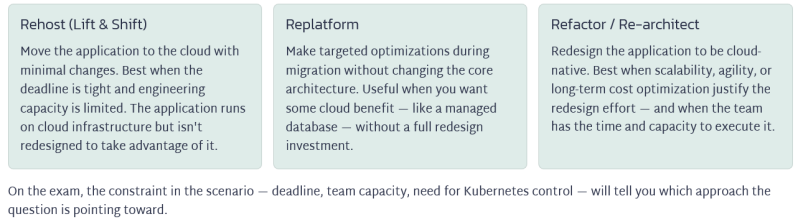
A sponsor wants to move a legacy application to the cloud before a data center contract expires. The application works, the deadline is tight, and the team has little capacity for redesign. Do you move the application as it is, make a few changes along the way, or rebuild it?  That’s the kind of decision I’d use to prepare for the Google Cloud Digital Leader certification. Each option could make sense under different circumstances.

Here, the deadline and limited engineering capacity tell you which trade-off matters most. For project and program managers, that’s familiar territory. The exam adds a layer of Google Cloud literacy so you can connect business goals and delivery constraints to the right cloud capabilities.

How much does the certification cost?

The standard exam costs $99 USD, plus applicable tax. Google gives you 90 minutes to answer 50–60 multiple-choice and multiple-select questions. You can take it through online proctoring or at a testing center. There are no formal prerequisites, and Google recommends experience collaborating with technical professionals. The certification is valid for three years. cloud.google.com

What topics are covered?

Google’s official exam guide divides the content into six nearly equal domains. That balance matters when you plan your study time. If AI is your strongest area, give yourself time to practice explaining cloud cost controls, migration decisions, and security responsibilities too. Google Cloud  |  Learn

Google's official exam guide divides content into six domains, each worth roughly 16–17% of the exam. That balance matters when you plan your study time. Don't over-index on AI if cloud cost controls, migration decisions, or security responsibilities still feel unfamiliar.

Exam domain Weight What to be ready to explain
Digital transformation 17% Why organizations adopt cloud, how cloud changes costs and delivery, and how IaaS, PaaS, and SaaS divide responsibilities
Data transformation 16% When to use a database, a data warehouse, or a data lake, and how tools such as BigQuery support analytics
Artificial intelligence 16% When analytics or machine learning fits a business need, when to use a pre-trained API or build a custom model, and why data quality and responsible AI matter
Infrastructure and application modernization 17% How to choose a migration approach and when virtual machines, containers, Kubernetes, or serverless computing fit
Trust and security 17% How identity, access, encryption, shared responsibility, and data location affect security and compliance
Cloud operations 17% How teams manage cloud spend, monitor reliability, and plan for service disruptions

Why This Certification Matters for PMs

A sponsor wants to move a legacy application to the cloud before a data center contract expires. The application works, the deadline is tight, and the team has little capacity for redesign. Do you move it as-is, make a few changes, or rebuild from scratch?

That's the kind of trade-off decision the Google Cloud Digital Leader exam prepares you to make with confidence. For project and program managers, weighing constraints is familiar territory. This certification adds the Google Cloud literacy needed to connect business goals and delivery constraints to the right cloud capabilities — and to have credible conversations with sponsors and engineers alike.

How to think through the questions

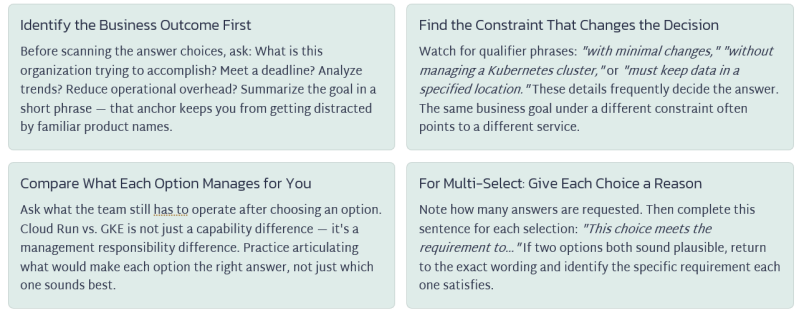
The exam doesn't test whether you can configure a service. It tests whether you can connect a business situation to the right cloud capability. Use these four reasoning moves every time you encounter a question.

Try two practice scenarios

These original examples show how to apply the reasoning before you try Google’s official sample questions.

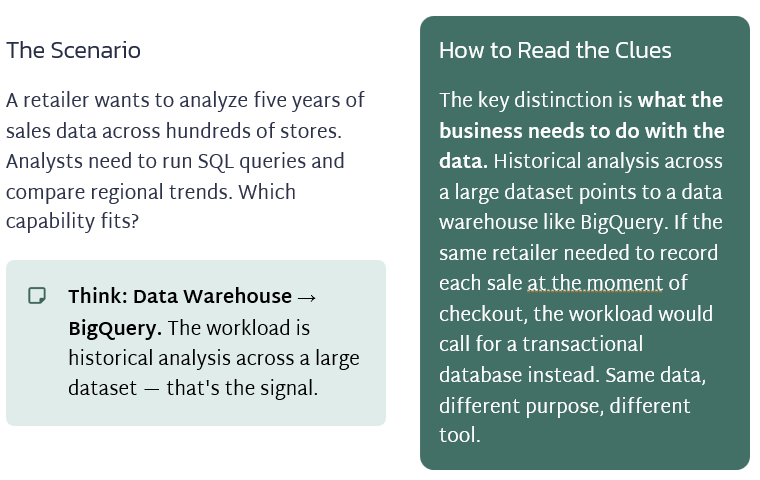
Scenario 1 — A retailer wants to analyze five years of sales across hundreds of stores. Analysts need to run SQL queries and compare regional trends. Which capability fits?

Think data warehouse. The workload is historical analysis across a large dataset, which makes BigQuery a fit. If the same retailer needed to record each sale at checkout, the workload would call for a transactional database. The clue is what the business needs to do with the data. Google Cloud  |  Learn

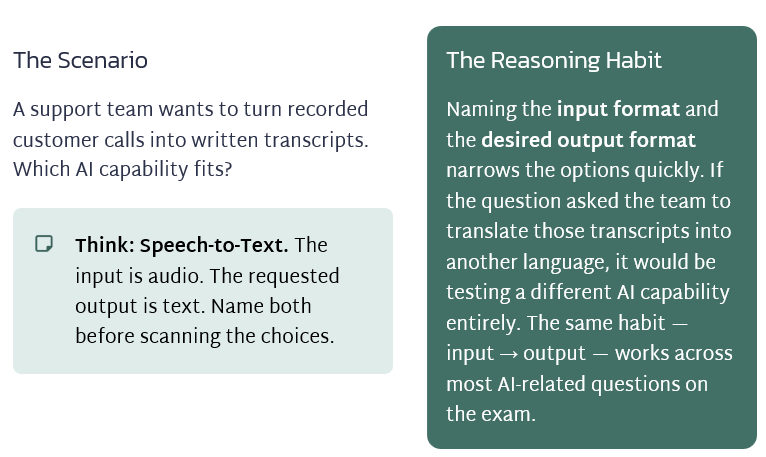
Scenario 2 — A support team wants to turn recorded customer calls into written transcripts. Which AI capability fits?

Think Speech-to-Text. The input is audio, and the requested output is text. If the question asked the team to translate those transcripts into another language, it would be testing a different capability. Naming the input and the desired output helps you narrow the choices quickly. Google Cloud  |  Learn
Migration Approaches: Choosing the Right Trade-Off

Infrastructure and application modernization is a 17% domain. Questions often hinge on recognizing which migration approach fits the business situation — especially when deadline pressure, team capacity, or redesign requirements are in play.
Compute Options: What the Team Still Has to Manage

A common question pattern presents a containerized workload with specific operational requirements. Knowing what each option handles for you is as important as knowing what it does.
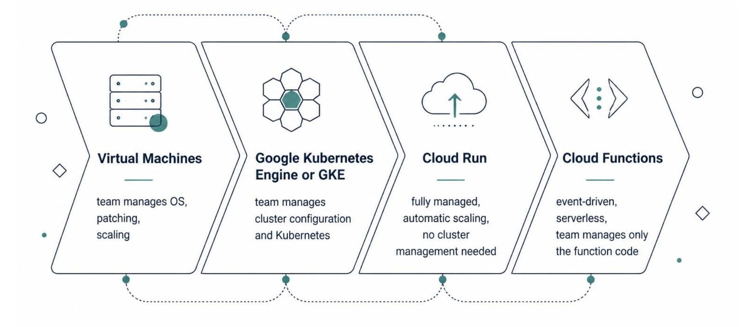
When a question says "without managing a Kubernetes cluster" and the workload is containerized, Cloud Run is the signal. When Kubernetes control is explicitly required, GKE becomes the stronger candidate. The constraint in the wording decides it.

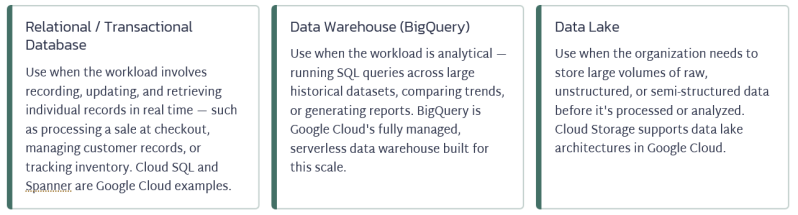
Data Tools: Matching the Workload to the Right Service

The data transformation domain tests your ability to distinguish between storage and analytics tools based on what the business needs to do with the data — not just what the data is.
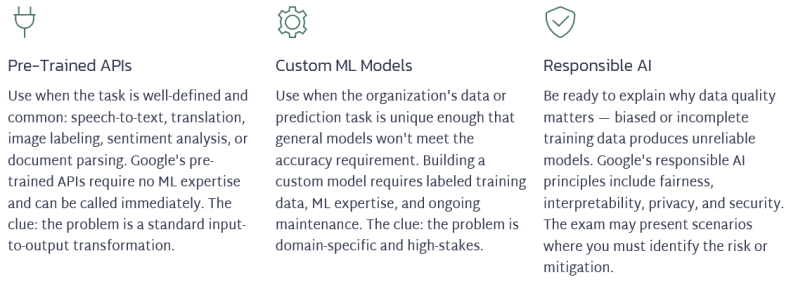
AI and ML: Pre-Trained API or Custom Model?

The AI domain — worth 16% — frequently tests whether you can recognize when a pre-built capability is sufficient versus when a custom model is warranted. Responsible AI and data quality are also in scope.
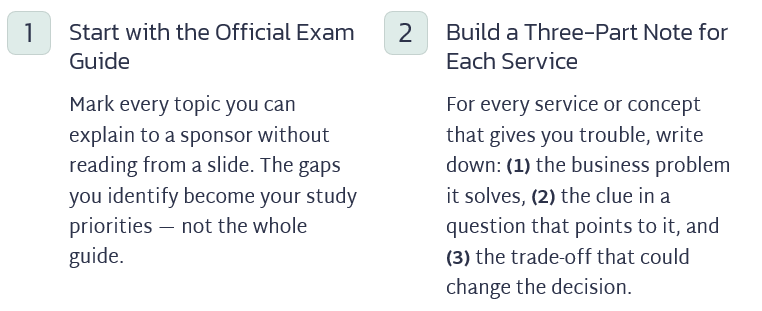
A practical study plan for project and program managers
 Google Cloud  |  Learn

At 60 questions in 90 minutes, you have an average of 90 seconds per question. During practice, pay attention to where you lose time. If you keep rereading a scenario, try writing a five-word summary of the business goal before comparing the options.
#GoogleCloud #CloudDigitalLeader #GoogleCloudCertification #CloudCertification #ExamPrep #CloudComputing #CloudLiteracy #DigitalTransformation #ProgramManagement #ProjectManagement #ManagingProjectsTheAgileWay


About the Author

Kimberly Wiethoff, MBA, PMP, PMI-ACP is an AI Transformation Program Leader specializing in enterprise digital transformation, AI-enabled delivery, PMO leadership, AI governance, Agile program execution, cloud transformation, and complex portfolio delivery.

Through Managing Projects the Agile Way, she shares practical strategies for modernizing project and program delivery, strengthening PMO leadership, and preparing organizations and leaders for the future of AI-enabled program management.


Google Cloud Digital Leader Practice Questions

Here are 12 original practice questions, two for each exam domain, with answers and explanations. As you work through them, identify the business goal and the constraint that drives the decision before looking at the answer choices.

The exam guide, launched August 12, 2026, lists the first five domains at approximately 18% each and Cloud Operations at approximately 10%. Use those weights in the blog’s exam coverage table.

cloud_digital_leader_exam_guide_english.pdf

1. Digital Transformation with Google Cloud · ~18%

1. A hospital must keep its patient records system in its own data center. It wants to run a new scheduling application in Google Cloud and connect it to the existing system. Which cloud architecture fits?

  • A. Private cloud
  • B. Multicloud
  • C. Hybrid cloud
  • D. Public cloud only

Answer — C. Hybrid cloud. The hospital needs its on-premises system and a public cloud application to work together. Multicloud would involve multiple cloud providers. The deciding clue is that the patient records system must stay on-premises.

2. A company wants a ready-to-use collaboration suite. Employees need to sign in and start working, while the provider handles application updates and the underlying infrastructure. Which service model fits?

  • A. Software as a Service (SaaS)
  • B. Platform as a Service (PaaS)
  • C. Infrastructure as a Service (IaaS)
  • D. Private cloud

Answer — A. SaaS. Employees need a finished application, and the provider operates it. PaaS would fit a team that wants a managed platform on which to build or deploy its own application. Ask yourself what the customer needs to manage.

2. Exploring Data Transformation with Google Cloud · ~18%

3. A retailer wants to analyze five years of sales across 600 stores. Analysts need to run SQL queries that compare sales trends by region and product category. Which Google Cloud service fits best?

  • A. Cloud Storage
  • B. Cloud SQL
  • C. Firestore
  • D. BigQuery

Answer — D. BigQuery. Comparing historical trends across a large dataset is an analytical workload. Cloud SQL would be a stronger fit if the requirement were to run a relational application that records individual sales transactions. The word SQL alone doesn’t decide the answer. Look at what the business wants to do with the data.

4. A logistics company needs to receive a continuous stream of shipment events, then filter and aggregate them as they arrive. Which two services address those requirements? Select two.

  • A. Looker
  • B. Pub/Sub
  • C. Dataflow
  • D. Cloud Storage Archive

Answer — B and C. Pub/Sub and Dataflow. Pub/Sub receives and distributes events. Dataflow processes the stream to filter and aggregate those events. Looker could help visualize the results later. Match each selected service to a distinct requirement: receive events and process events.

3. Innovating with Google Cloud Artificial Intelligence · ~18%

5. A contact center wants written transcripts from recorded calls. It wants to use a pre-trained capability and avoid building a custom model. Which service should it choose?

  • A. Speech-to-Text API
  • B. Cloud Translation API
  • C. Vision API
  • D. BigQuery ML

Answer — A. Speech-to-Text API. The input is recorded audio and the output is written text. Cloud Translation would fit a follow-on requirement to translate those transcripts. When the question describes an AI task, name the input and desired output to narrow the choices.

6. A retailer already has customer purchase data in BigQuery. Its analysts know SQL and want to build a model that predicts which customers are likely to buy again. Which capability best fits their skills and workflow?

  • A. Looker
  • B. Gemini for drafting marketing emails
  • C. BigQuery ML
  • D. Cloud Translation API

Answer — C. BigQuery ML. The team can create and run machine learning models using SQL where its data already resides. Looker can help the team explore or visualize results. The deciding clues are prediction, data already in BigQuery, and a team that works in SQL.

4. Modernize Infrastructure and Applications with Google Cloud · ~18%

7. A data center contract expires in eight weeks. A legacy application is stable, can run on a cloud virtual machine, and has no redesign budget. Which migration approach best fits?

  • A. Replatform
  • B. Rehost
  • C. Refactor
  • D. Retire

Answer — B. Rehost. Rehosting, also called lift and shift, moves the workload with minimal application changes. Replatforming would make sense if the team had time and funding to change part of the platform during the move. Here, the deadline and the lack of redesign budget drive the decision.

8. A team has already containerized a web application. Traffic spikes during promotions, and the team wants automatic scaling without operating a Kubernetes cluster. Which service fits best?

  • A. Compute Engine
  • B. GKE
  • C. Apigee
  • D. Cloud Run

Answer — D. Cloud Run. Cloud Run can run the container as a managed serverless service and scale it with demand. GKE would be a stronger choice if the team specifically needed Kubernetes capabilities. Two options can run containers, so focus on how much infrastructure the team wants to operate.

5. Trust and Security with Google Cloud · ~18%

9. An auditor needs to read objects in one Cloud Storage bucket for a review. The auditor should have no ability to modify or delete the objects. What should the administrator do?

  • A. Grant project-wide Editor access
  • B. Grant bucket-level administration
  • C. Grant an IAM role with the required read permissions on that bucket
  • D. Require multifactor authentication and leave the auditor’s permissions as they are

Answer — C. Grant narrowly scoped read access through IAM. This applies least privilege by limiting both the actions the auditor can take and the resource they can access. Multifactor authentication helps verify identity. IAM permissions determine what that identity is authorized to do.

10. A security team wants to discover and prioritize misconfigurations across its Google Cloud environment, including storage buckets that may be exposed. Which service most directly supports this goal?

  • A. Security Command Center
  • B. Cloud Armor
  • C. Cloud VPN
  • D. Certificate Manager

Answer — A. Security Command Center. The team is looking for visibility into its security posture and a way to prioritize findings. Cloud Armor addresses a different need, such as protecting internet-facing applications from certain traffic-based threats.

6. Scaling with Google Cloud Operations · ~10%

11. A program sponsor wants the finance team notified when monthly cloud spend reaches 80% of its budget, while production workloads continue running. What should the team configure?

  • A. A resource quota
  • B. A Cloud Billing budget with an alert threshold
  • C. A Cloud Billing report alone
  • D. A service-level objective

Answer — B. A Cloud Billing budget with an alert threshold. The requirement is to notify someone at a spending threshold. A billing budget alert does not automatically cap spending. A quota limits the consumption of a particular resource, while a billing report helps you review costs.

12. An operations team tracks the percentage of successful checkout requests and sets an internal target of 99.9% over a rolling 30-day window. What is that target called?

  • A. A service-level indicator (SLI)
  • B. A service-level agreement (SLA)
  • C. A resource quota
  • D. A service-level objective (SLO)

Answer — D. A service-level objective. The SLO is the target of 99.9% over 30 days. The SLI is the measured percentage of successful requests. An SLA is a service commitment to customers, often with defined consequences if the commitment is missed.


Download the Document, PDF, or Presentation

Google Cloud Digital Leader Certification What It Costs What It Covers And How To Think Through The Exam Docx

Word – 499.0 KB 0 downloads

Google Cloud Digital Leader Certification Pdf

PDF – 947.2 KB 0 downloads

Google Cloud Digital Leader Certification Pptx

PowerPoint – 2.1 MB 0 downloads

Author: Kimberly Wiethoff

New blogs, straight to your inbox. Join the list!