Retrospectives are often called the “heartbeat of Agile.” Yet too many teams treat them as routine check-ins where action items fade into memory. Research shows that only 30% of retrospective actions are ever implemented—and even fewer are sustained.
The difference between teams that simply hold retrospectives and those that truly leverage them lies in how they transform reflection into tangible, sustained change.
The Retrospective Reality Check
Most teams fall into a pattern: gather, discuss what went well, what didn’t, generate action items, and forget them by the next sprint. This creates the illusion of improvement while real progress stagnates.
High-performing teams break this cycle by treating retrospectives as strategic opportunities to evolve capabilities and accelerate impact.
Beyond Reflection: The Three Essential Questions
Effective retrospectives move beyond velocity and scope to ask questions that truly drive improvement:
- Business Value Impact – Did our work move the needle on business outcomes, customer experience, or strategic goals?
- Team Collaboration – Did we support each other, communicate clearly, and make transparent decisions?
- Improvement Opportunities – How can we enhance both what we deliver and how we work together?
This reframing shifts teams from being feature factories to becoming value creators.
Creating a Culture of Learning
When retrospectives focus on value and impact, teams cultivate a learning mindset. They begin to see themselves not just as software builders, but as problem solvers aligned to customer and business needs.
Research shows that learning-focused teams outperform peers by 25% in velocity and quality metrics.

The Impact of Effective Retrospectives
| Metric | Improvement |
|---|---|
| Defect Reduction | 25% fewer defects within 3 sprints |
| Velocity Gains | 30% improvement in 6 months |
| Team Satisfaction | 40% boost when actions are implemented |
| Implementation Success | 67% higher action follow-through in teams with strong psychological safety |
Keys to Effective Retrospectives
Effective retrospectives move beyond surface-level discussions about velocity and story points. They dig deeper into the questions that actually drive meaningful improvement and business impact.
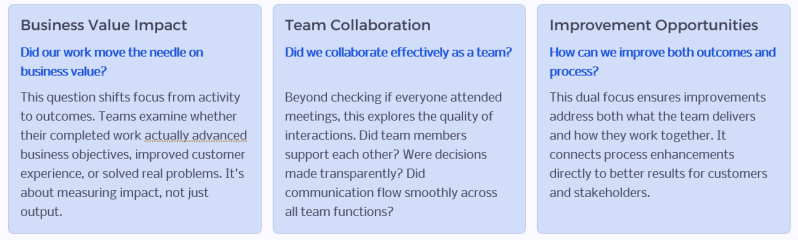
When teams broaden their retrospective conversations from velocity and scope to value and impact, something transformative happens. They begin to see themselves not just as feature factories, but as problem solvers and value creators.
This shift in perspective cultivates a learning mindset where team members actively seek out opportunities to improve both their technical capabilities and their understanding of customer needs. They start asking better questions about their work and become more invested in the outcomes they produce.
Teams operating at this level don't just deliver software—they deliver solutions that matter. Their retrospectives become strategic sessions where business acumen meets technical excellence, creating a powerful combination that drives both team satisfaction and organizational success.
Create a Safe Space
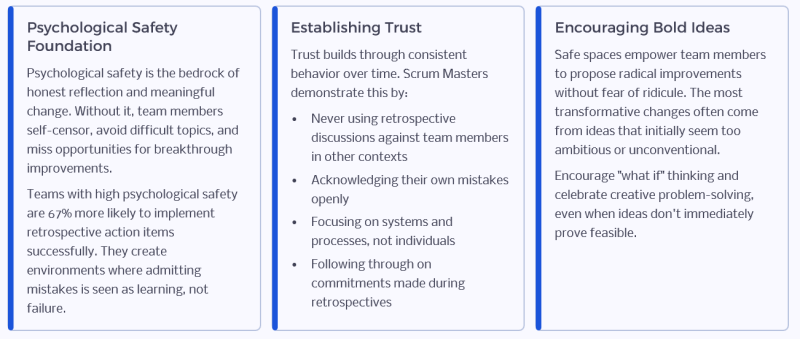
Psychological safety is the foundation.
Teams with high safety are 67% more likely to implement improvements. This means:
- Never weaponizing discussions.
- Acknowledging mistakes openly.
- Encouraging bold, creative ideas.
Focus on Outcomes, Not Just Output
Ask “Did we deliver meaningful value?” instead of “Did we finish the sprint?” This simple shift keeps retrospectives tied to business impact rather than just activity completion.
The traditional focus on sprint completion and velocity metrics, while important, often misses the bigger picture. Teams can achieve 100% sprint completion while delivering features that customers don't use or value.
Outcome-focused retrospectives examine deeper questions:
- Customer Impact: Did our work improve the customer experience in measurable ways?
- Business Value: How did our deliverables contribute to revenue, cost reduction, or strategic objectives?
- Problem Resolution: Did we solve the right problems, or just build the requested features?
- Learning Velocity: How quickly are we discovering and acting on new insights about our users and market?
This approach transforms retrospectives from inward-looking process reviews into strategic sessions that connect daily work with organizational success. Teams begin to see themselves as contributors to business outcomes, not just executors of technical tasks.
Focus on Outcomes, Not Just Output
Ask “Did we deliver meaningful value?” instead of “Did we finish the sprint?”
- Did our work improve customer experience?
- Did it support business strategy?
- Did it solve the right problems?
Turn Insights into Action
The gap between good intentions and actual implementation is where most retrospectives fail. Successful teams treat improvement actions with the same rigor as feature development.
Bridge the gap between good intentions and execution:
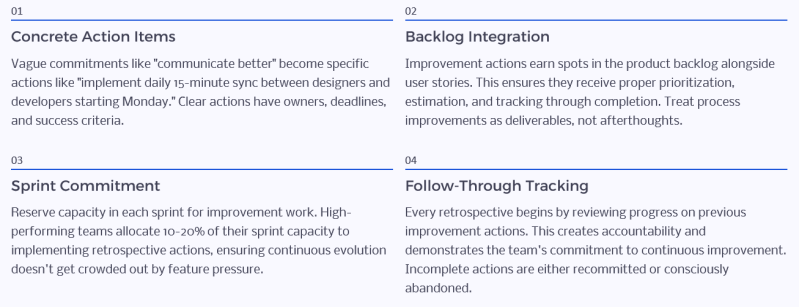
- Concrete Actions – Specific, owned, time-bound.
- Backlog Integration – Treat improvements like deliverables.
- Sprint Commitment – Dedicate 10–20% capacity to improvements.
- Follow-Through – Review progress on past actions in every retrospective.
Measure the Impact
Continuous improvement is only real when it’s measured:
- 25% defect reduction within three sprints.
- 30% velocity gains in six months.
- 40% increase in team satisfaction when retrospective actions are implemented.
Continuous improvement only works when results are visible and measurable. Teams that track the impact of their retrospective actions create powerful feedback loops that reinforce the value of the practice.
Effective measurement goes beyond basic metrics. Teams track both quantitative indicators (cycle time, defect rates, velocity) and qualitative measures (team satisfaction, stakeholder feedback, customer impact). This comprehensive view ensures improvements address the full spectrum of team effectiveness.
Regular measurement also helps teams learn which types of improvements generate the most significant results, allowing them to focus future retrospectives on the highest-impact opportunities for growth.
| Key | What It Means | Why It Matters |
|---|---|---|
| 1. Create a Safe Space | Building psychological safety by focusing on systems, not individuals; encourage bold ideas. | Teams with high safety are 67% more likely to implement improvement actions. |
| 2. Focus on Outcomes | Ask “Did we deliver value?” instead of “Did we finish the sprint?”; tie work to business/customer impact. | Shifts retrospectives from process reviews to strategic sessions. |
| 3. Turn Insights into Action | Define clear, owned, time-bound actions; integrate into backlog; reserve 10–20% sprint capacity. | Ensuring improvements don’t get lost; continuous change becomes part of delivery. |
| 4. Measure the Impact | Track velocity, defects, satisfaction, and business outcomes. | Yields measurable gains: 25% defect reduction, 30% velocity gains, 40% satisfaction boost. |
The Scrum Engineer’s Transformative Role
Scrum Masters who elevate retrospectives from routine meetings to engines of improvement master four critical capabilities that separate good facilitators from transformation leaders.
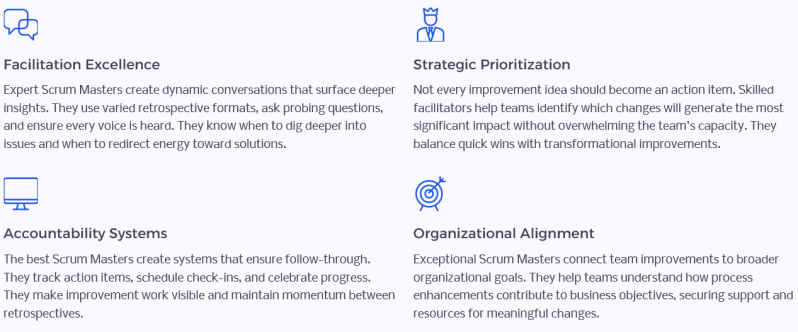
Scrum Engineers (or Scrum Masters) elevate retrospectives by:
- Facilitation Excellence – Asking probing questions, ensuring every voice is heard.
- Strategic Prioritization – Choosing changes with the highest impact.
- Accountability Systems – Tracking actions and celebrating progress.
- Organizational Alignment – Linking team improvements to business goals.
From Talk to Transformation
High-performing teams treat retrospectives as non-negotiable, giving them the same energy and focus as sprint planning or demos. Over time, this commitment compounds: higher quality, faster delivery, and more satisfied, motivated teams.
The most successful Agile teams share a common characteristic: they treat retrospectives as non-negotiable opportunities to evolve. They approach each retrospective with the same energy and preparation they bring to sprint planning or product demos.
These high-performing teams understand that every sprint carries valuable lessons—about their customers, their market, their technology, and themselves. They've learned that applying these lessons systematically, sprint after sprint, creates compound improvements that separate them from competitors.
The transformation happens gradually, then suddenly. Teams that commit to meaningful retrospectives find themselves delivering higher quality work faster, with greater satisfaction and less stress. They become the teams that others want to join and leaders want to emulate.
👉 Retrospectives done well aren’t about rehashing the past. They’re about shaping the future—one sprint at a time. They're where teams forge their identity as continuous learners and relentless improvers.
Your Next Steps
- Assess – Review your last three retrospectives. What percentage of actions were implemented?
- Implement the Three Questions – Focus discussion on business value, collaboration, and improvement opportunities.
- Create Accountability – Add 1–2 actions to your backlog with owners and deadlines.
- Measure and Iterate – Track the impact over three sprints and refine.
The goal isn’t perfect retrospectives—it’s consistent progress toward higher performance and greater impact.
#AgileLeadership #ScrumEngineer #Retrospectives #ContinuousImprovement #TeamSuccess #AgileMindset #ProjectManagement #ManagingProjectsTheAgileWay

About the Author
Kimberly Wiethoff, MBA, PMP, PMI-ACP is an AI Transformation Program Leader specializing in enterprise digital transformation, AI-enabled delivery, PMO leadership, AI governance, Agile program execution, cloud transformation, and complex portfolio delivery.
Through Managing Projects the Agile Way, she shares practical strategies for modernizing project and program delivery, strengthening PMO leadership, and preparing organizations and leaders for the future of AI-enabled program management.
Download Document, PDF, or Presentation
Author: Kimberly Wiethoff, MBA, PMP, PMI-ACP