Artificial Intelligence is quickly moving from experimentation to execution. Organizations across every industry are investing in AI to improve customer experiences, automate workflows, enhance decision-making, and unlock new business opportunities. Yet despite billions of dollars in AI investments, many organizations struggle to move beyond pilot projects and proofs of concept. The challenge is rarely the technology itself. More often, organizations fail because they underestimate the complexity of integrating AI into business operations, processes, governance structures, and organizational culture.
This is where Program Managers become essential.
While data scientists build models and technology teams deploy platforms, Program Managers play the critical role of ensuring AI initiatives deliver measurable business value. They connect strategy to execution, align stakeholders, manage dependencies, and guide organizations through transformational change.
As AI adoption accelerates, Program Managers are increasingly becoming the leaders of enterprise AI transformation.
AI Projects Are Different from Traditional Technology Projects
Many organizations initially approach AI as a standard technology implementation. They establish timelines, allocate resources, and expect predictable outcomes. AI initiatives, however, introduce unique challenges that require a different mindset.
Unlike traditional software projects, AI programs often involve:
- Uncertain outcomes
- Evolving business requirements
- Data quality challenges
- Regulatory considerations
- Ethical concerns
- Organizational change management
- Continuous model improvement
Success is not simply delivering a system on schedule. Success means creating measurable business outcomes while adapting to rapidly changing conditions.
Program Managers must be prepared to lead in environments where experimentation and learning are part of the delivery process.

Start with Business Problems, Not Technology
One of the most common mistakes organizations make is starting with AI rather than business value.
Executives often ask: "How can we use AI?"
The better question is: "What business problem are we trying to solve?"
Successful AI programs typically focus on objectives such as:
- Improving customer acquisition
- Increasing customer retention
- Reducing operational costs
- Accelerating decision-making
- Improving employee productivity
- Enhancing customer experiences
- Increasing revenue opportunities
When AI becomes the solution to a clearly defined business challenge, organizations are more likely to achieve meaningful results.
Program Managers should continuously guide discussions back to outcomes, benefits, and value realization.
Build a Cross-Functional Coalition
AI transformation is not owned by a single department.
Successful programs require collaboration across:
- Business leadership
- Product teams
- Operations
- Technology
- Data teams
- Risk and compliance
- Security
- Legal
- Customer experience teams
Many AI initiatives fail because teams work independently rather than collaboratively. Program Managers must establish governance structures that encourage alignment, transparency, and shared ownership. Strong stakeholder engagement becomes even more important because AI initiatives often affect multiple business functions simultaneously.
The Program Manager's ability to build relationships and facilitate alignment may ultimately determine the success of the transformation effort.
Focus on Data as a Strategic Asset
Organizations often discover that data—not AI—is their biggest challenge. AI systems rely on accurate, accessible, and trustworthy data.
Common obstacles include:
- Poor data quality
- Inconsistent data definitions
- Data silos
- Incomplete records
- Governance gaps
Without addressing these issues, even the most advanced AI models will struggle to produce meaningful results.
Program Managers should ensure data readiness is incorporated into program planning, risk management, and governance discussions from the beginning.
In many cases, data modernization becomes the first phase of AI transformation.
Establish AI Governance Early
As AI capabilities expand, governance becomes increasingly important.
Organizations must consider questions such as:
- How are AI decisions being made?
- Who is accountable for outcomes?
- How is bias being monitored?
- What regulatory requirements apply?
- How are customer data and privacy protected?
- What controls are needed for AI-generated content?
Without governance, organizations expose themselves to operational, legal, reputational, and compliance risks.
Program Managers should work with executive leadership to establish governance frameworks that define:
- Decision-making authority
- Risk management processes
- Compliance requirements
- Model monitoring expectations
- Performance measurement standards
Strong governance creates confidence and enables organizations to scale AI responsibly.
Move Beyond Pilots to Enterprise Scale
Many organizations successfully launch AI pilots but struggle to achieve enterprise adoption.
A pilot may demonstrate technical feasibility, but scaling requires significantly more effort.
Program Managers must coordinate:
- Technology integration
- Operational process changes
- Training programs
- Adoption strategies
- Change management activities
- Performance monitoring
- Continuous improvement processes
The transition from pilot to production is often where the greatest transformation challenges emerge.
Organizations that successfully scale AI treat implementation as an enterprise change initiative rather than a technology deployment.
Measure What Matters
One of the most important responsibilities of a Program Manager is defining success.
AI teams frequently focus on technical metrics such as:
- Model accuracy
- Response times
- Prediction precision
- Processing speed
Executives care about different outcomes.
They want to understand:
- Revenue impact
- Cost savings
- Productivity gains
- Customer satisfaction improvements
- Customer retention increases
- Risk reduction
- Time-to-market improvements
Program Managers must establish measurement frameworks that connect AI capabilities to business results.
This alignment helps maintain executive support and ensures investment decisions remain focused on value creation.
Change Management Is the Real Transformation
Technology implementation is often the easiest part of an AI initiative. The harder challenge is helping people adapt. Employees may worry about job displacement. Managers may question AI-generated recommendations. Customers may be hesitant to trust automated interactions. Successful AI transformation requires organizations to address these concerns proactively.
Program Managers should develop change management strategies that include:
- Communication plans
- Training programs
- Stakeholder engagement
- Adoption metrics
- Leadership sponsorship
- Employee feedback mechanisms
The organizations that achieve the greatest success with AI are those that focus as much on people as they do on technology.
The Rise of Agentic AI
The next phase of AI transformation is already emerging. Traditional AI systems provide recommendations and insights. Agentic AI goes further by taking action.
AI agents can:
- Execute workflows
- Coordinate tasks
- Interact with systems
- Resolve customer issues
- Perform routine business processes
As organizations begin deploying AI agents, Program Managers will face new governance, risk, and operational considerations. Questions around accountability, oversight, security, and performance monitoring will become even more important.
Organizations that prepare now will be better positioned to take advantage of these emerging capabilities.
The Future Role of the Program Manager
AI is reshaping how organizations operate, compete, and innovate. As a result, the role of the Program Manager is evolving as well.
Tomorrow's Program Managers will need to understand:
- AI strategy
- Data governance
- Digital transformation
- Business process optimization
- Change management
- Value realization
- Executive communication
They will serve as translators between business leaders, technical experts, and operational teams.
Most importantly, they will ensure that AI investments generate real business outcomes.
Final Thoughts
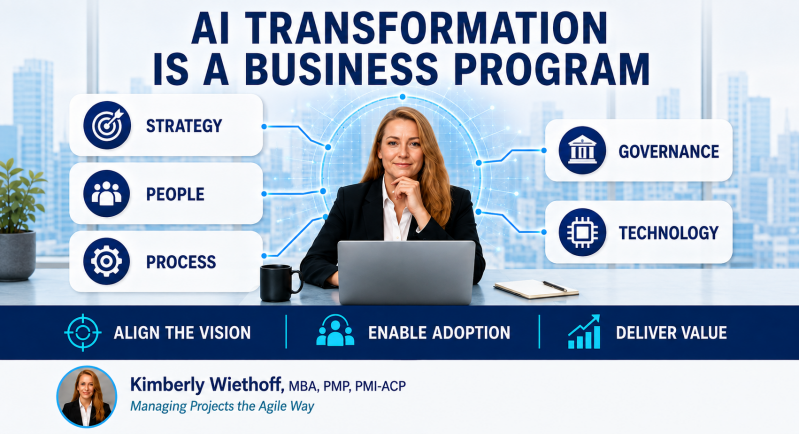
Artificial Intelligence is not simply another technology trend. It represents a fundamental shift in how organizations make decisions, engage customers, and operate at scale. The organizations that succeed will not necessarily be those with the most advanced algorithms. They will be the ones that effectively align strategy, governance, people, processes, and technology.
Program Managers are uniquely positioned to lead this transformation.
By focusing on business outcomes, stakeholder alignment, governance, data readiness, and organizational adoption, Program Managers can help their organizations move beyond AI experimentation and achieve lasting business value.
The future of AI transformation is not just about technology—it is about leadership.

About the Author
Kimberly Wiethoff, MBA, PMP, PMI-ACP is a Senior Program Manager specializing in enterprise digital transformation, AI-enabled delivery, PMO leadership, and Agile program execution. Through Managing Projects the Agile Way, she helps project leaders prepare for the future of work by combining proven program management practices with emerging AI technologies.
Managing Projects The Agile Way
#ArtificialIntelligence #AITransformation #ProgramManagement #DigitalTransformation #Leadership #BusinessTransformation #AgenticAI #GenerativeAI #DataGovernance #ChangeManagement #EnterpriseAI #ProjectManagement #PMO #AgileLeadership #Innovation #BusinessValue #StrategyExecution #FutureOfWork #ManagingProjectsTheAgileWay #TransformationLeadership
Download Document, PDF, or Presentation
Author: Kimberly Wiethoff, MBA, PMP, PMI-ACP