Continuous improvement is often described as one of the foundational principles of Agile. Yet many organizations struggle to move beyond the occasional retrospective or process adjustment. Teams become comfortable with the status quo, recurring issues remain unresolved, and opportunities for growth are missed.
The most effective Agile Coaches understand that continuous improvement is not a meeting, a metric, or a single initiative. It is a mindset and organizational capability that enables teams to consistently learn, adapt, and improve their performance over time.
High-performing organizations do not become successful because they avoid challenges. They become successful because they continuously identify opportunities to improve and take action. Agile Coaches play a critical role in creating the environment, behaviors, and systems that make continuous improvement part of the organization's DNA.
Why Continuous Improvement Matters
Markets evolve, customer expectations change, and technology advances at an unprecedented pace. Organizations that fail to adapt quickly often find themselves struggling to remain competitive.
Continuous improvement helps organizations:
- Increase delivery predictability
- Improve product quality
- Accelerate customer value delivery
- Reduce waste and inefficiencies
- Enhance team engagement
- Improve stakeholder satisfaction
- Strengthen organizational agility
Small improvements made consistently over time often generate far greater results than large, infrequent transformation efforts.
The goal is not perfection. The goal is becoming slightly better with every iteration.

Moving Beyond the Retrospective
Retrospectives are an important Agile practice, but continuous improvement cannot be limited to a single discussion at the end of a sprint.
Many teams fall into common traps:
- Discussing the same issues repeatedly
- Creating action items that are never completed
- Focusing only on team-level concerns
- Failing to measure improvement efforts
An Agile Coach helps teams transform retrospectives from routine meetings into catalysts for meaningful change.
Effective retrospectives should:
- Identify root causes rather than symptoms
- Prioritize actionable improvements
- Assign ownership
- Establish measurable outcomes
- Review progress regularly
Improvement only occurs when insights lead to action.
Building a Culture of Experimentation
Continuous improvement thrives in environments where teams feel empowered to experiment.
Instead of asking, "How do we fix this permanently?" Agile Coaches encourage teams to ask:
- What can we try next?
- How can we test this idea quickly?
- What would success look like?
- What can we learn from the results?
This mindset shifts organizations from fear of failure to curiosity and learning.
Small, low-risk experiments often produce valuable insights while minimizing disruption.
Over time, experimentation becomes a powerful engine for innovation and adaptation.
Using Metrics to Drive Improvement
Data provides valuable visibility into team performance, but metrics should never be used as a tool for judgment.
The purpose of measurement is learning.
Agile Coaches help teams focus on metrics that reveal opportunities for improvement, such as:
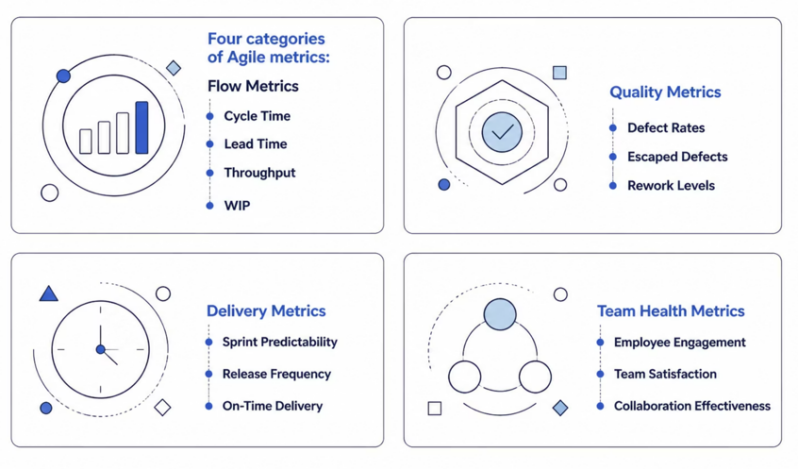
The most important question is not, "What does the metric say?" but rather, "What should we do differently because of it?"
Removing Organizational Impediments
Many improvement opportunities lie outside the team's control.
Common organizational barriers include:
- Slow approval processes
- Unclear decision-making authority
- Resource constraints
- Excessive governance
- Cross-functional dependencies
- Competing priorities
Agile Coaches act as organizational change agents by identifying systemic issues and partnering with leadership to address them.
When impediments are removed, teams can focus their energy on delivering value rather than navigating bureaucracy.
Coaching Leaders for Continuous Improvement
Continuous improvement is not solely a team responsibility.
Leaders play a critical role in creating an environment where improvement efforts can succeed.
Agile Coaches help leaders:
- Encourage transparency
- Support experimentation
- Reward learning
- Remove barriers
- Foster collaboration
- Focus on outcomes rather than activity
When leaders model continuous improvement behaviors themselves, teams are far more likely to embrace the mindset.
Transformation starts at the top.
Leveraging AI to Accelerate Improvement
Artificial intelligence is creating new opportunities for Agile Coaches to identify improvement opportunities faster and more accurately.
AI-powered analytics can help organizations:
- Detect delivery bottlenecks
- Identify recurring defects
- Monitor team sentiment
- Predict delivery risks
- Analyze sprint performance trends
- Surface organizational impediments
Instead of spending hours collecting and analyzing data manually, Agile Coaches can focus on interpreting insights and guiding meaningful change.
AI does not replace coaching. It enhances the coach's ability to make data-driven decisions and focus attention where it matters most.
Creating Sustainable Improvement Habits
One of the biggest mistakes organizations make is treating continuous improvement as a temporary initiative.
Sustainable improvement requires habits that become part of everyday work.
Successful Agile Coaches encourage teams to:
- Reflect regularly
- Celebrate progress
- Share lessons learned
- Track improvement outcomes
- Embrace experimentation
- Continuously challenge assumptions
Over time, improvement becomes less about formal processes and more about how the team naturally operates.
The most mature Agile organizations no longer need to be reminded to improve. Continuous improvement becomes second nature.
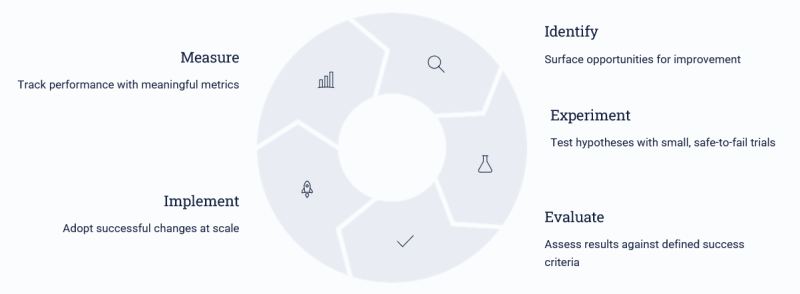
The Continuous Improvement Flywheel
High-performing teams create a self-reinforcing cycle:
- Measure performance.
- Identify opportunities.
- Experiment with solutions.
- Evaluate results.
- Implement successful changes.
- Repeat.
Each cycle generates new insights, stronger capabilities, and improved outcomes.
This flywheel effect allows organizations to continuously adapt while maintaining alignment with business objectives.
Conclusion
Continuous improvement is the heartbeat of Agile.
While frameworks, ceremonies, and tools provide structure, lasting success comes from creating a culture where learning, experimentation, and adaptation are embedded into daily work.
Agile Coaches play a pivotal role in fostering this culture by helping teams uncover opportunities, remove obstacles, leverage data, and develop sustainable improvement habits.
Organizations that embrace continuous improvement gain more than operational efficiency. They build resilience, adaptability, and a competitive advantage that enables them to thrive in an ever-changing business environment.
The most successful Agile teams are not those that get everything right the first time. They are the teams that learn faster than everyone else.
Continuous improvement is the foundation of Agile success, but it requires more than retrospectives and action items. High-performing teams build a culture of learning, experimentation, accountability, and data-driven decision-making. Agile Coaches help organizations create sustainable improvement habits that drive better outcomes, stronger collaboration, and greater adaptability in an ever-changing business environment.

About the Author
Kimberly Wiethoff, MBA, PMP, PMI-ACP is a Senior Program Manager specializing in enterprise digital transformation, AI-enabled delivery, PMO leadership, and Agile program execution. Through Managing Projects the Agile Way, she helps project leaders prepare for the future of work by combining proven program management practices with emerging AI technologies.
Managing Projects The Agile Way
#ContinuousImprovement #AgileCoaching #AgileTransformation #LeanAgile #Scrum #ScrumMaster #Leadership #OrganizationalChange #BusinessTransformation #TeamPerformance #ContinuousLearning #AgileLeadership #EnterpriseAgility #DigitalTransformation #ProjectManagement #ProductManagement #Innovation #TeamCollaboration #FutureOfWork #OperationalExcellence
Download Document, PDF, or Presentation
Author: Kimberly Wiethoff, MBA, PMP, PMI-ACP