Many Agile transformations fail not because of the framework, but because organizations focus on changing processes instead of changing behaviors. Sustainable transformation requires executive support, empowered teams, continuous improvement, and leaders who embrace agility as a mindset—not just a methodology. Agile Coaches are the catalysts who bridge strategy, culture, and execution to help organizations deliver lasting business value.
Over the past two decades, organizations around the world have invested billions of dollars in Agile transformations. Some have achieved remarkable improvements in speed, quality, customer satisfaction, and employee engagement. Others, despite significant investments in training, tools, and consultants, struggle to realize the promised benefits.
Why?
The answer is surprisingly simple: Agile transformations rarely fail because of Scrum, Kanban, or SAFe®. They fail because organizations focus on changing processes instead of changing behaviors.
Agile is not a project with a finish line. It is an ongoing transformation in how people collaborate, make decisions, solve problems, and deliver value. Agile Coaches play a critical role in ensuring this transformation succeeds by helping organizations address both the technical and human aspects of change.
Mistake #1: Treating Agile as a Process Instead of a Mindset
Many organizations begin their transformation by introducing new ceremonies, tools, and terminology.
Teams start holding stand-ups. Sprint boards appear. User stories replace traditional requirements. Yet months later, very little has changed.
Why?
Because simply following Agile practices does not create Agile thinking.
An Agile mindset emphasizes:
- Customer value
- Collaboration
- Transparency
- Continuous learning
- Adaptability
- Shared ownership
Without these principles, Agile becomes little more than a new vocabulary layered on top of old behaviors.
How Coaches Help
Agile Coaches continually reinforce the "why" behind Agile practices, helping teams and leaders understand that ceremonies are tools—not the destination.

Mistake #2: Lack of Executive Sponsorship
One of the strongest predictors of transformation success is active leadership engagement. Unfortunately, many organizations delegate Agile to the technology department while executives continue making decisions through traditional command-and-control structures.
Teams quickly recognize the disconnect.
They are told to be empowered while every decision still requires executive approval. Innovation slows. Trust erodes. Momentum disappears.
How Coaches Help
Agile Coaches work closely with executives to:
- Align leadership behaviors with Agile values
- Establish realistic transformation goals
- Remove organizational impediments
- Model servant leadership
- Support organizational learning
Transformation succeeds when leaders change alongside their teams.
Mistake #3: Measuring Activity Instead of Outcomes
Many organizations focus on Agile metrics that are easy to measure rather than those that matter most.
Examples include:
- Number of story points completed
- Sprint velocity
- Number of ceremonies completed
While useful, these metrics say very little about business success.
Organizations should instead ask:
- Are customers happier?
- Are releases more predictable?
- Is quality improving?
- Are teams collaborating more effectively?
- Is time-to-market decreasing?
How Coaches Help
Experienced Agile Coaches help organizations build dashboards that connect delivery metrics with business outcomes, enabling leadership to make more informed decisions.
Mistake #4: Ignoring Organizational Impediments
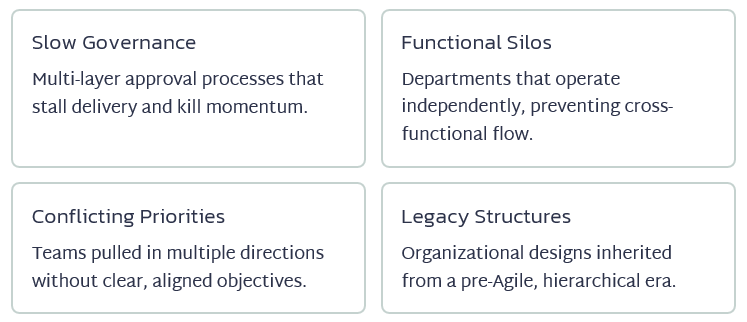
Many Agile transformations focus heavily on coaching individual teams while leaving systemic organizational barriers untouched.
Examples include:
- Slow governance processes
- Multiple approval layers
- Functional silos
- Conflicting priorities
- Resource constraints
- Legacy organizational structures
No amount of Scrum training can overcome organizational systems that prevent teams from working effectively.
How Coaches Help
Agile Coaches identify recurring organizational obstacles, partner with leadership to remove them, and advocate for structural improvements that enable teams to succeed.
Sometimes the greatest improvement comes not from changing the team, but from changing the environment around the team.
Mistake #5: Treating Agile as an IT Initiative
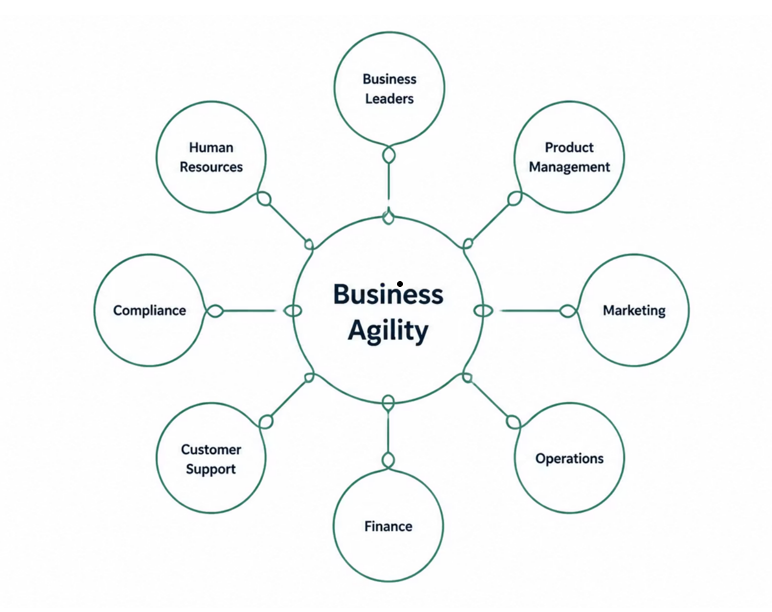
Agile originated in software development, but today's organizations recognize that business agility extends far beyond technology.
Successful Agile organizations include:
- Business leaders
- Product Management
- Marketing
- Operations
- Finance
- Customer Support
- Compliance
- Human Resources
When Agile remains isolated within IT, cross-functional collaboration suffers.
How Coaches Help
Agile Coaches encourage enterprise-wide collaboration by helping business and technology teams align around shared goals, customer outcomes, and value delivery.
Mistake #6: Neglecting Continuous Improvement
Some organizations assume that once Agile has been implemented, the transformation is complete.
In reality, Agile is built on continuous improvement.
High-performing organizations regularly:
- Evaluate delivery performance
- Analyze customer feedback
- Experiment with new practices
- Learn from failures
- Adapt their processes
Organizations that stop improving eventually stop evolving.
How Coaches Help
Agile Coaches foster a culture of reflection, experimentation, and learning through retrospectives, Communities of Practice, leadership coaching, and organizational improvement initiatives.
Mistake #7: Underestimating the Human Side of Change
Technology and frameworks are relatively easy to implement.
Changing behaviors is much harder.
Agile transformations often create uncertainty as employees adapt to:
- New roles
- Greater accountability
- Increased transparency
- Different leadership expectations
- New ways of collaborating
Without support, resistance naturally emerges.
How Coaches Help
Agile Coaches serve as change leaders who help individuals navigate uncertainty, build trust, resolve conflict, and develop the confidence needed to embrace new ways of working.
Transformation succeeds because people choose to change—not because processes require them to.
How AI Is Strengthening Agile Transformations
Artificial intelligence is becoming an increasingly valuable partner in Agile transformations.
AI-powered analytics can help organizations:
- Detect delivery bottlenecks
- Identify recurring impediments
- Monitor team health
- Predict delivery risks
- Analyze sprint trends
- Surface organizational patterns across multiple teams
Rather than spending hours collecting and analyzing data, Agile Coaches can focus on interpreting insights, mentoring leaders, and driving meaningful organizational improvements.
AI enhances coaching—it does not replace it.
The most effective Agile Coaches combine human-centered leadership with data-driven intelligence to make better decisions and accelerate transformation.
The Agile Coach as a Transformation Leader
Today's Agile Coach is far more than a Scrum expert or meeting facilitator.
They serve as:
- Leadership advisor
- Change agent
- Organizational consultant
- Mentor
- Facilitator
- Systems thinker
- Continuous improvement champion
Their success is measured not by how many ceremonies they facilitate, but by how effectively they help organizations deliver customer value and build resilient, high-performing teams.
Final Thoughts
Agile transformations rarely fail because organizations choose the wrong framework. They fail when organizations overlook the cultural, organizational, and leadership changes required to support Agile ways of working.
The most successful transformations focus on people before processes, outcomes before activities, and continuous learning over rigid compliance.
Agile Coaches play an essential role in making this happen. By mentoring leaders, empowering teams, removing organizational barriers, and fostering a culture of collaboration and continuous improvement, they help organizations turn Agile from a methodology into a lasting competitive advantage.
In today's rapidly changing business environment, the organizations that succeed won't simply adopt Agile—they'll embrace agility as part of their culture. And that transformation begins with strong leadership, committed teams, and exceptional Agile Coaches.

About the Author
Kimberly Wiethoff, MBA, PMP, PMI-ACP is a Senior Program Manager specializing in enterprise digital transformation, AI-enabled delivery, PMO leadership, and Agile program execution. Through Managing Projects the Agile Way, she helps project leaders prepare for the future of work by combining proven program management practices with emerging AI technologies.
Managing Projects The Agile Way
#AgileTransformation #AgileCoaching #AgileLeadership #Leadership #ContinuousImprovement #EnterpriseAgility #Scrum #ScrumMaster #ChangeManagement #BusinessTransformation #DigitalTransformation #ServantLeadership #OrganizationalChange #ProjectManagement #ProductManagement #LeanAgile #ArtificialIntelligence #Innovation #HighPerformingTeams #FutureOfWork
Download Document, PDF, or Presentation
Author: Kimberly Wiethoff, MBA, PMP, PMI-ACP