A few years ago, every project team consisted entirely of people. Project managers coordinated business analysts, architects, developers, testers, change managers, and executives to deliver successful outcomes. That model is beginning to change.
As Agentic AI matures, many organizations won't simply adopt AI tools—they'll build teams that include both people and specialized AI agents. These agents won't replace project professionals. They'll take ownership of repetitive, data-intensive, and coordination-heavy activities, allowing human leaders to focus on strategy, relationships, innovation, and decision-making.
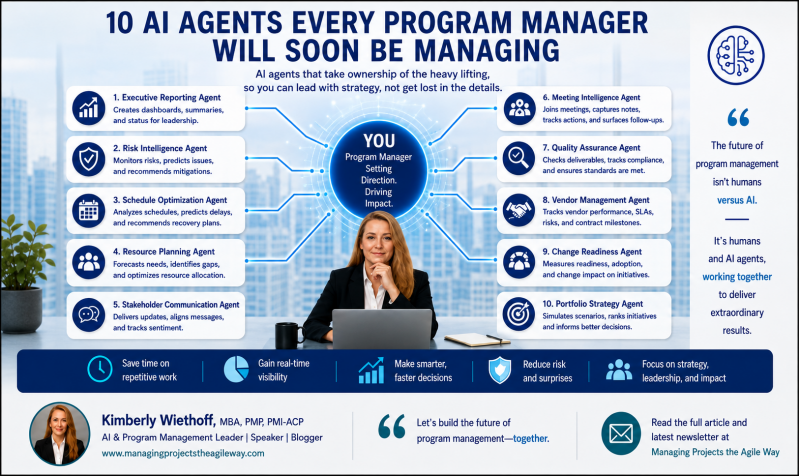
The program manager of the future won't just lead people. They'll orchestrate an entire digital workforce. So, what might that AI project team look like?
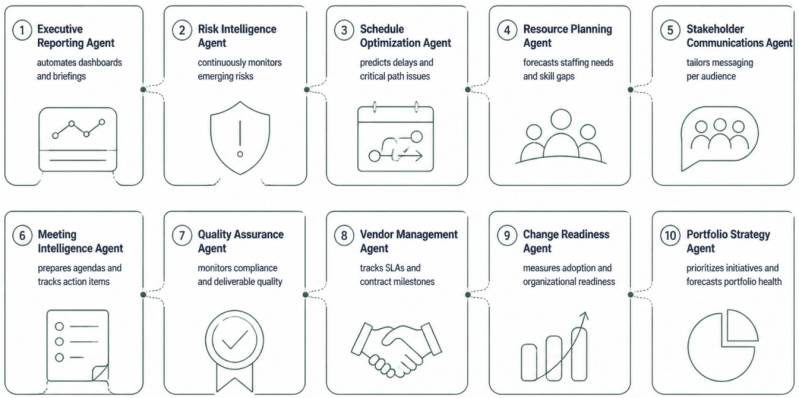
The Executive Reporting Agent
Every week, program managers spend hours collecting updates from multiple teams, consolidating information, and preparing executive reports. An Executive Reporting Agent can:
- Gather updates automatically
- Generate portfolio dashboards
- Summarize accomplishments
- Highlight risks and decisions
- Draft executive briefings
- Tailor reports for different audiences
Instead of building reports, program managers review and refine them.
The Risk Intelligence Agent
Risk management has traditionally depended on periodic reviews. AI changes that. A Risk Intelligence Agent continuously monitors:
- Project schedules
- Budget trends
- Team velocity
- Vendor performance
- Open issues
- Dependency changes
It identifies emerging risks before they become major problems and recommends mitigation strategies. Instead of reacting to risks, leaders gain time to prevent them.

The Schedule Optimization Agent
Complex programs often contain thousands of tasks and dependencies. A Schedule Optimization Agent can:
- Predict milestone delays
- Analyze critical paths
- Evaluate schedule impacts
- Recommend recovery scenarios
- Rebalance workloads
It acts like a scheduling strategist that never sleeps.
The Resource Planning Agent
Finding the right people at the right time has always been one of program management's biggest challenges. A Resource Planning Agent can:
- Forecast staffing shortages
- Identify skill gaps
- Recommend resource reallocations
- Balance workloads
- Predict future capacity constraints
Instead of scrambling to fill vacancies, organizations can plan proactively.
The Stakeholder Communications Agent
Stakeholders want different information delivered in different ways. One executive wants a one-page summary. Another wants detailed metrics. A business sponsor wants business outcomes. The Communications Agent adapts messaging for each audience while maintaining consistency across the program.
The Meeting Intelligence Agent
How much time do we spend preparing for and following up on meetings? Too much. A Meeting Intelligence Agent can:
- Prepare agendas
- Gather supporting documents
- Capture notes
- Assign action items
- Track decisions
- Monitor follow-up progress
Meetings become decision-making sessions instead of note-taking exercises.
The Quality Assurance Agent
Instead of waiting until testing begins, AI agents can continuously evaluate project quality. They can monitor:
- Requirements completeness
- Documentation quality
- Test coverage
- Process compliance
- Standards adherence
- Deliverable consistency
Quality becomes continuous instead of reactive.
The Vendor Management Agent
Large programs often involve multiple vendors with competing priorities. An AI Vendor Management Agent can:
- Track contract milestones
- Monitor service-level agreements (SLAs)
- Identify delivery risks
- Compare vendor performance
- Flag upcoming renewals
- Recommend escalation points
This gives program managers greater visibility across the vendor ecosystem.
The Change Readiness Agent
Technology projects don't fail because of software. They often fail because people aren't ready. A Change Readiness Agent can measure:
- Training completion
- User engagement
- Communication effectiveness
- Adoption trends
- Organizational readiness
- Resistance indicators
It helps leaders address concerns before they become barriers to success.
The Portfolio Strategy Agent
Perhaps the most valuable AI teammate sits at the portfolio level. A Portfolio Strategy Agent can:
- Prioritize initiatives
- Analyze investment scenarios
- Recommend funding allocations
- Forecast portfolio health
- Measure business value realization
- Identify strategic dependencies
Instead of asking, "How are our projects performing?" executives can ask, "Are we investing in the right work?"
What Program Managers Will Actually Do
Reading this list, some people immediately ask: "Will AI replace program managers?"
The better question is: Who coordinates all these AI agents? Someone must:
- Define objectives
- Set priorities
- Resolve conflicts
- Balance competing stakeholder needs
- Make ethical decisions
- Approve recommendations
- Manage governance
- Align work with business strategy
That's the role of the program manager. As AI becomes more capable, leadership becomes even more valuable. Managing AI agents requires many of the same skills used to lead high-performing human teams: communication, prioritization, governance, and sound judgment.
Building Your Hybrid Project Team
The most successful organizations won't choose between humans and AI. They'll design hybrid teams where each contributes what they do best.
People excel at:
- Leadership
- Creativity
- Negotiation
- Empathy
- Strategic thinking
- Ethical judgment
- Relationship building
AI agents excel at:
- Continuous monitoring
- Pattern recognition
- Data analysis
- Repetitive workflows
- Documentation
- Forecasting
- Speed and consistency
Together, they create a stronger delivery model than either could achieve alone.
Where to Start
You don't need ten AI agents on day one. Begin with one or two repetitive, high-value activities, such as:
- Executive reporting
- Risk monitoring
- Meeting documentation
- Resource forecasting
Measure the time saved, refine your governance model, and expand thoughtfully. Organizations that take an incremental approach are more likely to build trust and realize sustainable value.
Final Thoughts
The future of program management isn't about replacing people with AI. It's about giving program managers a digital team that works alongside them—one that analyzes data, monitors progress, automates routine work, and surfaces insights so leaders can focus on strategy and outcomes.
The question is no longer whether AI agents will become part of project delivery. It's how effectively program managers will learn to lead them. Tomorrow's most successful program managers won't simply manage projects. They'll lead hybrid teams where people and AI agents collaborate to deliver extraordinary results.

About the Author
Kimberly Wiethoff, MBA, PMP, PMI-ACP is a Senior Program Manager specializing in enterprise digital transformation, AI-enabled delivery, PMO leadership, and Agile program execution. Through Managing Projects the Agile Way, she helps project leaders prepare for the future of work by combining proven program management practices with emerging AI technologies.
Managing Projects The Agile Way
#AgenticAI hashtag#AIAgents hashtag#ProgramManagement hashtag#ProjectManagement hashtag#ArtificialIntelligence hashtag#AILeadership hashtag#FutureOfWork hashtag#PMO hashtag#DigitalTransformation hashtag#EnterpriseAI hashtag#Innovation hashtag#Leadership hashtag#ManagingProjectsTheAgileWay
Download Document, PDF, or Presentation
Author: Kimberly Wiethoff, MBA, PMP, PMI-ACP