AI projects are everywhere. Organizations are investing in copilots, intelligent automation, predictive analytics, generative AI, machine learning, and increasingly, AI agents capable of performing work rather than simply assisting with it. The technology is advancing quickly. The harder question is becoming: Are these investments actually creating measurable business value?
During an AI pilot, success can be relatively easy to demonstrate. A model produces an impressive result. An AI assistant generates content in seconds. An agent completes a workflow that previously required several manual steps. Everyone sees the potential. But once organizations begin moving from experimentation to enterprise deployment, the conversation changes. Executives eventually ask:
What value did we actually receive from the investment?
That is where many AI initiatives struggle. It is relatively easy to demonstrate that AI works. It is much harder to prove that AI improved the business enough to justify the investment. For program managers, PMOs, transformation leaders, and AI governance teams, ROI cannot be something calculated after implementation.
Benefits realization needs to begin before the project starts.
AI Success Is Not the Same as Business Success
Consider some of the metrics commonly reported by AI teams:
- The model achieved 95% accuracy.
- The chatbot answered 50,000 questions.
- Employees generated 100,000 prompts.
- An AI agent completed 10,000 tasks.
- 85% of employees activated their AI licenses.
- The pilot launched on schedule.
- User satisfaction reached 90%.
Those numbers may be encouraging. But none of them necessarily prove that the organization received a return on its investment. Technical performance tells us whether the technology works. Adoption tells us whether people are using it.
Business outcomes tell us whether the investment mattered.
Executives are not ultimately investing in prompts, models, agents, tokens, or licenses. They are investing because they expect something in the organization to improve. Perhaps they expect:
- Lower operating costs
- Faster processes
- Higher employee productivity
- Increased revenue
- Fewer errors
- Reduced risk
- Better customer experiences
- Greater organizational capacity
- Faster decision-making
The job of the PMO is to connect the technology investment to those outcomes.
Start With the Business Problem, Not the AI Solution
One of the easiest mistakes to make with AI is beginning with the technology.
- "We need an AI assistant."
- "We should build an AI agent."
- "We need a generative AI strategy."
Those statements describe potential solutions. They do not describe business problems. Instead, ask: What business outcome are we trying to improve?

| Instead of saying | Define the Objective as |
|---|---|
| "We want to implement an AI assistant." | "We want to reduce the time employees spend searching for internal information by 30%." |
| "We want to use AI for project reporting." | "We want to reduce program managers' reporting preparation time from six hours per week to two while maintaining or improving reporting quality." |
| "We want an AI customer service agent." | "We want to resolve 40% of routine customer inquiries without human intervention while maintaining customer satisfaction above 90%." |
Now we have something measurable.
- The AI becomes the solution.
- The business outcome becomes the goal.
That distinction fundamentally changes how the project is governed.
Establish the Baseline Before Implementing AI
You cannot prove improvement if you do not know where you started. Before implementing AI, capture the current state of the process. Depending on the use case, that could include:
- Hours required to complete the process
- Cost per transaction
- Cycle time
- Error rate
- Rework
- Customer response time
- Revenue conversion
- Employee productivity
- Defect rates
- Escalation rates
- Customer satisfaction
- Employee satisfaction
- Compliance incidents
But establishing a baseline can be more complicated than simply calculating an average. Many organizations have inconsistent processes before AI enters the picture. Different teams may perform the same work differently. Some employees may complete a task in 20 minutes while others require an hour. Some departments may have significantly higher error rates than others. In those situations, don't wait for a perfect baseline. Instead, establish a credible baseline range. Measure the process across:
- Multiple employees
- Different teams
- Different transaction types
- Different periods
- High- and low-performing groups
Then document the variation. For example: Current reporting preparation time: 4–7 hours per week, median 5.5 hours. That is far more useful than pretending the organization has a perfectly standardized six-hour process. The goal is not mathematical perfection.
The goal is having enough credible evidence to demonstrate whether the AI solution materially changed performance.
Define the Value Hypothesis
Before funding an AI initiative, I recommend documenting a simple value hypothesis: If we implement [AI capability], we expect [business metric] to improve from [baseline] to [target], creating approximately [business value] within [time period].
For example: If we implement AI-assisted project reporting, we expect reporting preparation time to decrease from an average of five hours per program manager per week to two hours, creating approximately 3,000 hours of additional annual delivery capacity.
That statement does several things. It establishes:
- The problem.
- The baseline.
- The expected improvement.
- The measurement period.
- The expected value.
Now the steering committee has something concrete to evaluate.
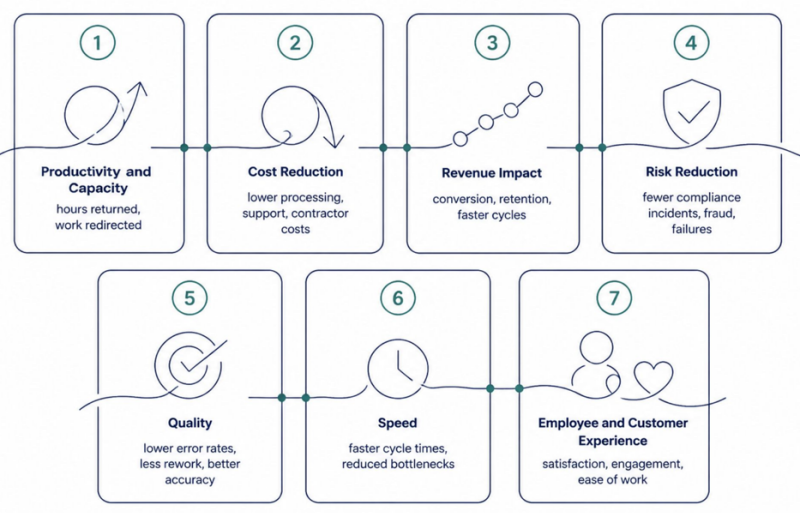
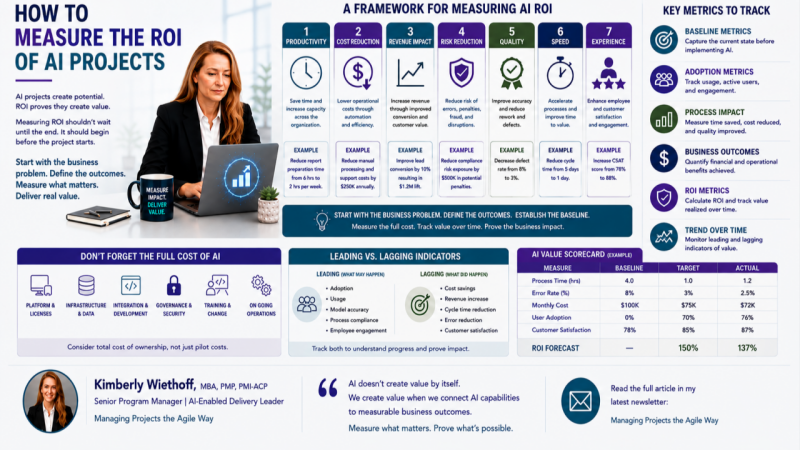
Seven Dimensions of AI Value
AI value does not always fit neatly into one financial metric. Evaluate investments across multiple dimensions to build a complete and credible business case. The traditional ROI formula (ROI = (Benefit − Cost) ÷ Cost × 100) remains the foundation. But a $500K investment yielding $900K in measurable benefits (80% ROI) only tells part of the story. Capture value across all seven dimensions for a complete picture.
Look Beyond Traditional Financial ROI
The traditional ROI formula still matters: ROI = (Benefit − Cost) ÷ Cost × 100
Suppose an organization invests $500,000 in an AI solution and receives $900,000 in measurable benefits. The net benefit is: $900,000 − $500,000 = $400,000
ROI is: $400,000 ÷ $500,000 × 100 = 80%
That is useful. But AI value does not always fit neatly into one financial metric. I recommend evaluating AI investments across several dimensions.
Productivity and Capacity
Productivity is often one of the easiest AI benefits to measure. Suppose 20 program managers spend five hours each week preparing reports. That's: 100 hours per week. If AI reduces reporting work to two hours per person: 60 hours are returned to the organization every week. Across 52 weeks, that represents: 3,120 hours of additional capacity.
But there is an important distinction. Time Saved Is Not Automatically Money Saved
If nobody's salary changes and no positions are eliminated, the organization did not necessarily "save" the salary associated with those hours. What it created was capacity. Those 3,120 hours might now be redirected toward:
- Risk management
- Stakeholder engagement
- Strategic planning
- Dependency management
- Coaching teams
- Vendor management
- Benefits realization
- Delivery improvement
That capacity is valuable.
But leaders should describe the benefit accurately. One of the quickest ways to undermine an AI business case is to claim millions of dollars in "savings" based entirely on employee hours that were never actually removed from the cost structure.
Cost Reduction
Some AI solutions do generate direct financial savings. Examples include:
- Reduced manual processing
- Lower support costs
- Less rework
- Fewer defects
- Reduced contractor dependency
- Lower operational expense
- Reduced downtime
- Lower cost per transaction
- Reduced overtime
These benefits are generally easier to convert into financial terms. For example, if automation reduces annual contractor expenses by $400,000 and requires $150,000 annually to operate, there is a tangible financial benefit. This is where Finance should become an important partner in benefits realization. The PMO should not have to invent financial assumptions independently.
Finance should validate how benefits will be classified and measured before the project begins.
Revenue Impact
AI can also create value by increasing revenue. Potential examples include:
- Improved lead conversion
- Better customer targeting
- Faster sales cycles
- Personalized recommendations
- Increased customer retention
- Faster product launches
- Improved pricing decisions
- Greater sales capacity
Revenue attribution, however, requires discipline. Suppose sales increase 12% after an AI recommendation engine launches. Did AI create the entire 12%? Maybe not. Marketing campaigns, seasonal demand, pricing changes, new products, economic conditions, or sales incentives could also have contributed. Program managers should resist the temptation to attribute every positive result to AI.
The goal is credible measurement, not the largest possible ROI number.
Risk Reduction
Some of the most valuable AI systems create value by preventing something from happening. AI may reduce:
- Fraud
- Compliance violations
- Security incidents
- Project delays
- Operational failures
- Quality defects
- Financial losses
- Safety incidents
Risk reduction can be difficult to quantify because you are measuring something that didn't happen.
One useful approach is:
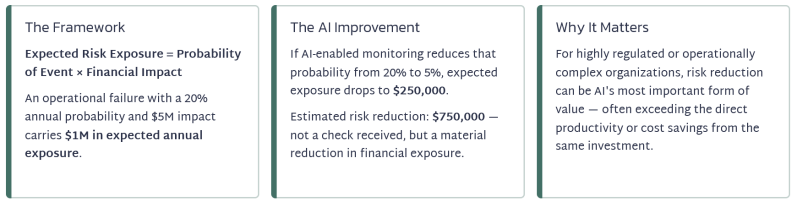
Expected Risk Exposure = Probability of Event × Financial Impact
Suppose a particular operational failure has:
- A 20% annual probability
- An estimated $5 million impact
Expected annual exposure is: 20% × $5 million = $1 million
If an AI-enabled monitoring capability reduces that probability to 5%, expected exposure becomes: 5% × $5 million = $250,000
The estimated risk reduction is: $750,000
That does not mean the organization received a $750,000 check. It means the expected financial exposure has been materially reduced. For highly regulated or operationally complex organizations, that can be one of AI's most important forms of value.
Risk Reduction: Measuring What Didn't Happen
Some of the most valuable AI systems create value by preventing something — fraud, compliance violations, operational failures, safety incidents. This can be difficult to quantify, but there is a practical approach.
Quality
AI may improve quality even when it does not dramatically reduce costs. Measure changes in:
- Error rates
- First-pass accuracy
- Rework
- Defects
- Customer complaints
- Documentation quality
- Decision accuracy
- Compliance quality
- Data completeness
For example:
Before AI: 14% of transactions require rework. After AI: 8% require rework.
That reduction can affect labor, cycle time, customer experience, and operating cost simultaneously. Quality improvements often create secondary benefits that should be captured as part of the broader value story.
Speed
Sometimes the value is simply doing something faster. AI might reduce: Five days → one day or Three hours → ten minutes
Cycle-time reduction can create significant downstream value. Faster processes may:
- Improve customer satisfaction
- Accelerate revenue
- Reduce project delays
- Improve employee productivity
- Increase organizational capacity
- Reduce waiting and handoffs
- Improve decision-making
Speed becomes particularly valuable when AI removes bottlenecks from critical business processes.
Employee and Customer Experience
Not every meaningful benefit fits neatly into a financial formula. AI may improve:
- Employee satisfaction
- Customer satisfaction
- Response quality
- Ease of completing work
- Access to information
- User experience
- Employee engagement
These outcomes should still be measured. An AI assistant that reduces employee frustration with searching through hundreds of documents may create value even if the exact financial benefit is difficult to calculate. The key is not to confuse qualitative benefits with direct financial returns. Instead, create a balanced value story.
Don't Forget the Full Cost of AI
One of the biggest mistakes in AI business cases is underestimating the denominator in the ROI equation.
The cost of AI is not simply the software license.
Organizations may need to account for:
- AI platform costs
- Model or API consumption
- Cloud infrastructure
- Data preparation
- Integration
- Cybersecurity
- AI governance
- Testing and validation
- Training
- Change management
- Vendor support
- Monitoring
- Model maintenance
- Human review
- Compliance
- Data storage
- Model evaluation
- Support operations
This becomes particularly important when moving from pilot to production.
A pilot might involve 50 users. Enterprise deployment might involve 10,000. A demonstration might process 1,000 prompts. Production might process millions. An experimental agent may perform one isolated task. A production agent may require identity management, permissions, logging, monitoring, exception handling, human escalation, security controls, and governance.
One of the biggest mistakes in AI business cases is underestimating the denominator. The cost of AI is not simply the software license — and production economics are very different from pilot economics.
| Infrastructure & Platform | Governance & Compliance | People & Change |
|---|---|---|
| AI platform and API costs | Cybersecurity and AI governance | Training and change management |
| Cloud infrastructure and data storage | Testing, validation, and compliance | Human review and support operations |
| Model consumption at scale | Model monitoring and maintenance | Integration and data preparation |
Production changes the economics.
That is why organizations need to evaluate total cost of ownership, not simply the cost of experimentation.
AI Agents Change the ROI Equation
Agentic AI introduces another important dimension. Traditional AI often assists employees. Agents increasingly perform portions of workflows themselves. That means organizations can begin measuring metrics such as:
- Percentage of workflow completed autonomously
- Human interventions per transaction
- Exception rates
- Successful task completion
- Cost per autonomous transaction
- Average handling time
- Escalation frequency
- Human review requirements
- Agent failure rates
- Business outcomes generated
Consider an AI agent processing routine service requests. Reporting: "The agent completed 50,000 tasks." sounds impressive.
But a stronger value report would say: "The agent successfully completed 72% of eligible service requests without human intervention, reduced average handling time by 63%, lowered cost per transaction by 28%, and maintained customer satisfaction above the established threshold."
That tells executives what the agent accomplished for the business.
Measure Adoption Alongside ROI
AI cannot create business value if nobody uses it. That makes adoption an important leading indicator.
Track:
- Active users
- Usage frequency
- Process adoption
- Training completion
- AI-assisted transactions
- User satisfaction
- Repeat usage
- Feature utilization
But remember: Adoption is not ROI. Ten thousand employees using an AI tool does not automatically mean the organization is creating value.
The next question must always be: What improved because they used it?
High adoption with no measurable outcome improvement may indicate that employees like the technology but the business case was poorly defined. Low adoption with strong technical performance may indicate a change-management problem. Both situations require different interventions.
Create an AI Value Scorecard
Every significant AI initiative should have a value scorecard. A simple scorecard might include:
| Metric | Baseline | Target | Current | Trend |
|---|---|---|---|---|
| Process cycle time | 5 days | 2 days | 2.4 days | Improving |
| Error rate | 12% | 6% | 7% | Improving |
| User adoption | 0% | 80% | 76% | Improving |
| Cost per transaction | $18 | $12 | $13 | Improving |
| Customer satisfaction | 84% | 90% | 91% | Above Target |
| Annual value | $0 | $1.5M | $1.1M forecast | At Risk |
Now the steering committee does not need to ask: "How is the AI project going?" They can ask: "Are we achieving the outcomes we funded?" That is a much better governance conversation.
Separate Leading and Lagging Indicators
Program managers should monitor both.
Leading Indicators
Leading indicators tell us whether the organization is moving toward value. Examples include:
- Adoption
- Usage
- Model accuracy
- Process compliance
- Employee engagement
- Training completion
- Agent success rates
Lagging Indicators
Lagging indicators tell us whether value was actually realized. Examples include:
- Cost savings
- Revenue increase
- Cycle-time reduction
- Error reduction
- Customer satisfaction
- Risk reduction
- Productivity improvement
Leading indicators tell us what may happen. Lagging indicators tell us what did happen. A mature AI value framework needs both.
Track Value Over Time
AI ROI is rarely static. Some initiatives produce value almost immediately.
Others require:
- User adoption
- Process redesign
- Better data
- Model refinement
- Organizational learning
- Integration improvements
- Change management
At each checkpoint, ask:
- Are people using it?
- Is the process improving?
- Are the expected benefits appearing?
- Are operating costs matching assumptions?
- Has the risk profile changed?
- Should we continue, adjust, scale, or stop?
That means ROI should be measured throughout the lifecycle. A practical cadence might be: Pilot → 30 Days → 90 Days → 6 Months → 12 Months
This turns benefits realization into an ongoing management discipline rather than a post-project exercise.
When AI Doesn't Deliver the Expected ROI
Not every AI initiative will succeed. And that is not necessarily a failure of AI strategy. The bigger failure is continuing to invest in something simply because the organization has already invested heavily in it. When expected value is not materializing, investigate why. Ask:
- Is adoption too low?
- Is the data poor?
- Is the workflow wrong?
- Are users bypassing the solution?
- Is the model performing poorly?
- Are AI outputs requiring too much human correction?
- Were our assumptions unrealistic?
- Are operating costs higher than expected?
- Did the business process change?
- Is another solution now more appropriate?
Sometimes the answer is to improve the solution. Sometimes it is to redesign the workflow. Sometimes it is to change the model. Sometimes it is to improve adoption. And sometimes the right decision is to stop investing.
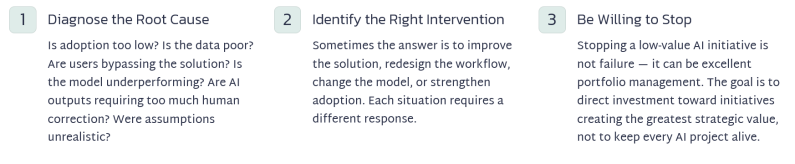
Stopping a low-value AI initiative is not necessarily failure. It can be excellent portfolio management.
The goal of an AI portfolio should not be to keep every AI project alive. The goal should be to continually direct investment toward the initiatives creating the greatest strategic value.
The PMO Should Own Benefits Realization
AI teams typically focus on whether the technology works. Business teams focus on whether the process works. Finance focuses on whether the investment works. Cybersecurity and governance teams focus on whether the solution operates within acceptable risk. Executives focus on whether the investment supports strategy.
The PMO can connect all of them.
That makes benefits realization one of the most important opportunities for PMOs in enterprise AI transformation. The PMO can establish:
- Business outcome definitions
- Baseline requirements
- Benefits owners
- Value hypotheses
- Measurement frameworks
- Governance checkpoints
- Executive scorecards
- Benefits realization reviews
- Scale/stop decisions
Most importantly, the PMO should not stop tracking an AI initiative when the project goes live. Go-live is a delivery milestone. It is not proof of business value. Benefits realization continues until the organization can answer: Did we receive the business value we expected from this investment?
From Project Status to Value Status
Traditional project dashboards typically focus on:
- Schedule: Green
- Budget: Green
- Scope: Green
- Risks: Yellow
Those metrics remain important. But imagine an executive AI portfolio dashboard that also reported:
- Expected annual value: $2.4M
- Value realized to date: $1.1M
- Productivity improvement: 31%
- Adoption: 82%
- Error reduction: 24%
- Autonomous workflow completion: 68%
- ROI forecast: 137%
- Benefits realization: On Track
Now leadership is not simply reviewing whether projects were delivered successfully. They are evaluating whether investments are successful. That is a significant shift. It changes the PMO conversation from: "Did we deliver what we promised?" to: "Did what we delivered create the value we promised?"
AI Portfolio Management Should Follow the Value
This becomes even more important as organizations move from a handful of AI pilots to dozens—or potentially hundreds—of AI use cases. Eventually, leaders will need to decide:
- Which AI initiatives should we scale?
- Which should we improve?
- Which should remain limited?
- Which should we stop?
- Where should the next dollar of AI investment go?
A portfolio view allows leadership to compare AI initiatives based on more than technical feasibility. Projects can be evaluated according to:
- Strategic alignment
- Expected value
- Realized value
- Cost
- Risk
- Adoption
- Scalability
- Time to value
- Data readiness
- Organizational readiness
This is where AI governance and portfolio management begin to converge. Governance should not exist only to control risk. It should also help organizations make better investment decisions.
The Next Evolution of the PMO
For years, PMOs have been challenged to demonstrate their strategic value. AI creates an opportunity to redefine that role. The AI-enabled PMO of the future should not simply track schedules, budgets, milestones, and resources. It should help leadership answer:
- Where are we investing?
- What outcomes did we expect?
- What value are we actually realizing?
- Which initiatives deserve additional investment?
- Which investments should we stop?
That moves the PMO from project administration toward enterprise value management. And as organizations invest more heavily in AI, that capability will become increasingly important.
The Organizations That Will Win With AI
The most successful organizations will not necessarily be the ones with the most AI pilots, copilots, models, or agents.
Final Thoughts
AI creates tremendous opportunities. But opportunity alone is not a business case. Organizations need to move the conversation from: "What can AI do?" to: "What measurable value should AI create?"
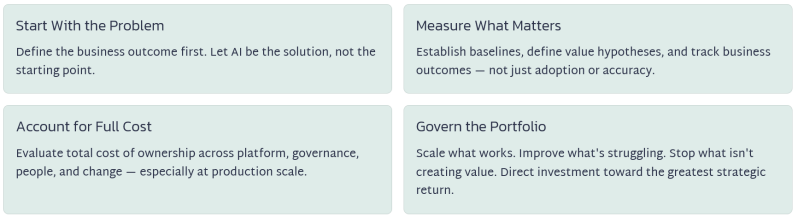
Start with the business problem. Establish the baseline. Define the value hypothesis. Capture the full cost. Measure adoption. Track business outcomes. Evaluate benefits over time. Connect AI agents to measurable workflow improvements. And be willing to change direction when the expected value is not materializing. Because the most successful organizations will not necessarily be the ones with the most AI pilots, copilots, models, or agents.
They will be the organizations that know: Which AI investments are creating value. Which ones are not. And where they should invest next.
That is where program managers and PMOs have an opportunity to become some of the most important leaders in enterprise AI transformation.

About the Author
Kimberly Wiethoff, MBA, PMP, PMI-ACP is a Senior Program Manager and AI transformation leader specializing in enterprise digital transformation, AI-enabled delivery, PMO governance, Agile program execution, and benefits realization. She focuses on helping organizations connect technology investments with measurable business outcomes and evolving the role of program management for an AI-enabled enterprise.
Through Managing Projects the Agile Way, she shares practical strategies for AI transformation, program and portfolio management, Agile delivery, PMO leadership, governance, and the changing role of project professionals in the age of artificial intelligence.
#AI #ArtificialIntelligence #AIROI #EnterpriseAI #AITransformation #ProgramManagement #ProjectManagement #PMO #PMOLeadership #BusinessValue #BenefitsRealization #AIGovernance #AgenticAI #DigitalTransformation #AILeadership #ManagingProjectsTheAgileWay
Download Document, PDF, or Presentation
Author: Kimberly Wiethoff, MBA, PMP, PMI-ACP