Artificial intelligence is moving rapidly from experimentation to enterprise adoption, but scaling AI successfully requires more than proving that a model, copilot, or agent can perform a task. Organizations also need to determine whether those capabilities are creating measurable, sustainable business value across productivity, financial performance, quality, adoption, risk, and operational capacity. As AI expands across teams and workflows, leaders need a disciplined way to measure not only whether AI is working, but whether it is worth continuing to fund, scale, or redesign.
Getting an AI pilot to work is an important milestone. But it is not the same as proving that AI creates lasting business value. During a pilot, organizations typically focus on questions such as:
- Does the technology work?
- Can it improve the process?
- Will employees use it?
- Is the model accurate enough?
- Can we demonstrate an initial return?
- Can we safely move it into production?
Those are necessary questions during experimentation. But once AI moves into production and begins expanding across teams, functions, and workflows, the questions need to change.
Leadership now needs to ask: Is AI producing measurable business outcomes—and are those outcomes sustainable as we scale?
That is a very different measurement challenge. An AI solution that creates value for 50 pilot users may not create the same value when deployed to 5,000 employees. Costs change. User behavior changes. Governance requirements increase. Infrastructure expands. Processes evolve. New risks emerge. Organizations therefore need to move beyond measuring whether individual AI experiments succeed and develop a broader framework for AI value realization at scale.
The Measurement Challenge Changes After the Pilot
Pilots are intentionally controlled. They typically involve:
- A limited number of users
- Clearly defined use cases
- Short measurement periods
- Highly engaged participants
- Close support from the implementation team
- Limited integration complexity
- Manageable technology costs
Enterprise AI is different. An AI capability may eventually affect hundreds or thousands of employees, multiple business processes, customer interactions, operational decisions, compliance requirements, and technology platforms.
A generative AI assistant that initially helps 100 employees may eventually support 10,000.
An AI agent that automates one workflow may eventually interact with multiple systems, trigger downstream processes, make decisions, and escalate exceptions to employees.
At that point, measuring only hours saved, prompts generated, or tasks automated provides an incomplete picture.
Organizations need to evaluate value across multiple dimensions.

1. Productivity and Capacity
Productivity remains one of the most visible benefits of AI. But organizations should move beyond simply asking: How many hours did AI save?
Instead, measure whether AI enables employees to:
- Complete work faster
- Handle greater volumes
- Reduce administrative work
- Shorten cycle times
- Manage more customers or transactions
- Spend more time on strategic activities
- Reduce bottlenecks
- Improve decision-making
Then ask the more important question: What did the organization accomplish with the capacity AI created?

Suppose an AI solution saves employees 10,000 hours annually. That sounds impressive. But those 10,000 hours do not automatically represent financial savings. If salaries and headcount remain unchanged, the organization has primarily created capacity. The business value comes from what happens next. Perhaps employees use that capacity to:
- Serve more customers
- Manage additional projects
- Resolve risks earlier
- Accelerate product development
- Increase sales activity
- Improve quality
- Reduce backlog
- Perform work previously outsourced
That is a much stronger value story. Instead of reporting: AI saved 10,000 hours. Leadership can report: AI created 10,000 hours of additional capacity, allowing the organization to increase transaction volume by 18% without increasing headcount. Now productivity is connected to a measurable business outcome.
2. Financial Impact
As AI adoption expands, organizations should connect AI outcomes to financial measures.
Depending on the use case, these may include:
- Operating cost reduction
- Cost avoidance
- Revenue growth
- Margin improvement
- Reduced outsourcing
- Reduced contractor expenses
- Increased transaction capacity
- Lower cost per transaction
- Reduced rework
- Reduced downtime
But scaling also changes the cost side of the equation. A pilot may appear inexpensive because many enterprise costs have not yet materialized. Production introduces additional costs, including:
- AI platforms and licenses
- Model and API consumption
- Cloud infrastructure
- Data preparation
- Integration
- Cybersecurity
- Governance
- Monitoring
- Testing and validation
- Training
- Change management
- Support
- Model evaluation
- Human oversight
- Vendor management
That means the financial question should not simply be: How much value did AI generate? It should be: How much net value did AI generate after accounting for the full cost of operating it at scale? That distinction becomes increasingly important as AI usage expands.
3. Understand the Economics of Scaling
There is another challenge organizations sometimes overlook: AI value and AI cost may not scale at the same rate. Imagine an AI assistant produces $500,000 in estimated annual benefits during an initial deployment. Leadership might assume that expanding the solution tenfold will produce $5 million in benefits. That may happen. But it may not.
Later adopters may have different workflows. Some teams may use the solution less effectively. Additional integrations may be required. Infrastructure and model consumption costs may increase. More governance and support may be needed. This creates an important measurement:
Marginal Value of Scaling
Organizations should ask: What additional value do we receive from the next level of AI adoption compared with the additional cost required to support it?
The first 1,000 users may generate tremendous value. The next 5,000 may generate less incremental value. Or the opposite may occur: network effects, organizational learning, and process redesign may cause value to accelerate. Either way, leaders should not assume that pilot economics automatically translate into enterprise economics.
They should measure them.
4. Quality and Performance
Faster does not automatically mean better. If AI reduces processing time by 30% but increases errors, rework, or customer complaints, the productivity improvement may not represent real value.
Organizations should therefore establish quality measures such as:
- Error rates
- Defect rates
- Rework
- Accuracy
- First-pass resolution
- Customer satisfaction
- Service-level performance
- Decision consistency
- Escalation rates
For generative AI applications, organizations may also need to monitor:
- Factual accuracy
- Relevance
- Hallucination rates
- Human override rates
- Output acceptance rates
- Failed responses
- Escalations
The goal is not simply: Faster. It is: Faster + Better + Sustainable.
An AI system that produces work twice as quickly but requires employees to spend significant time reviewing and correcting the output may have far less value than the initial productivity metric suggests.
5. Adoption and Behavior Change
An AI solution cannot generate enterprise value if employees do not use it. Pilot participants are often enthusiastic early adopters. Enterprise deployment introduces a much broader population with different levels of technical comfort, trust, experience, and willingness to change.
Organizations should measure:
- Active users
- Frequency of use
- Adoption by team
- Adoption by business unit
- Percentage of eligible workflows using AI
- Abandonment rates
- Human overrides
- Repeat usage
- Employee satisfaction
But adoption should never become a vanity metric. Reporting: 8,000 employees used our AI platform last month. does not prove that the platform created business value. A stronger question is: Are employees using AI achieving better outcomes than comparable workflows without it?
This creates an important connection: Adoption → Behavior Change → Process Improvement → Business Outcome
If that chain breaks anywhere, value can disappear.

6. Risk and Governance
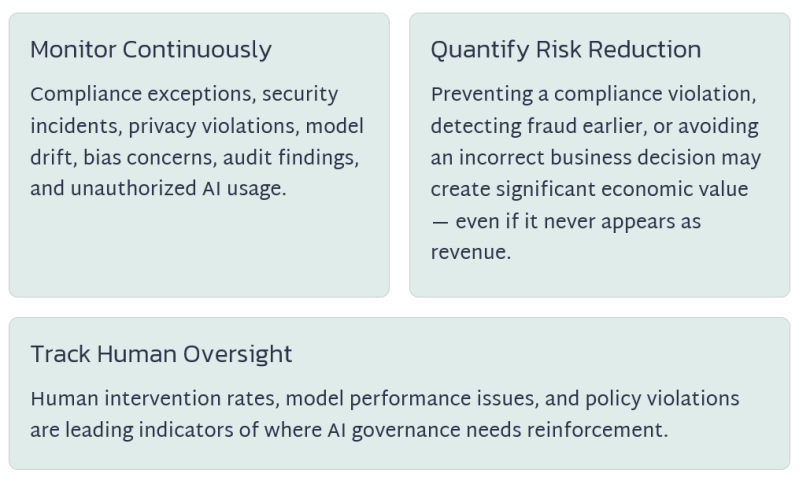
Some of AI's most important value comes from preventing negative outcomes.
Organizations should monitor areas such as:
- Compliance exceptions
- Security incidents
- Privacy violations
- Model performance issues
- Bias or fairness concerns
- Human intervention rates
- Audit findings
- Policy violations
- Unauthorized AI usage
- Model drift
Risk reduction can also create economic value. Preventing a compliance violation, detecting fraud earlier, identifying a security issue, or avoiding an incorrect business decision may create significant value even though it does not appear as revenue on a financial statement. This is why AI governance should not be viewed only as a cost or barrier to innovation.
Effective governance protects the value organizations are trying to create.
7. Agentic AI Requires a New Measurement Model
AI agents add another dimension to enterprise value measurement. Traditional generative AI generally helps a person perform work. Agentic AI can increasingly perform portions of the work itself. That changes the metrics organizations need.
For AI agents, consider measuring:
- Tasks completed autonomously
- Percentage of workflow completed without intervention
- Successful task completion rate
- Exception rate
- Human escalation rate
- Human review requirements
- Cost per completed transaction
- Average processing time
- Failed actions
- Rework generated by agents
For example, saying: Our AI agent completed 100,000 tasks. does not tell leadership much about business value.
A stronger measurement would be: The AI agent successfully completed 74% of eligible transactions without human intervention, reduced average handling time by 61%, and lowered cost per transaction by 23% while maintaining established quality thresholds.
That connects autonomous work directly to business performance. As organizations deploy more agents, measuring autonomy with quality and control will become increasingly important.
Move From Project Metrics to Value Metrics
One of the biggest changes organizations need to make is shifting the conversation away from whether the AI project was delivered successfully.
Traditional project measures still matter:
- Was it delivered on time?
- Was it within budget?
- Did we complete the scope?
- Did we meet the technical requirements?
But those measures tell us whether we successfully delivered the solution. They do not tell us whether the solution successfully delivered value.
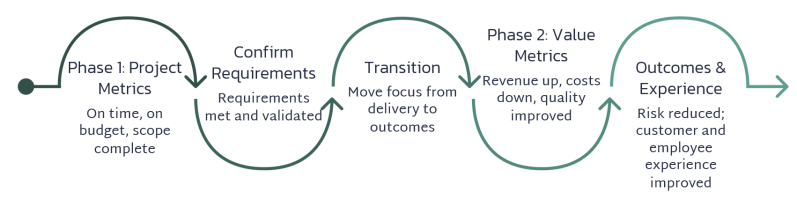
Traditional project measures confirm successful delivery. But they do not confirm whether the solution delivered value. After implementation, leadership should ask whether business outcomes — revenue, cost, quality, cycle time, risk, customer and employee experience, and organizational capacity — actually improved. That is the difference between measuring AI delivery and measuring AI value.
After implementation, leadership should increasingly ask:
- Did revenue increase?
- Did costs decrease?
- Did quality improve?
- Did cycle time decrease?
- Did risk decline?
- Did customer experience improve?
- Did employee experience improve?
- Did organizational capacity increase?
That is the difference between measuring AI delivery and measuring AI value.
Establish a Baseline Before Scaling
Meaningful measurement requires comparison. Before expanding an AI solution, capture the performance of the existing process whenever possible. For example:
| Measure | Current Baseline | AI Target |
|---|---|---|
| Average processing time | 45 minutes | 20 minutes |
| Error rate | 12% | 5% |
| Cost per transaction | $18 | $11 |
| First-pass resolution | 68% | 85% |
| Weekly employee capacity | 100 transactions | 140 transactions |
| Customer satisfaction | 82% | 90% |
Without a credible baseline, organizations may know performance changed but struggle to prove how much value AI actually created. But what happens when the existing process is already inconsistent? Do not force a single baseline number. Instead:
- Use historical ranges
- Segment performance by team
- Segment by workflow type
- Compare high- and low-performing groups
- Measure across an agreed time period
- Use median values when averages are distorted by outliers
- Document known process variation
For example: Current processing time: 35–60 minutes, with a median of 47 minutes. That creates a much more defensible comparison point. The objective is not a perfect baseline. It is a credible baseline.
Watch for Value Leakage
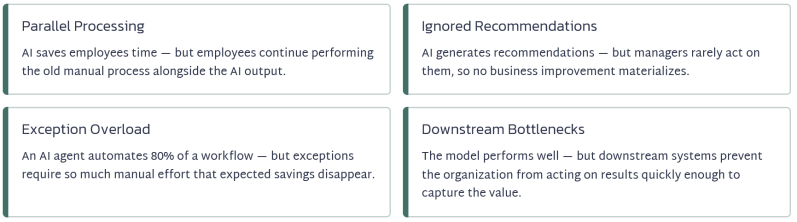
One of the biggest risks after scaling is something I call value leakage. The AI solution may technically deliver the expected capability, but portions of the expected business benefit disappear between implementation and operations.
For example:
- AI saves employees time—but employees continue performing the old manual process as well.
- AI generates recommendations—but managers rarely act on them.
- An AI agent automates 80% of a workflow—but exceptions require so much manual work that the expected savings disappear.
- Employees receive AI licenses—but only a small percentage incorporate AI into meaningful workflows.
The model performs well—but downstream systems prevent the organization from acting on the results quickly.
In each situation, the technology may be working. The value chain is not.
This is why organizations need to measure not only whether AI performs correctly but whether the surrounding operating model allows the value to reach the business.
Assign a Benefits Owner
Every major AI initiative should have someone accountable for the business outcome. That person does not necessarily need to own the technology. They need to own the benefit. For example:
- Technology owner: Responsible for whether the AI platform operates successfully.
- Product owner: Responsible for whether the capability meets user needs.
- Business owner: Responsible for whether the process improves.
- Benefits owner: Responsible for whether the expected value is realized.
In some organizations, one person may hold several of these responsibilities. The important point is that benefits should not become everyone's responsibility—and therefore no one's responsibility. Every major AI business case should clearly identify:
Who is accountable for proving that the expected business value was realized?
Measure Value Over Time
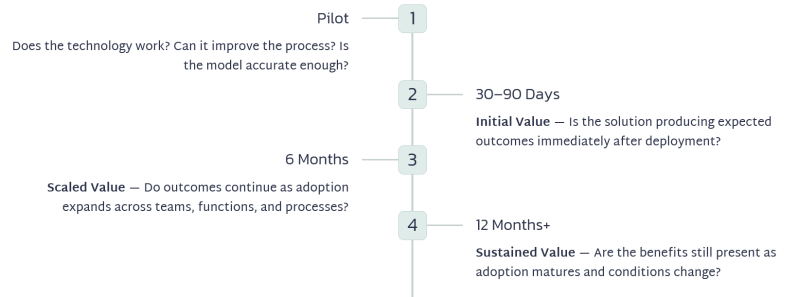
AI value should never be measured once. Models change. Data changes. Employees change how they work. Business conditions change. Costs change. Adoption may increase—or decline. Organizations should measure AI value across three stages.
- Initial Value - Is the solution producing the expected outcomes immediately after deployment?
- Scaled Value - Do those outcomes continue as adoption expands across teams, functions, and processes?
- Sustained Value - Are the benefits still present six months, twelve months, or longer after implementation?
A practical measurement cadence might include: Pilot → 30 Days → 90 Days → 6 Months → 12 Months
This turns AI measurement from a project-closeout exercise into an ongoing management discipline.
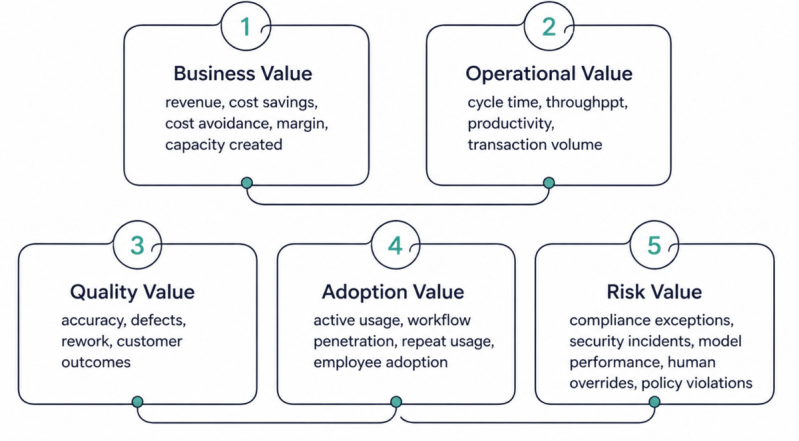
Create an Enterprise AI Value Scorecard
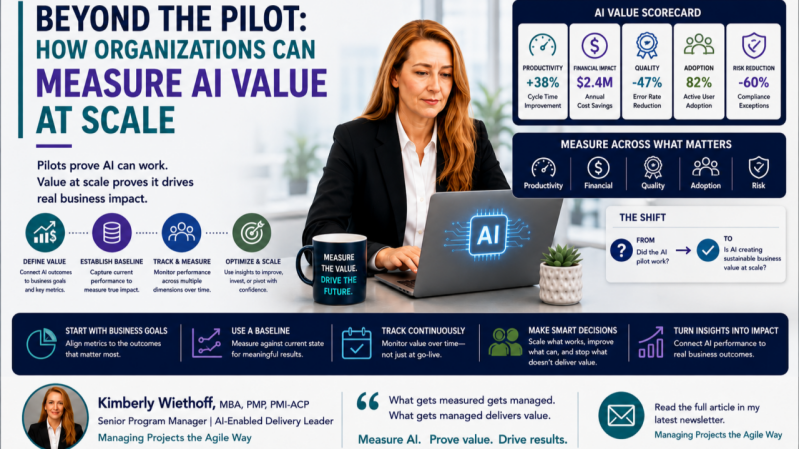
Executives should not have to review dozens of technical metrics to determine whether an AI investment is working. A practical AI value scorecard can bring the most important measures together.
Business Value
- Revenue
- Cost savings
- Cost avoidance
- Margin
- Capacity created
Operational Value
- Cycle time
- Throughput
- Productivity
- Transaction volume
Quality Value
- Accuracy
- Defects
- Rework
- Customer outcomes
Adoption Value
- Active usage
- Workflow penetration
- Repeat usage
- Employee adoption
Risk Value
- Compliance exceptions
- Security incidents
- Model performance
- Human overrides
- Policy violations
Each AI initiative does not need dozens of KPIs.
It needs a small number of metrics directly tied to the business case that justified the investment.
Move From AI Project Management to AI Portfolio Management
Once an organization has dozens of AI initiatives, measuring each one independently is no longer enough. Leadership needs a portfolio view.
Imagine an AI investment portfolio containing:
- AI Initiative A: High value, high adoption, low risk
- AI Initiative B: High potential, low adoption
- AI Initiative C: Moderate value, rapidly increasing operating costs
- AI Initiative D: Low value, high risk
- AI Initiative E: Strong pilot results, but benefits declining after scale
Those initiatives should not receive the same level of investment.
Portfolio governance should allow leadership to compare initiatives based on:
- Strategic alignment
- Expected value
- Realized value
- Total cost
- Adoption
- Risk
- Scalability
- Time to value
- Sustainability
The goal is not simply to ask: Which AI projects are green?
It is to ask: Where should the next dollar of AI investment go?
That is a much more strategic conversation.
Know When to Scale—and When to Stop
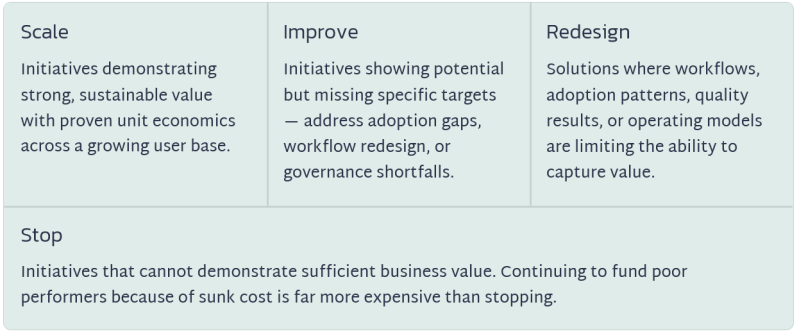
Perhaps the most important reason to measure AI value is not to prove that every AI initiative was successful. It is to make better investment decisions. Organizations should be willing to:
- Scale initiatives demonstrating strong, sustainable value.
- Improve initiatives showing potential but missing specific targets.
- Redesign solutions where workflows, adoption, quality, or operating models are limiting results.
- Stop initiatives that cannot demonstrate sufficient business value.
Stopping an AI initiative that does not produce value is not necessarily failure. Continuing to fund one because the organization has already invested heavily in it can be far more expensive. A mature AI organization does not measure success by how many AI projects it launches. It measures success by how effectively it allocates resources toward AI investments that produce measurable outcomes.
The PMO Has an Important Role in AI Value Realization
AI teams understand models. Technology teams understand platforms. Finance understands financial performance. Business leaders understand operational outcomes. Risk and security teams understand governance requirements. The PMO has an opportunity to connect them.
As organizations scale AI, the PMO can help establish:
- Standard value frameworks
- Baseline requirements
- Benefits owners
- Measurement cadences
- Executive scorecards
- Portfolio comparisons
- Benefits realization reviews
- Scale, improve, redesign, or stop decisions
This represents an important evolution of the PMO. Instead of asking only: Are our AI projects on schedule and on budget? the PMO can help leadership answer: Are our AI investments producing the business outcomes we expected? That moves the PMO from delivery oversight toward enterprise value management.
The Leadership Question Has Changed
During the experimentation phase of AI, organizations frequently asked: "Can we use AI here?"
As AI matures, the more important questions are becoming:
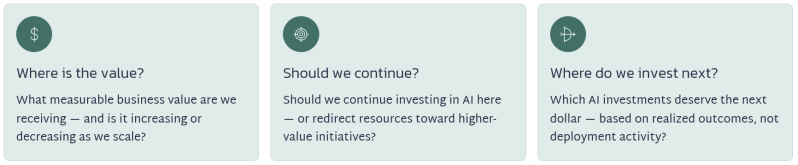
- "Should we continue investing in AI here?"
- "What measurable business value are we receiving?"
- "Is that value increasing or decreasing as we scale?"
- "Where should we invest next?"
Organizations that can answer those questions consistently will be better positioned to move beyond disconnected experiments and create sustainable enterprise AI capabilities. The goal is not simply to deploy more AI. It is not to purchase more copilots. It is not to build the largest number of agents. It is not to automate the greatest number of tasks.
The goal is to create more business value—and be able to prove it.
That is the difference between experimenting with AI and truly operating AI at enterprise scale.

About the Author
Kimberly Wiethoff, MBA, PMP, PMI-ACP is an AI Transformation Program Leader specializing in enterprise digital transformation, AI-enabled delivery, PMO governance, Agile program execution, cloud transformation, and benefits realization.
Through Managing Projects the Agile Way, she shares practical strategies for AI transformation, program and portfolio management, Agile delivery, PMO leadership, AI governance, and the evolving role of project professionals in the AI-enabled enterprise.
#AI #ArtificialIntelligence #AITransformation #EnterpriseAI #AIValue #AIROI #AgenticAI #ProgramManagement #ProjectManagement #PMO #PMOLeadership #AIGovernance #BenefitsRealization #DigitalTransformation #AILeadership #ManagingProjectsTheAgileWay
Download Document, PDF, or Presentation
Author: Kimberly Wiethoff, MBA, PMP, PMI-ACP