Artificial intelligence is moving from experimentation to enterprise transformation. Over the past several years, organizations have rapidly introduced AI copilots, generative AI platforms, predictive analytics, intelligent automation, and increasingly sophisticated AI agents. Individual teams are discovering new ways to automate work, analyze information, accelerate decision-making, and improve productivity.
But there is a significant difference between using AI tools and building an enterprise capability around AI.
Without a coordinated operating model, AI adoption can quickly become fragmented. One department may deploy a generative AI assistant. Another purchases an AI scheduling platform. A third develops predictive models. Employees may experiment with public AI tools independently, while IT, cybersecurity, legal, compliance, and business leaders struggle to understand what is being used, what data is being shared, and whether those investments are actually creating measurable value.
The challenge is no longer simply: How do we use AI?
The more important questions are: Where should we use AI? How should we govern it? Which initiatives deserve investment? How do we measure their value? And how do we scale what works without creating unnecessary risk?
This is where the AI Project Management Office—or AI PMO—can become an important enterprise capability.
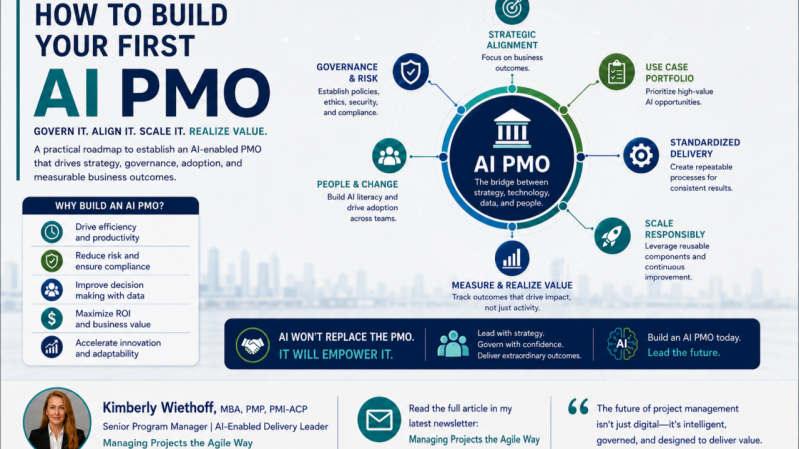
An AI PMO does more than manage AI projects. It creates the governance, portfolio discipline, delivery standards, measurement framework, and organizational capabilities required to move AI from scattered experimentation to sustainable business transformation.
For organizations beginning that journey, the AI PMO can provide the structure needed to innovate quickly without losing control.
What Is an AI PMO?
A traditional PMO typically focuses on improving project and program delivery through governance, standards, portfolio management, resource planning, reporting, and delivery oversight. An AI PMO expands that responsibility.
Its mission is to help the organization identify, prioritize, govern, deliver, measure, and scale AI-enabled initiatives while ensuring those initiatives remain aligned with enterprise strategy.
A successful AI PMO helps ensure AI investments are:
- Aligned with measurable business objectives
- Prioritized according to enterprise value
- Governed responsibly
- Secure and compliant
- Supported by appropriate data
- Delivered using consistent processes
- Monitored after implementation
- Adopted successfully by employees
- Measured against expected outcomes
- Scalable across teams and business functions
This makes the AI PMO a bridge between groups that have traditionally operated separately. Business leaders understand the problems that need to be solved. Technology teams understand the architecture and platforms. Data teams understand the information required to support AI. Security, legal, risk, and compliance teams understand the controls that must exist. Project and program leaders understand how to turn strategy into coordinated execution.
The AI PMO connects those capabilities into a repeatable operating model.

Step 1: Start With Business Outcomes, Not AI Technology
One of the easiest mistakes to make during an AI transformation is beginning with the technology. A new generative AI platform becomes available, executives become interested, and suddenly teams begin searching for places to use it. That approach reverses the equation.
The first question should never be: “Where can we deploy this AI tool?”
Instead, ask: “Which business problems are important enough to solve, and could AI help us solve them better?”
The AI PMO can facilitate structured discovery sessions with business leaders to identify opportunities.
Questions might include:
- Which processes consume significant employee time?
- Where do repetitive manual tasks exist?
- Which processes experience frequent delays or errors?
- Where are employees searching through large amounts of information?
- Which decisions depend on manual analysis?
- Where do customers experience unnecessary friction?
- Which workflows generate large volumes of structured or unstructured data?
- Where could earlier predictions improve decisions?
- Which business capabilities could create competitive advantage if significantly improved?
From there, potential AI solutions can be explored. For example, the answer might involve generative AI, predictive analytics, intelligent document processing, workflow automation, an AI agent—or no AI at all. That last possibility matters.
A mature AI PMO should be willing to determine that AI is not the right solution when a simpler process improvement or automation would deliver better value. AI strategy should begin with the business problem, not the novelty of the technology.

Step 2: Establish AI Governance Before Scaling
Organizations often view governance as something that slows innovation. For AI, the opposite can be true.
Clear governance gives employees boundaries within which they can experiment confidently. Without those boundaries, teams may either take unnecessary risks or avoid AI altogether because they do not know what is permitted.
The AI PMO should therefore work with legal, cybersecurity, compliance, data, architecture, privacy, and business leadership to establish an AI governance framework.
That framework may address areas such as:
- Responsible AI principles
- Data privacy and classification
- Cybersecurity
- Intellectual property
- Approved AI platforms
- Third-party AI vendors
- Model validation
- Bias and fairness
- Explainability
- Human oversight
- Regulatory requirements
- AI-generated content
- Model and agent monitoring
- Auditability
- Incident management
- AI risk classification
Not every AI initiative requires the same level of governance. An internal assistant that summarizes non-sensitive meeting notes has a very different risk profile from an AI model recommending financial decisions, supporting clinical workflows, or making employment-related recommendations.
That is why the AI PMO should consider establishing risk tiers.
Example AI Risk Tiers
- Low Risk - Internal productivity tools with limited access to sensitive information.
- Moderate Risk - AI systems that influence operational workflows or analyze internal business information.
- High Risk - AI that affects customers, financial decisions, regulated processes, sensitive data, or significant business decisions.
The governance process can then scale according to risk. Low-risk initiatives might follow an accelerated approval path, while higher-risk systems receive additional security, legal, model validation, compliance, and executive review.
The goal is not bureaucracy. The goal is governance proportional to risk.
Step 3: Create an AI Use Case Portfolio
Once employees begin understanding what AI can do, ideas will emerge quickly. The challenge soon becomes deciding which ideas deserve investment. This is where traditional portfolio management becomes extremely valuable.
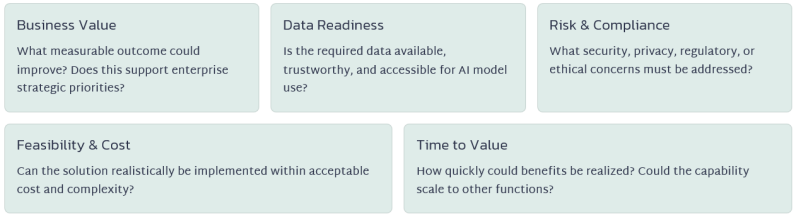
Instead of treating AI initiatives as unrelated experiments, create an AI Use Case Portfolio. Each proposed use case can be evaluated using consistent criteria such as:
| Evaluation Area | Questions to Consider |
|---|---|
| Business Value | What measurable outcome could improve? |
| Strategic Alignment | Does this support enterprise priorities? |
| User Impact | Who benefits and how significant is the improvement? |
| Data Readiness | Is the required data available and trustworthy? |
| Technical Feasibility | Can the solution realistically be implemented? |
| Risk | What security, compliance, privacy, or ethical concerns exist? |
| Complexity | How difficult will implementation and integration be? |
| Cost | What will development, licensing, infrastructure, and support cost? |
| Time to Value | How quickly could benefits be realized? |
| Scalability | Could the capability be reused elsewhere? |
A simple scoring model can help leaders compare opportunities objectively. One useful approach is to map use cases across business value and implementation complexity.
- High Value + Low Complexity - Prioritize these opportunities as potential quick wins.
- High Value + High Complexity - Treat these as strategic investments requiring stronger planning and sponsorship.
- Low Value + Low Complexity - Consider them only when they provide useful learning or enable future capabilities.
- Low Value + High Complexity - These initiatives are usually candidates for elimination.
The AI PMO should be comfortable saying no. Portfolio management isn't about approving every good idea. It is about directing limited investment toward the opportunities most likely to create enterprise value.
Step 4: Build a Standard AI Delivery Lifecycle
AI initiatives do not always behave like traditional software projects.
Traditional development often assumes that requirements can be defined and the system can then be built against those requirements. AI introduces additional uncertainty.
Teams may need to determine whether sufficient data exists, whether a model performs accurately enough, whether outputs are reliable, whether users trust the results, and whether the economics justify production deployment.
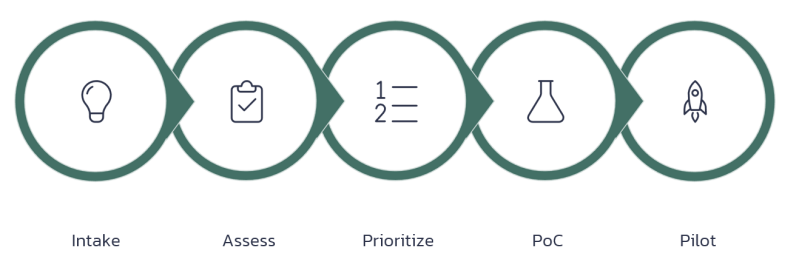
An AI PMO should establish a lifecycle that acknowledges this uncertainty. A practical lifecycle might include:
- Idea / Intake - Capture the business problem, proposed outcome, users, expected value, and initial AI concept.
- Assessment - Evaluate strategic alignment, feasibility, data readiness, risk, cost, and complexity.
- Prioritization - Compare the opportunity against the broader AI portfolio.
- Discovery / Proof of Concept - Determine whether the underlying AI capability can solve the problem.
- Pilot - Test the solution with real users in a controlled environment.
- Validation - Evaluate performance, security, risk, user adoption, and expected benefits.
- Production Deployment - Integrate the AI capability into enterprise workflows.
- Adoption and Change Management - Train employees and redesign processes where necessary.
- Benefits Realization - Compare actual outcomes against the original business case.
- Continuous Monitoring - Monitor performance, cost, risk, adoption, model behavior, and changing business conditions.
This creates repeatability without forcing every AI initiative into exactly the same delivery model.
Step 5: Build an AI-Ready Workforce
Technology alone does not create transformation. People do.
Employees need to understand how AI changes their work, what they are allowed to do with it, when human judgment is required, and how to recognize unreliable outputs.
An AI PMO can partner with HR, learning and development, cybersecurity, data teams, and business leaders to establish an enterprise AI learning program.
Training may include:
- AI fundamentals
- Generative AI
- Prompt engineering
- Data literacy
- Responsible AI
- AI governance
- Security and privacy
- Human-AI collaboration
- AI-assisted decision-making
- AI agent oversight
- Change management
Different roles will require different levels of knowledge. Executives may need to understand AI strategy, investment decisions, governance, and risk. Program managers may need to understand AI delivery lifecycles, value measurement, data dependencies, and model uncertainty.
Employees may need practical guidance on using approved AI tools safely and effectively. Technical teams will require much deeper skills. The objective is not to turn everyone into a machine-learning engineer.
It is to build an organization in which employees understand how to work effectively and responsibly alongside AI.
Step 6: Measure Value, Not AI Activity
Organizations frequently confuse AI activity with AI value. Metrics such as these may be useful operationally:
- Number of pilots launched
- Number of models deployed
- Number of AI licenses purchased
- Number of employees trained
- Number of prompts submitted
But they do not answer the question executives ultimately care about: Did AI improve the business?
The AI PMO should establish a benefits-realization framework connecting every major AI initiative to measurable outcomes.
Those outcomes may include:
Productivity
- Hours eliminated from manual work
- Cycle-time reduction
- Increased throughput
- Faster analysis
Financial Value
- Cost reduction
- Cost avoidance
- Revenue growth
- Improved margins
- Reduced vendor spending
Quality
- Lower error rates
- Higher accuracy
- Reduced rework
- Improved consistency
Customer Experience
- Faster response times
- Higher satisfaction
- Better personalization
- Reduced customer effort
Risk
- Earlier risk identification
- Improved compliance
- Fraud reduction
- Fewer operational incidents
Adoption
- Active users
- Frequency of use
- Workflow penetration
- Employee satisfaction
- Percentage of targeted processes using the capability
A strong AI business case establishes the baseline before implementation whenever possible. If an invoice process currently takes 15 minutes per transaction and AI reduces it to five minutes, the organization can quantify the difference.
But value measurement should continue after deployment. Initial benefits may decline, increase, or shift as employees change how they work. The AI PMO therefore owns not simply project completion, but benefits realization over time.
Step 7: Treat Change Management as Part of the AI Product
AI transformation can create understandable concern.
Employees may wonder:
- Will AI eliminate my job?
- Will my work be monitored?
- Can I trust the output?
- What happens when AI is wrong?
- Am I responsible for reviewing its decisions?
- Which information can I safely provide to AI?
- What skills will I need next?
Ignoring these questions creates resistance. Successful AI adoption requires transparency. Leaders should explain what the AI is designed to do, what it is not designed to do, where humans remain accountable, and how employee roles may evolve.
Program managers should also involve employees early. The people performing the work often understand the process better than anyone else. They can identify exceptions, risks, workarounds, and practical requirements that may not appear in process documentation.
Instead of designing AI for employees, organizations should increasingly design AI with employees.
Step 8: Scale Responsibly
A successful pilot creates another challenge: How do we scale it?
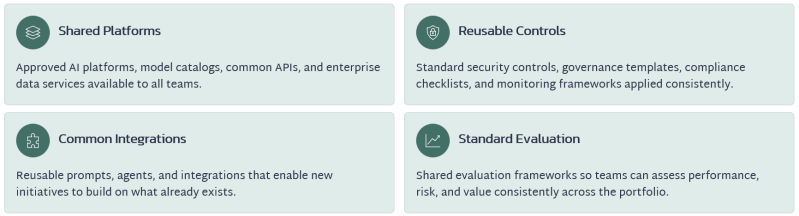
Scaling does not mean simply purchasing more licenses or deploying the same tool everywhere. The AI PMO should look for reusable capabilities.
These might include:
- Shared AI platforms
- Approved model catalogs
- Reusable prompts
- Reusable agents
- Common APIs
- Enterprise data services
- Standard security controls
- Shared monitoring
- Common governance templates
- Reusable integrations
- Standard evaluation frameworks
The more reusable infrastructure the organization develops, the faster future AI initiatives can move. Instead of every team building governance, integrations, security controls, and monitoring from scratch, they can build on enterprise capabilities that already exist.
This is where the AI PMO begins creating value beyond individual projects. It becomes an enterprise accelerator.
What Should the AI PMO Operating Model Look Like?
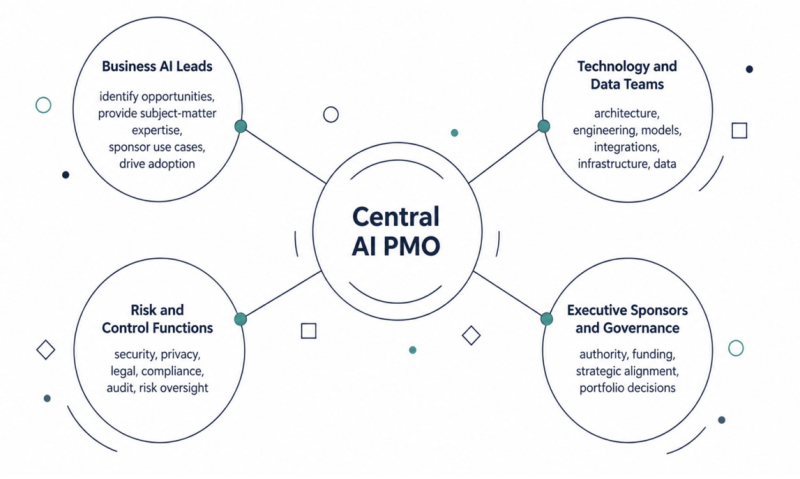
There is no single structure that works for every organization. However, many organizations can begin with a hub-and-spoke model.
Central AI PMO / Center of Excellence
The central team owns:
- Governance
- Portfolio management
- Standards
- Enterprise reporting
- AI architecture coordination
- Risk management
- Benefits realization
- Reusable capabilities
- Training frameworks
Business AI Leads
Business functions identify opportunities, provide subject-matter expertise, sponsor use cases, and drive adoption.
Technology and Data Teams
These teams provide architecture, engineering, models, integrations, infrastructure, and data capabilities.
Risk and Control Functions
Security, privacy, legal, compliance, audit, and risk teams provide appropriate oversight.
This model creates central consistency without preventing innovation within individual business units.
Building Your First AI PMO Team
You do not need dozens of people to launch an AI PMO. Many organizations can begin with a small virtual or cross-functional team. Core roles may include:
- Executive Sponsor - Provides authority, funding, organizational alignment, and executive support.
- AI PMO Director or Program Lead - Owns the portfolio, operating model, governance processes, delivery standards, and executive reporting.
- AI Governance Lead - Coordinates responsible AI, risk classification, policy, and oversight.
- Data & Analytics Lead - Assesses data readiness, quality, analytics, and model requirements.
- Enterprise Architect - Ensures AI solutions fit enterprise architecture and integration standards.
- Security & Compliance Representative - Evaluates cybersecurity, privacy, regulatory, and compliance concerns.
- Change Management Lead - Supports communication, training, adoption, and workforce transformation.
- Business Relationship Manager / Product Lead - Connects business problems with potential AI solutions.
As AI maturity increases, organizations may add machine-learning engineers, AI architects, agent developers, model-risk specialists, automation engineers, prompt engineers, AI product managers, and additional portfolio leadership.
A Practical 90-Day AI PMO Roadmap
Organizations do not need to build the entire operating model before getting started. A focused 90-day approach can establish the foundation.
Days 1–30: Discover and Assess
Start by understanding the current environment.
- Inventory existing AI tools and initiatives.
- Identify executive sponsors.
- Meet with business leaders.
- Document major business pain points.
- Assess existing AI policies.
- Identify major data and security concerns.
- Establish an initial AI governance working group.
- Begin collecting potential AI use cases.
Primary deliverable: Current-state AI assessment and initial opportunity inventory.
Days 31–60: Design the Operating Model
Create the basic structure for managing AI.
- Define AI PMO roles and responsibilities.
- Create the AI intake process.
- Develop use-case evaluation criteria.
- Establish initial AI risk categories.
- Define the approval process.
- Create standard business-case templates.
- Establish pilot success criteria.
- Define initial value metrics.
- Select several high-value pilot opportunities.
Primary deliverable: AI PMO operating model and prioritized pilot portfolio.
Days 61–90: Launch and Learn
Move from design to execution.
- Launch selected pilots.
- Establish portfolio reporting.
- Monitor risks and dependencies.
- Collect adoption data.
- Measure pilot outcomes.
- Capture lessons learned.
- Refine governance processes.
- Develop the next wave of use cases.
Primary deliverable: Initial AI portfolio dashboard, pilot results, and scaling roadmap.
After 90 days, the organization should have more than a collection of AI experiments. It should have the beginnings of a repeatable enterprise capability.
How AI PMOs Mature Over Time
An AI PMO should evolve as organizational capability grows.
Stage 1: Experimentation
- Teams independently explore AI tools and pilots.
- Governance is limited and measurement is inconsistent.
Stage 2: Coordination
- The organization begins cataloging initiatives, defining approved tools, and introducing governance.
Stage 3: Standardization
- Common intake, prioritization, risk management, delivery, and measurement processes emerge.
Stage 4: Enterprise Scaling
- Reusable platforms, shared services, AI agents, enterprise data capabilities, and cross-functional governance accelerate adoption.
Stage 5: Intelligent Portfolio Management
- AI itself begins supporting portfolio decisions.
At this stage, AI may continuously analyze project performance, resource capacity, risk signals, financial performance, strategic priorities, and external conditions. The AI PMO moves from managing AI projects to helping orchestrate an AI-enabled enterprise.
Common Pitfalls to Avoid
Even organizations with strong technical capabilities can struggle with AI transformation.
Several mistakes appear repeatedly.
- Starting With Technology - Buying AI tools without identifying business problems creates expensive solutions looking for problems.
- Scaling Before Establishing Governance - Rapid adoption without clear policies can create security, privacy, regulatory, and reputational risk.
- Ignoring Data Readiness - AI performance depends heavily on the quality, accessibility, relevance, and governance of underlying data.
- Treating Every AI Idea as a Project - Some ideas should remain experiments. Others should be stopped quickly. Portfolio discipline matters.
- Underestimating Change Management - Employees will not automatically adopt AI simply because the technology is available.
- Measuring Activity Instead of Outcomes - More AI does not necessarily mean more value.
- Treating AI as an IT Initiative - AI transformation affects business processes, workforce capabilities, operating models, customer experiences, risk management, and strategy.
It must therefore be treated as an enterprise transformation.
The Future AI PMO
The most interesting evolution of the AI PMO may occur when AI itself becomes part of the PMO workforce.
Imagine a portfolio environment where AI agents continuously analyze delivery data and support program leaders.
AI could:
- Monitor project health 24/7.
- Identify emerging schedule risks.
- Analyze dependencies across programs.
- Predict resource shortages.
- Draft status reports.
- Prepare steering committee materials.
- Analyze financial variances.
- Monitor benefits realization.
- Identify duplicate initiatives.
- Summarize risks across the portfolio.
- Prepare governance documentation.
- Recommend portfolio reprioritization when business conditions change.
The program manager's role does not disappear. It changes.
Instead of spending significant time collecting updates, formatting reports, chasing status information, and consolidating spreadsheets, program leaders can spend more time evaluating tradeoffs, managing stakeholders, solving problems, coaching teams, governing AI, and connecting execution with strategy.
Program managers become strategic orchestrators of work performed by both humans and intelligent systems. That may ultimately be one of the most significant changes AI brings to the project management profession.
Final Thoughts
Artificial intelligence isn't replacing the PMO. It is creating an opportunity to redefine what the PMO can become.
For years, many PMOs have worked to move beyond the perception that they are primarily administrative organizations responsible for templates, status reports, schedules, and governance checkpoints.
AI creates an opportunity for the PMO to become something much more strategic.
The AI PMO can connect strategy, governance, portfolio management, technology, data, risk, workforce transformation, and measurable business outcomes into a unified operating model.
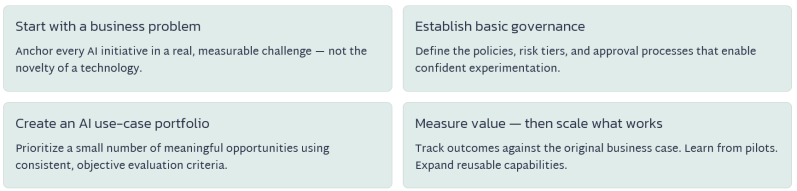
Organizations do not need to build a massive AI organization on day one. Start with a business problem. Establish basic governance. Create an AI use-case portfolio. Prioritize a small number of meaningful opportunities. Measure their value. Learn from them. Then scale what works.
The organizations that develop this capability today will be better positioned to move beyond isolated AI experiments and build sustainable enterprise AI capabilities.
The future of project management isn't simply digital. It is intelligent, measurable, governed, and strategically aligned. And the AI PMO can help lead the way.

About the Author
Kimberly Wiethoff, MBA, PMP, PMI-ACP is a Senior Program Manager specializing in enterprise digital transformation, AI-enabled delivery, PMO governance, and Agile program execution. Through Managing Projects the Agile Way, she helps organizations modernize project delivery by combining proven PMO practices with emerging AI technologies.
Managing Projects The Agile Way
#AIPMO #ArtificialIntelligence #PMO #ProgramManagement #ProjectManagement #DigitalTransformation #AIGovernance #EnterpriseAI #AILeadership #BusinessTransformation #Innovation #FutureOfWork #ManagingProjectsTheAgileWay
Download Document, PDF, or Presentation
Author: Kimberly Wiethoff, MBA, PMP, PMI-ACP