Artificial Intelligence is changing the way organizations plan, execute, and govern complex programs. From automated status reporting and intelligent risk detection to predictive analytics and AI agents capable of completing multi-step workflows, capabilities that once required hours of manual effort can increasingly be completed in minutes.
That has created an understandable question across the project management profession: If AI can perform more of the work traditionally associated with project and program management, will organizations eventually need fewer program managers? I don't believe AI will replace great program managers. But I do believe something else is happening—and it may ultimately have a much greater impact on our profession: Program managers who learn to leverage AI will outperform those who don't.
The competitive divide won't simply be between humans and machines. It will increasingly be between professionals who know how to work effectively with AI and those who continue operating as though nothing has changed. AI isn't replacing leadership. It's redefining what great leadership looks like. The role of a program manager has never really been about maintaining schedules, updating RAID logs, or producing PowerPoint status reports. Those are activities that support the job.
The real job is making informed decisions, managing uncertainty, connecting strategy to execution, aligning stakeholders, anticipating risk, navigating organizational complexity, and delivering business outcomes. AI doesn't eliminate those responsibilities. It gives us an opportunity to perform them better.
The Traditional Program Management Model Is Changing
For decades, program managers have spent a significant percentage of their time collecting and organizing information. We gather updates from project managers and workstream leads. We reconcile schedules. We update risks and dependencies. We prepare steering committee presentations. We analyze budgets. We chase action items. We consolidate information from multiple systems so executives can understand what is happening. All of that work has value. But much of it is also highly administrative. AI is beginning to change that equation.
Imagine an AI-enabled program environment in which information from Jira, Azure DevOps, ServiceNow, financial systems, resource plans, meeting transcripts, risk registers, and project schedules can be analyzed continuously. Instead of spending hours gathering information, the program manager begins the day with a prioritized view of what requires attention.
That could include:
- Milestones showing early signs of schedule slippage.
- Dependencies likely to affect critical-path activities.
- Risks whose probability or impact appears to be increasing.
- Resource constraints developing across multiple initiatives.
- Budget variances requiring investigation.
- Decisions that have remained unresolved too long.
- Stakeholders whose priorities may be moving out of alignment.
- Actions from previous meetings that remain incomplete.
The program manager's role doesn't disappear. The starting point for the work changes. Instead of spending the majority of our time discovering what happened, we can spend more time determining what should happen next.


AI Handles Data. Leaders Provide Direction.
Enterprise programs generate enormous amounts of information. Project schedules. Risk registers. Resource plans. Budgets. Dependencies. Status reports. Meeting notes. Decisions. Change requests. Issues. Backlogs. Financial forecasts. Traditionally, program managers have served as human integration engines, pulling information from multiple sources and transforming it into something leadership can understand.
AI is exceptionally well suited to helping with this work. It can summarize large amounts of information, identify patterns, compare current performance with historical trends, flag anomalies, categorize risks, analyze sentiment, identify missing information, and generate initial drafts of reports. Generative AI can turn raw project updates into an executive summary. Predictive analytics can help identify projects at risk of missing milestones. AI assistants can extract decisions and action items from meetings. AI agents can increasingly execute workflows across multiple systems, escalating exceptions when human judgment is required.
These capabilities don't make program managers obsolete. They allow us to redirect our attention toward work that creates greater value. The question becomes: What could you accomplish if you recovered five or ten hours every week currently spent compiling, formatting, reconciling, and chasing information?
That time could be invested in stakeholder conversations, scenario planning, risk mitigation, team development, strategic alignment, and solving the problems that actually threaten business outcomes. That is where program managers create value that technology alone cannot provide.
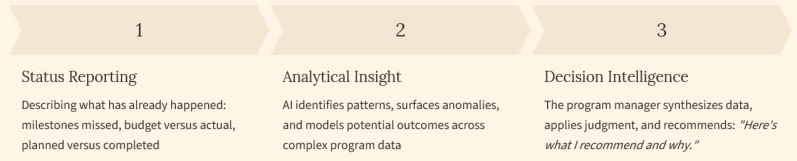
The Role Is Evolving from Reporting to Decision Intelligence
For years, one of the most common questions asked of a program manager was: "What's the status?" Program managers became experts at answering it. Green. Yellow. Red. On track. At risk. Delayed. Budget versus actual. Planned versus completed. But executives increasingly need something more valuable than a description of what has already happened. They need decision intelligence. They need answers to questions such as:
- What risks should I be paying attention to?
- Where are we most likely to miss our targets?
- Which dependencies could create downstream problems?
- Which initiatives deserve additional investment?
- Where should resources be reallocated?
- What happens if priorities change?
- What are our options?
- What decision do you recommend?
These aren't reporting questions. They're leadership questions.
AI can help identify patterns, analyze scenarios, and surface potential outcomes. But data alone doesn't make a decision. Someone still needs to understand the business context. Someone needs to know which assumptions are realistic. Someone needs to understand the political and organizational implications. Someone needs to challenge the AI when its recommendation doesn't make sense. And someone ultimately needs to say:
"Based on the information we have, here's what I recommend and why."
That is the program manager of the future.
AI Makes Great Program Managers Even Better
One of the biggest misconceptions surrounding AI is that access to information is equivalent to experience. It isn't. AI can process thousands—or millions—of data points faster than any human being. But program leadership requires much more than processing information.
AI doesn't walk into an executive steering committee where two senior leaders have competing priorities and determine how to create alignment without damaging either relationship. It doesn't recognize every unwritten rule inside an organization. It doesn't automatically understand why a technically correct solution may be organizationally impossible. It doesn't build trust with a team that has just experienced a major failure. It doesn't inspire people during a difficult transformation. And it doesn't possess years of lived experience managing difficult stakeholders, troubled projects, changing priorities, organizational politics, budget pressures, vendor problems, and unexpected crises.
Experienced program managers develop something extremely valuable over time: Judgment.
We learn when a "green" status isn't really green. We learn when a small issue is signaling a much larger problem. We learn when stakeholders are technically agreeing but aren't truly aligned. We learn when the schedule looks achievable on paper but the organization isn't ready to execute it. AI can provide another source of intelligence. Experience determines what we do with it.
Predictive Leadership Is the Next Competitive Advantage
Traditional program management has historically been retrospective.
- What happened last week?
- Which milestone was missed?
- Which risk became an issue?
- Why did the budget exceed the forecast?
- Why didn't someone escalate sooner?
AI creates an opportunity to move from retrospective management toward predictive leadership.
Imagine knowing which projects are beginning to slip before deadlines are missed. Imagine identifying resource constraints several weeks before they affect delivery. Imagine seeing that a particular combination of unresolved dependencies, declining velocity, and increasing defect volume historically precedes a major schedule problem. Imagine identifying which initiatives are most likely to exceed their budgets before the variance becomes significant.
This changes the conversation. Instead of: "We missed the milestone. Here's why." The conversation becomes: "Our current indicators suggest a high probability of missing the milestone six weeks from now. Here are the three factors driving that risk, and here are the actions I recommend taking today."
That is a fundamentally different form of program leadership. The program manager moves from reporter of outcomes to predictor and influencer of outcomes.
From Reactive Risk Management to Continuous Risk Intelligence
Risk management is another area where AI can dramatically strengthen program leadership. Traditional risk registers often depend on people manually identifying risks, estimating probability and impact, and remembering to update them. The result is frequently a static document reviewed periodically rather than a living representation of program uncertainty. AI can help create a more dynamic approach. It can analyze project data, meeting transcripts, issue trends, schedule movement, financial information, dependency changes, and historical program performance to identify signals that may deserve attention.
For example, AI might detect that:
- The same dependency has been mentioned in three consecutive meetings without resolution.
- A vendor's delivery dates have moved repeatedly.
- Defect volumes are increasing while testing capacity is decreasing.
- Several teams depend on the same scarce technical resource.
- A critical decision has remained unresolved beyond the expected timeframe.
- Similar programs historically experienced problems under comparable conditions.
None of these signals automatically mean the program will fail. But they give the program manager something incredibly valuable: Earlier visibility.
And in complex enterprise programs, earlier visibility often means more options.
AI Can Strengthen Governance—If We Govern AI
AI also creates an interesting paradox for PMOs and program leaders. We can use AI to strengthen governance, but AI itself must also be governed. AI can help monitor compliance, identify missing documentation, evaluate whether required stage-gate activities have occurred, summarize audit evidence, flag policy exceptions, and improve portfolio transparency.
At the same time, organizations must establish controls around how AI is used. Program leaders increasingly need to understand questions such as:
- Who is accountable for AI-generated recommendations?
- What data is the system allowed to access?
- How do we validate AI-generated information before using it in executive decisions?
- How are AI decisions documented and audited?
- When must a human remain in the decision loop?
- How do we detect bias, hallucinations, or inaccurate recommendations?
- What happens when an AI agent takes an action incorrectly?
AI governance is quickly becoming part of enterprise governance. That means future program managers won't simply need to know how to use AI. They'll also need to know how to use it responsibly.
AI Agents Will Change the Program Management Operating Model
Generative AI copilots are only the beginning. The next major shift is the emergence of agentic AI—systems capable of performing multi-step tasks with increasing levels of autonomy. Instead of simply asking an AI assistant to summarize a meeting, an AI agent could potentially:
- Analyze the meeting transcript.
- Identify decisions and action items.
- Update the appropriate project records.
- Notify action owners.
- Monitor due dates.
- Escalate overdue actions.
- Update program-level reporting.
Another agent might monitor risks. Another could analyze resource capacity. Another could prepare portfolio forecasts. Another could monitor governance requirements. The program manager could eventually be coordinating not only human teams, vendors, executives, and business stakeholders—but also a collection of specialized AI agents. This creates an entirely new leadership challenge. Program managers will need to determine:
What should be automated? What should be augmented? And what must remain human-led? The answer won't be the same for every organization, program, or decision. Knowing the difference will become a critical leadership capability.
The Skills That Matter Most Are Changing
As AI automates more administrative work, the capabilities that distinguish exceptional program managers become increasingly human. Technical fluency still matters. Program managers should understand AI well enough to recognize what it can do, where it can create value, and where its limitations create risk. But the differentiating capabilities will include the ability to:
- Build executive trust.
- Influence without authority.
- Navigate organizational complexity.
- Lead teams through uncertainty.
- Communicate complex ideas clearly.
- Connect technology investments to business strategy.
- Challenge assumptions.
- Facilitate difficult decisions.
- Manage organizational change.
- Evaluate AI-generated recommendations critically.
- Balance speed, innovation, governance, and risk.
- Make informed decisions with incomplete information.
In other words, AI doesn't make leadership less important. It makes leadership more visible. When administrative work becomes easier to automate, the value of the program manager is no longer measured by how efficiently they produce the report. It is measured by what they do with the information.
What Does an AI-Enabled Program Manager Look Like?
Being AI-enabled doesn't mean using ChatGPT occasionally to write an email or summarize meeting notes. It means intentionally integrating AI into the program management operating model. An AI-enabled program manager might use AI to accelerate meeting preparation, analyze large volumes of project data, identify risk patterns, generate scenario analyses, prepare executive communications, review program documentation, identify dependencies, support resource forecasting, or automate repetitive governance activities.
But they don't simply accept whatever the AI produces.
- They validate it.
- They challenge it.
- They provide context.
- They recognize when the model lacks information.
- They understand when human judgment must override an automated recommendation.
- Most importantly, they remain accountable for the outcome.
The goal isn't to become dependent on AI. The goal is to use AI as a force multiplier for human capability.
The Productivity Gap Will Become Difficult to Ignore
This is why I believe AI-enabled program managers will increasingly outperform those who don't adopt these capabilities. Consider two experienced program managers leading similarly complex portfolios. One spends several hours every week manually consolidating status reports, reviewing spreadsheets, preparing meeting summaries, tracking actions, and searching through project documentation. The other uses AI to accelerate much of that work and redirects those hours toward stakeholder engagement, strategic analysis, risk mitigation, team coaching, and scenario planning.
Over one week, the difference may not appear dramatic. Over a year, it becomes significant. The AI-enabled program manager has had hundreds of additional hours available for higher-value work. They have potentially identified risks earlier. They have prepared executives faster. They have evaluated more scenarios. They have spent more time developing relationships. They have had more capacity to think strategically. That doesn't mean the second program manager is working harder.
They are operating with greater leverage. And leverage compounds.
Organizations Must Evolve Too
The responsibility doesn't fall entirely on individual program managers. Organizations also need to create environments where responsible AI adoption can occur. Some organizations remain so concerned about AI-related risk that employees are prohibited from using even basic generative AI tools. Those concerns around privacy, security, intellectual property, compliance, and data protection are legitimate. But avoiding AI entirely isn't a long-term strategy.
Organizations need governance models that allow employees to experiment safely, learn responsibly, and identify valuable use cases without exposing sensitive information. That may require approved enterprise AI platforms, clear acceptable-use policies, human-in-the-loop requirements, data classifications, auditability standards, AI training, and defined accountability. The organizations that create these guardrails will be able to innovate faster than organizations that simply say, "Don't use AI." Responsible adoption requires both innovation and governance.
Five Questions Every Program Manager Should Be Asking
Program managers don't need to transform their entire operating model overnight. A better starting point is identifying where AI could remove friction from the work they already perform. Ask yourself:
- What repetitive work consumes the most time each week?
Those activities may be strong candidates for automation. - Where do I spend too much time gathering information instead of analyzing it?
AI may help accelerate synthesis and pattern recognition. - Which risks do we usually discover too late?
Those may be opportunities for predictive monitoring. - What information do executives repeatedly ask for?
AI-enabled dashboards, summaries, or decision-support capabilities may improve visibility. - Which decisions require human judgment regardless of how capable AI becomes?
Those are the areas where leadership must remain firmly in control.
The objective isn't to insert AI into every process. It's to identify where AI creates enough value to justify using it.
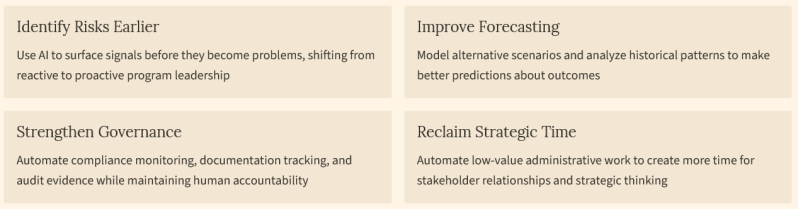
The Best Program Managers Will Learn to Partner with AI
The question isn't whether AI will become part of program management. It already has. The better question is: How will we choose to use it?
Will we use AI simply to write faster status reports? Or will we use it to fundamentally improve how programs are managed? Will we use it to identify risks earlier? Improve forecasting? Strengthen governance? Model alternative scenarios? Automate low-value administrative work? Give executives better decision intelligence? Create more time for conversations with teams and stakeholders?
The greatest opportunity isn't using AI to perform the same work slightly faster. It's using AI to change where program managers spend their time and attention.
The Future PMO Will Measure Outcomes, Not Activity
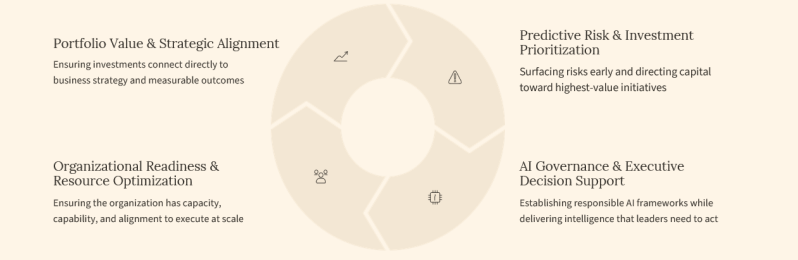
This evolution also has implications for PMOs. If AI can automate reporting, status consolidation, documentation, and portions of governance, PMOs need to reconsider how they define their value. The future PMO cannot simply be the organization that collects templates and asks teams for weekly status updates. It must become an intelligence and decision-support function. That means focusing more heavily on:
- Portfolio value.
- Strategic alignment.
- Predictive risk.
- Investment prioritization.
- Resource optimization.
- Business outcomes.
- Organizational readiness.
- AI governance.
- Executive decision support.
AI can automate processes. The PMO must provide purpose.
Final Thoughts
Technology has transformed program management many times throughout my career. We've moved from spreadsheets to integrated project platforms. From static reports to real-time dashboards. From manual tracking to automated workflows. From traditional project delivery to Agile, DevOps, cloud platforms, predictive analytics, and now AI-enabled delivery.
AI is simply the next evolution—but it may be one of the most significant.
The organizations that succeed won't necessarily be the ones with the most AI tools. They'll be the organizations with leaders who know where AI creates value, where human judgment remains essential, and how to combine the two responsibly. And the program managers who thrive won't be those who compete against AI. They'll be those who learn how to lead with it.
Because successful enterprise transformation has never been driven by technology alone. It's driven by people who know how to use technology to make better decisions, anticipate problems, align organizations, build stronger teams, and deliver meaningful business outcomes.
AI won't replace great program managers. But AI-enabled program managers are going to raise the standard for everyone else.

About the Author
Kimberly Wiethoff, MBA, PMP, PMI-ACP is an AI Transformation Program Leader specializing in enterprise digital transformation, AI-enabled delivery, PMO leadership, AI governance, Agile program execution, cloud transformation, and complex portfolio delivery.
Through Managing Projects the Agile Way, she shares practical strategies for modernizing project and program delivery, strengthening PMO leadership, and preparing organizations and leaders for the future of AI-enabled program management.
#ArtificialIntelligence #AILeadership #ProgramManagement #ProjectManagement #AITransformation #DigitalTransformation #PMO #AIGovernance #AgenticAI #PredictiveAnalytics #EnterpriseTransformation #TechnologyLeadership #ExecutiveLeadership #FutureOfWork #Leadership
Download Document, PDF, or Presentation
Author: Kimberly Wiethoff, MBA, PMP, PMI-ACP