When people hear the name ADP, they often think of one thing: payroll. While payroll remains one of ADP's core strengths, today's ADP platforms have evolved into comprehensive Human Capital Management (HCM) ecosystems that transform how organizations manage their workforce. A successful ADP digital transformation impacts nearly every business function, streamlining processes, improving compliance, enhancing employee experiences, and providing leaders with the data they need to make informed decisions.
A successful ADP digital transformation impacts nearly every business function, streamlining processes, improving compliance, enhancing employee experiences, and equipping leaders with the data they need to make confident, informed decisions. Rather than simply replacing legacy software, an ADP implementation is an opportunity to redesign how work gets done across the enterprise.
Let's explore the major business functions that benefit from an ADP transformation.
Human Resources: Building a Single Source of Truth
Human Resources sits at the center of any ADP transformation. Instead of maintaining employee information across disconnected spreadsheets, siloed systems, and paper files, organizations consolidate their entire workforce into one secure, authoritative platform — eliminating redundancy and reducing error.
Instead of maintaining employee information across multiple spreadsheets, disconnected systems, and paper files, organizations can centralize workforce data into one secure platform.
Key capabilities include:
- Employee records management
- Digital onboarding
- Organizational charts
- Employee self-service
- Manager self-service
- Document management
- Policy acknowledgments
- Position management
By consolidating employee data, HR teams spend less time on administrative tasks and more time supporting strategic workforce initiatives.


Payroll: Automating One of the Most Critical Business Processes
Payroll accuracy directly affects employee trust. Errors create frustration, erode confidence in leadership, and introduce legal risk. Modern ADP payroll solutions automate time-consuming manual activities while helping organizations stay ahead of constantly evolving tax and labor regulations.
Modern ADP payroll solutions automate many manual activities while helping organizations maintain compliance with constantly changing tax and labor regulations.
Automation reduces processing time while simultaneously improving accuracy, auditability, and transparency across the organization.
Payroll transformation includes:
- Automated payroll processing
- Multi-state tax management
- Wage garnishments
- Direct deposit
- Payroll auditing
- Payroll reporting
- Off-cycle payroll
- Payroll corrections
Automation reduces processing time while improving accuracy and transparency.

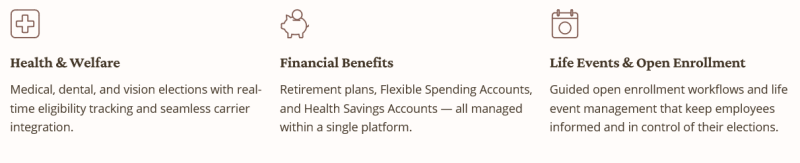
Benefits Administration
Benefits enrollment has traditionally been one of the most paper-intensive, manually complex processes in HR. ADP simplifies benefits management by integrating enrollment directly into the employee experience — reducing friction for employees and administrative burden for HR teams alike.
Capabilities include:
- Open enrollment
- Life event management
- Medical, dental, and vision elections
- Retirement plans
- Flexible Spending Accounts
- Health Savings Accounts
- Benefits eligibility tracking
- Carrier integration
Employees gain greater visibility into their benefits while HR reduces administrative workload.
Talent Acquisition
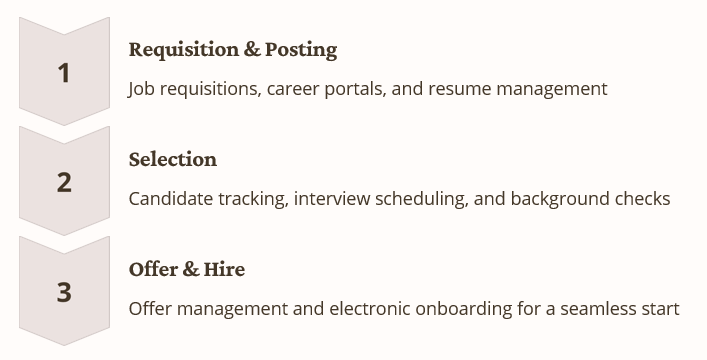
Recruiting has become increasingly competitive. Organizations that fail to provide a seamless candidate experience risk losing top talent before an offer is even extended. ADP integrates recruiting workflows end-to-end — from the moment a job requisition is created to the day a new hire completes onboarding.
Features often include:
- Job requisitions
- Career portals
- Resume management
- Candidate tracking
- Interview scheduling
- Offer management
- Background checks
- Electronic onboarding
A smoother hiring process creates a better candidate experience and accelerates time-to-fill.
Talent Management
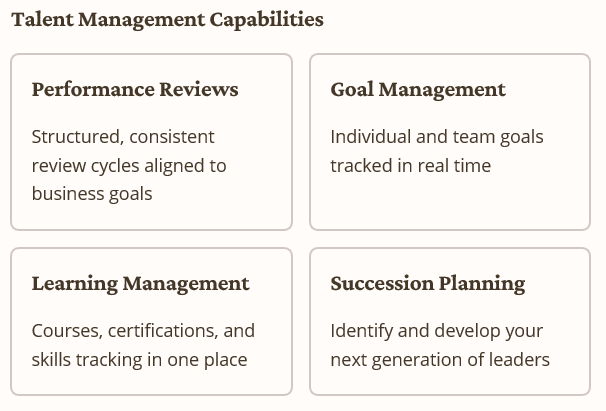
Hiring employees is only the beginning. Organizations must also develop, engage, and retain their talent to realize long-term business value. ADP's talent management capabilities create a continuous development loop — connecting performance, learning, and career growth in one unified experience.
These tools help organizations retain high performers, identify future leaders, and build a resilient workforce that is ready for tomorrow's challenges.
ADP supports talent management through:
- Performance reviews
- Goal management
- Career development
- Succession planning
- Learning management
- Skills tracking
- Employee development plans
These capabilities help organizations retain high-performing employees while preparing future leaders.
Workforce Management
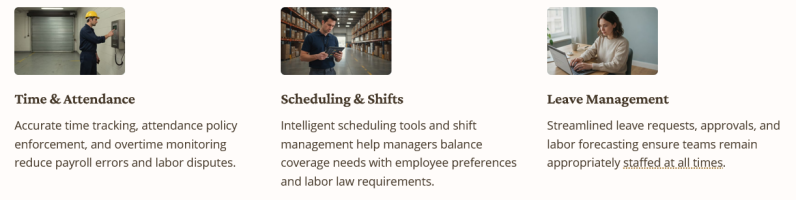
As organizations grow, managing employee schedules, attendance, and labor costs becomes exponentially more complex. ADP workforce management solutions give managers the visibility and control they need to optimize labor utilization without sacrificing compliance or employee satisfaction.
ADP workforce management solutions support:
- Time tracking
- Scheduling
- Overtime monitoring
- Leave management
- Attendance policies
- Labor forecasting
- Shift management
Managers gain better visibility into workforce utilization while reducing labor costs.
Finance
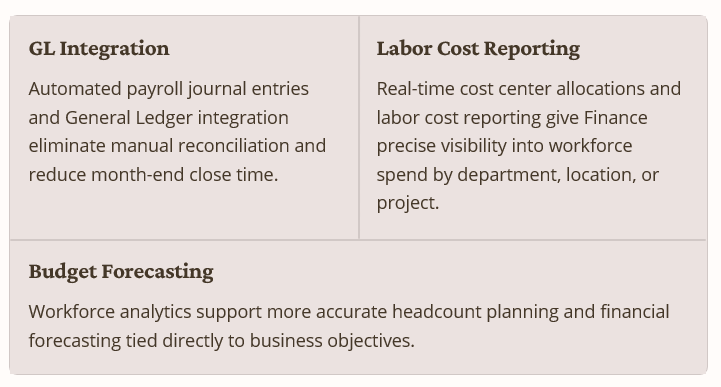
Although ADP is often viewed as an HR platform, Finance teams benefit significantly from accurate, real-time workforce data. Payroll is one of the largest line items in any organization's budget — and seamless integration between HR and Finance creates the accuracy and transparency that CFOs demand.
Finance teams rely on ADP for:
- Payroll journal entries
- Labor cost reporting
- General Ledger integration
- Budget forecasting
- Cost center allocations
- Financial reconciliation
- Workforce analytics
Improved integration between HR and Finance creates greater financial accuracy.
Information Technology
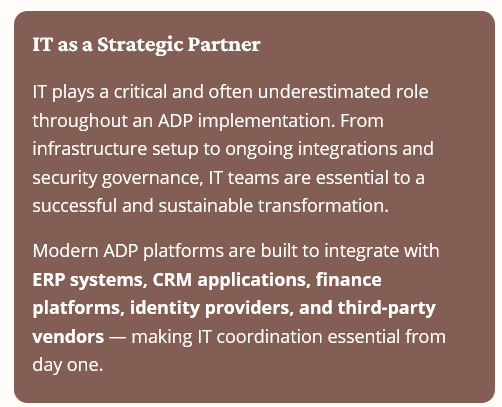
IT plays a critical and often underestimated role throughout an ADP implementation. From infrastructure setup to ongoing integrations and security governance, IT teams are essential to a successful and sustainable transformation.
Modern ADP platforms are built to integrate with ERP systems, CRM applications, finance platforms, identity providers, and third-party vendors — making IT coordination essential from day one.
Responsibilities often include:
- System integrations
- Single Sign-On (SSO)
- Identity management
- Security configuration
- Data migration
- API management
- Environment management
- Disaster recovery
Modern ADP platforms integrate with ERP systems, CRM applications, finance platforms, identity providers, and third-party vendors.
Compliance and Risk Management
Compliance requirements continue to grow in complexity across every industry. ADP's built-in compliance capabilities help organizations navigate a landscape of constantly shifting federal, state, and local obligations — reducing risk without adding administrative headcount.
ADP helps organizations manage:
- Tax compliance
- Labor law reporting
- ACA reporting
- OSHA reporting
- Audit trails
- Security permissions
- Electronic signatures
- Record retention
Automated compliance reduces organizational risk while simplifying audits.

Employee Experience
Today's workforce expects digital experiences that rival the consumer applications they use every day. When employees face friction navigating benefits, pay, or time-off requests, engagement suffers. ADP delivers an intuitive, mobile-first experience that empowers employees to manage their own information — on any device, at any time.
ADP improves employee engagement through:
- Mobile access
- Self-service
- Personalized dashboards
- Benefits information
- Pay statements
- PTO requests
- Company announcements
- Learning resources
Employees spend less time navigating administrative tasks and more time focusing on meaningful work.

Managers and Leadership
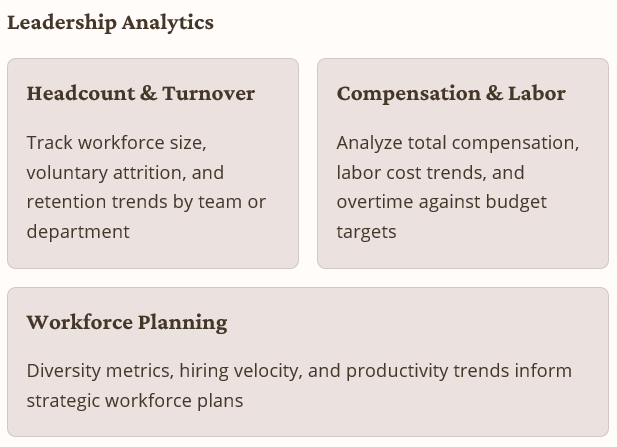
Executives and managers cannot lead effectively without accurate, timely workforce information. ADP equips leaders at every level with the dashboards and analytics they need to move from reactive management to proactive, strategic decision-making.
ADP provides dashboards and analytics that support:
- Headcount reporting
- Turnover analysis
- Workforce planning
- Diversity metrics
- Compensation analysis
- Labor costs
- Productivity trends
- Hiring metrics
Real-time workforce insights enable faster, more confident decisions — reducing reliance on manual reports and outdated spreadsheets.
Data Analytics and Business Intelligence
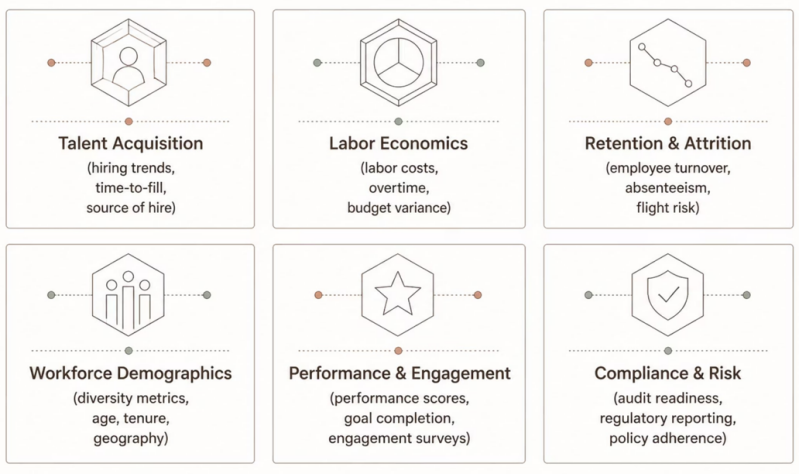
One of the most transformative advantages of an ADP implementation is the visibility it creates into workforce data. Rather than reacting to workforce challenges after the fact, leaders can proactively identify trends, surface risks early, and seize opportunities for improvement — all powered by a single, trusted data source.
Organizations can analyze:
- Hiring trends
- Employee turnover
- Absenteeism
- Labor costs
- Overtime
- Workforce demographics
- Performance metrics
- Employee engagement
Instead of reacting to workforce issues, leaders can proactively identify trends and opportunities.
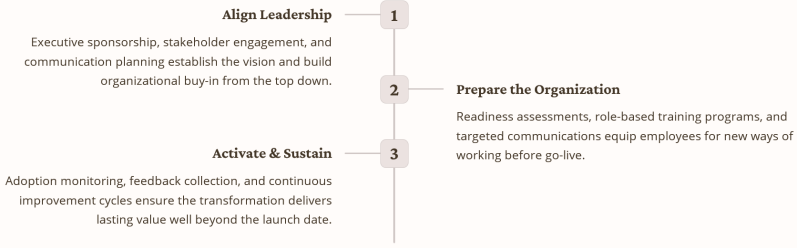
Organizational Change Management
Technology alone does not deliver transformation. The most sophisticated platform in the world will underperform if people are not prepared, supported, and genuinely engaged in the change. Successful ADP implementations pair technical delivery with structured change management — building the human foundation that sustains long-term adoption.
Successful ADP implementations include structured change management focused on helping employees adopt new ways of working.
Key activities include:
- Executive sponsorship
- Communication planning
- Stakeholder engagement
- Training programs
- Readiness assessments
- Adoption monitoring
- Feedback collection
- Continuous improvement
Organizations that invest in change management often experience faster adoption and stronger long-term outcomes.
Why Program Management Is Essential
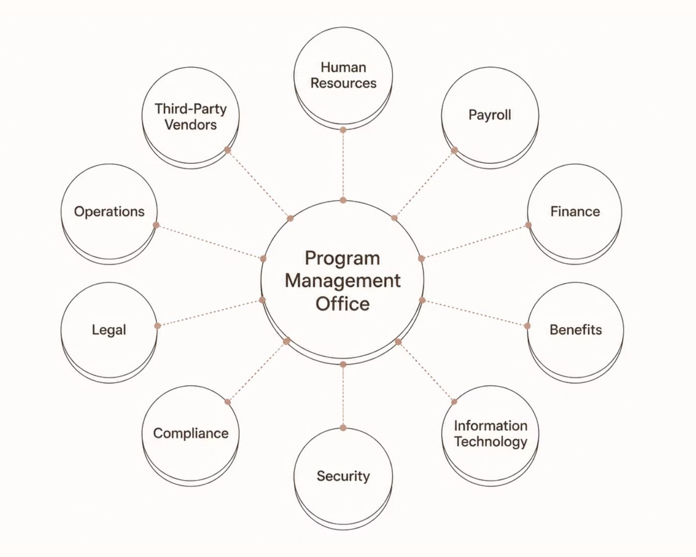
Because an ADP transformation touches nearly every corner of the organization, these implementations demand coordinated, disciplined leadership. Program managers serve as the connective tissue — aligning cross-functional workstreams, managing dependencies, mitigating risks, and ensuring the transformation delivers measurable business value rather than just a software go-live.
An effective ADP program requires close collaboration among:
- Human Resources
- Payroll
- Finance
- Benefits
- Information Technology
- Security
- Compliance
- Legal
- Operations
- Executive Leadership
- Third-party vendors
Strong governance and communication help ensure that each workstream moves forward together rather than in isolation.
Final Thoughts
An ADP digital transformation is far more than a payroll modernization project. It is an enterprise-wide initiative that reshapes how organizations recruit, hire, pay, develop, support, and retain their workforce. By connecting HR, Payroll, Finance, IT, Compliance, and Leadership within a unified platform, organizations gain greater operational efficiency, improved compliance, better decision-making, and a more engaging employee experience.
The organizations that realize the greatest value are those that approach ADP as a strategic business transformation rather than a software implementation. When supported by strong program governance, thoughtful change management, and a clear focus on business outcomes, an ADP transformation can become a catalyst for long-term organizational growth and operational excellence.
Follow Managing Projects the Agile Way
Interested in more insights on enterprise program management, PMO leadership, Agile delivery, digital transformation, AI, and business modernization? Follow Managing Projects the Agile Way for practical guidance, lessons learned, and proven strategies to help you lead successful transformation initiatives.
#ADP #DigitalTransformation #HumanCapitalManagement #HRTechnology #Payroll #ProgramManagement #BusinessTransformation #PMO #ChangeManagement #EnterpriseTechnology #HRIS #Leadership #WorkforceManagement #DigitalWorkplace #ManagingProjectsTheAgileWay

About the Author
Kimberly Wiethoff, MBA, PMP, PMI-ACP is an AI Transformation Program Leader specializing in enterprise digital transformation, AI-enabled delivery, PMO leadership, AI governance, Agile program execution, cloud transformation, and complex portfolio delivery.
Through Managing Projects the Agile Way, she shares practical strategies for modernizing project and program delivery, strengthening PMO leadership, and preparing organizations and leaders for the future of AI-enabled program management.
Download Document, PDF, or Presentation
Author: Kimberly Wiethoff, MBA, PMP, PMI-ACP