In today’s enterprise landscape, the ability to connect customer experiences with operational execution is no longer optional—it’s a competitive advantage. That’s exactly where Microsoft Dynamics 365 certifications come in. Whether you're a project manager, program leader, consultant, or technical professional, understanding the Dynamics 365 certification ecosystem can position you at the center of digital transformation initiatives—and significantly increase your market value. This guide breaks down how to navigate that journey strategically.
Why Dynamics 365 Certifications Matter
Certifications aren’t just about passing exams—they’re about signaling capability.
According to the guide, certified professionals stand out because they:
- Validate real-world implementation skills
- Demonstrate the ability to solve business problems
- Increase their earning potential and professional value
But more importantly—they show you can bridge business and technology, which is where the highest-value roles live.
Understanding the Two Worlds: CRM vs ERP
One of the most important concepts in Dynamics 365 is that it operates across two interconnected ecosystems:
1. Customer Engagement (CRM)
- Sales
- Marketing
- Customer Service
- Field Service

2. Finance & Operations (ERP)
- Finance
- Supply Chain
- Commerce
- HR & Manufacturing
As illustrated in the diagram on page 3, these two worlds together create a true end-to-end business platform.
👉 The professionals who understand both are the ones leading enterprise transformation—not just supporting it.
Your Certification Journey: A Strategic Approach
The biggest mistake people make? Treating certifications like a checklist.
Instead, think of it as a career roadmap:
Step 1: Start with Fundamentals
- MB-910 (CRM)
- MB-920 (Finance & Operations)
These build the foundational language and concepts.
Step 2: Specialize
Choose based on your career goals:
- CRM (Sales, Marketing, Service)
- ERP (Finance, Supply Chain, Commerce)
Step 3: Expand Cross-Functionally
This is where your value multiplies.
As highlighted in the guide, professionals who combine certifications across both domains are able to:
- Design integrated solutions
- Troubleshoot across platforms
- Provide strategic insights
- Support end-to-end processes
👉 Translation: This is where $200K+ roles start to open up.
The Real Power: Connecting CRM and ERP
The real-world value of Dynamics 365 comes from how systems connect.
The workflow shown on page 9 illustrates this beautifully:
- Sales captures opportunities (CRM)
- Demand flows into supply chain planning (ERP)
- Orders are fulfilled (ERP)
- Customer service maintains relationships (CRM)
This isn’t theory—this is how modern enterprises operate.
👉 If you can lead programs that connect these flows, you’re not just managing projects—you’re driving business outcomes.
Important Certification Trends You Should Know
The certification landscape is evolving.
For example:
- Microsoft is shifting toward customer insights and analytics
- New certifications are replacing older, siloed ones
- There is increased focus on data-driven decision-making
👉 The takeaway:
Certifications are no longer about tools—they’re about business intelligence and integration.
Building Your Certification Roadmap
The most successful professionals don’t just study—they plan.
Here’s a simple framework:
Assess Your Starting Point
Do you need fundamentals, or can you jump into specialization?
Define Your Career Direction
- CRM-focused (customer experience)
- ERP-focused (operations)
- Or hybrid (high-value strategic roles)
Create a Study Plan
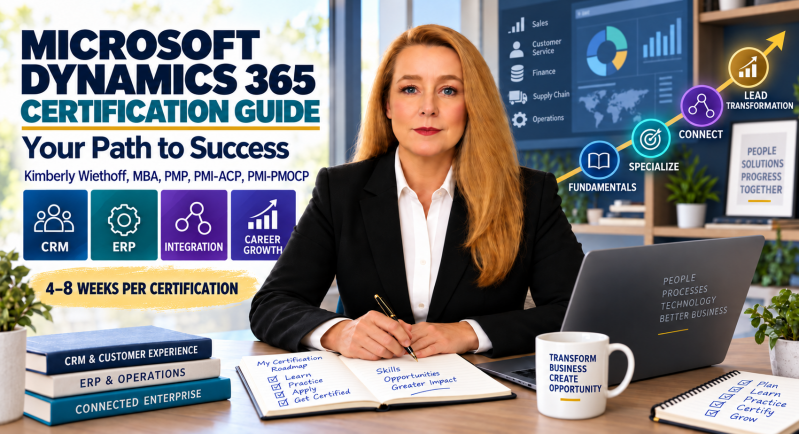
The guide recommends 4–8 weeks per certification, including hands-on practice.
Expand Continuously
The highest earners don’t stop at one certification—they build a portfolio.
Pro Tip: Hands-On Experience Is the Differentiator
One of the best insights from the guide:
“Nothing prepares you better than actually configuring and using the applications.”
Set up a Dynamics 365 trial environment and:
- Build workflows
- Configure modules
- Simulate real business scenarios
👉 This is what separates someone who knows from someone who can lead.
Your Next Steps
If you’re serious about elevating your career:
This Week
- Create a Microsoft Learn account
- Start a fundamentals learning path
This Month
- Set up a trial environment
- Schedule your first exam
This Year
- Earn a role-based certification
- Apply it in real-world scenarios
- Expand into cross-functional expertise
Final Thought
Dynamics 365 certifications are not just about technology.
They’re about positioning yourself at the intersection of:
- Customer experience
- Operational excellence
- Data-driven decision-making
And that’s exactly where the future of enterprise leadership is headed.
The question isn’t whether you should start— it’s which path you’ll take first.

About the Author
Kimberly Wiethoff, MBA, PMP, PMI-ACP is a Senior Program Manager specializing in enterprise digital transformation, AI-enabled delivery, PMO leadership, and Agile program execution. Through Managing Projects the Agile Way, she helps project leaders prepare for the future of work by combining proven program management practices with emerging AI technologies.
Managing Projects The Agile Way
#MicrosoftDynamics365 #DigitalTransformation #ERP #CRM #EnterpriseTechnology #ProjectManagement #ProgramManagement #AgileLeadership #TechLeadership #BusinessTransformation #CloudComputing #DataDriven #AIinBusiness #CareerGrowth #ITLeadership #ConsultingLife #FutureOfWork #ContinuousLearning #ProfessionalDevelopment #ManagingProjectsTheAgileWay
Download the Document, PDF, or Presentation
Author: Kimberly Wiethoff