In today’s dynamic business environment, Project Management Offices (PMOs) are no longer just support hubs—they are strategic powerhouses driving enterprise transformation, innovation, and value realization. The PMI-PMOCP™ (Project Management Office Certified Professional) certification from the Project Management Institute (PMI) is designed for professionals ready to lead PMOs with confidence, strategic foresight, and measurable impact.
Whether you're building a PMO from scratch, evolving an existing one, or aligning programs with strategic goals, the PMI-PMOCP™ validates your ability to create, optimize, and lead high-performing PMOs in any industry.
📌 What Is the PMI-PMOCP™ Certification?
The PMI-PMOCP™ credential is tailored for PMO professionals who want to:
- Formalize their expertise in PMO strategy, design, and execution
- Learn how to measure and maximize PMO performance
- Drive organizational alignment and stakeholder engagement
- Lead with agility and influence across cross-functional teams
It recognizes PMO leaders who go beyond administration—those who shape and scale project governance into business impact.
🧭 Who Should Apply?
The PMI-PMOCP™ is ideal for:
- PMO Directors and Managers
- Portfolio and Program Managers
- Project Management Professionals (PMP® holders)
- Senior Project Analysts and Strategists
- Anyone aspiring to elevate a PMO into a strategic asset
If you’re involved in establishing, operating, or enhancing a PMO, this certification is for you.

📚 What Does the Exam Cover?
The exam consists of 120 multiple-choice questions delivered over 165 minutes, covering six core domains:

This comprehensive structure ensures that you’re equipped to build a PMO that is both value-driven and future-ready.
✅ Eligibility Requirements
To apply, you’ll need:
-
A secondary degree (or global equivalent)
-
3+ years of project-related experience or an active PMP® certification
-
Completion of 10 hours of PMO-specific education, which can be earned via PMI’s official on-demand PMI-PMOCP™ Exam Prep Course
💵 Certification Fees
PMI Members $520 USD
Non-Members $670 USD
Training Course
10 Hour PMI-PMOCP Training Course: https://www.pmi.org/learning/thought-leadership/value-delivery
PMI Members $160
Udemy Practice Exams
5 Exams (600 Questions) - https://www.udemy.com/course-dashboard-redirect/?course_id=6537869
3 Exams (360 Questions) - https://www.udemy.com/course/pmi-pmocp-certification-practice-exams-2025/
5 Exams (611 Questions) with Study Notes - https://www.udemy.com/course/pmipmocpexams/
2 Exams (202 Questions) - https://www.udemy.com/course/pmi-pmocp-premium-simulator-with-advanced-questions/
6 Exams (420 Questions) - https://www.udemy.com/course/2025-pmi-pmocp-exam-prep-150-practice-questions/
Managing Projects the Agile Way Blogs
- Choosing the Right PMO Approach: From Supportive to Strategic / PMO Leadership & Strategy | Managing Projects the Agile Way
- Mastering OPM3®: The Organizational Project Management Maturity Model / PMO Leadership & Strategy | Managing Projects the Agile Way
- The Definition, Purpose, and Lifecycle of a PMO / PMO Leadership & Strategy | Managing Projects the Agile Way
- Unlocking PMO Value: The Eight-Step PMO Value Ring Methodology / PMO Leadership & Strategy | Managing Projects the Agile Way
- Understanding the 30 Core Competencies of the PMO Value Ring / PMO Leadership & Strategy | Managing Projects the Agile Way
- The PMO as a Physician: Diagnosing, Treating, and Preventing Organizational Pain / PMO Leadership & Strategy | Managing Projects the Agile Way
- The Value-Generating PMO Flywheel: How Momentum Builds Sustainable Value / PMO Leadership & Strategy | Managing Projects the Agile Way
🛠 Preparation Resources
PMI provides a solid foundation to help you prepare, including:
-
PMI-PMOCP™ Exam Prep Course (meets 10-hour requirement)
-
Project Management Offices: A Practice Guide – essential for strategic and practical PMO topics
-
Exam Content Outline – your roadmap to what’s tested
Additional prep tips:
-
Join PMI chapters and PMO communities for group study
-
Leverage mock exams and performance dashboards
-
Attend PMO-focused webinars and case studies
🔁 How to Maintain Your Certification
To keep your certification active, you’ll need to earn 30 PDUs every 3 years. Focus areas include:
-
Ways of Working
-
Business Acumen
-
Power Skills (leadership, communication, influence)
Getting the PMI-PMOCP™ tells the world: “I don’t just manage projects. I lead the system that empowers them to succeed.”
8 compelling reasons why someone would want to earn the PMI-PMOCP™
🎯 1. Demonstrate Strategic PMO Leadership
This certification is designed to show you can do more than just run a PMO—you can lead it strategically. It proves you can align PMO functions with enterprise goals, deliver measurable value, and adapt to organizational needs.
📈 2. Enhance Career Mobility and Marketability
PMO roles are increasingly strategic, and employers are seeking professionals with validated expertise in governance, metrics, and transformation. PMI-PMOCP™ makes your résumé stand out for:
-
PMO Director / Manager roles
-
Enterprise PMO (EPMO) leadership
-
Portfolio governance positions
-
Strategic transformation offices
🧠 3. Gain Credibility with Executives
This certification teaches you how to speak the language of the C-suite. It shows that you:
-
Understand how to justify a PMO’s ROI
-
Can use metrics to influence decision-making
-
Know how to evolve the PMO in a dynamic business landscape
🛠 4. Learn to Build and Evolve PMOs
Whether you’re standing up a new PMO or optimizing an existing one, the PMI-PMOCP™ provides a structured framework to:
-
Design PMOs that are fit for purpose
-
Create governance structures that adapt
-
Tailor tools, processes, and people strategies
🔍 5. Master the Six Critical PMO Domains
The exam focuses on areas often overlooked in traditional project management:
-
Organizational alignment
-
Structuring PMOs for agility and scalability
-
People and stakeholder engagement
-
Performance monitoring and continuous improvement
🌍 6. Join a Growing Global Credential
The PMI-PMOCP™ is relatively new and growing fast. By earning it early, you're joining an elite group of forward-thinking PMO professionals and establishing yourself as a thought leader in modern PMO practices.
💡 7. Bridge the Gap Between Projects and Strategy
It’s not enough to deliver projects on time and on budget. This certification empowers you to:
-
Align initiatives with business strategy
-
Prioritize portfolios effectively
-
Demonstrate how the PMO drives enterprise value
🔄 8. Fulfill a Need Not Met by PMP or PgMP
PMP® and PgMP® focus on project and program execution. The PMI-PMOCP™ fills a niche by validating your ability to design, lead, and evolve the office that governs them.
🚀 Final Thoughts
The PMI-PMOCP™ certification fills a much-needed gap for professionals leading project governance and portfolio alignment. It elevates the role of the PMO from tactical support to strategic catalyst.
If you’re ready to take your PMO career to the next level, one that influences business outcomes, earns executive trust, and adapts to change—then the PMI-PMOCP™ is your next career-defining move.
#PMIPMOCP #PMOCertification #PMOLeadership #StrategicProjectManagement #PMI #ProjectManagementOffice #BusinessAgility #PortfolioManagement #PMOCareer #PowerSkills #AgilePMO #PMOTransformation #ManagingProjectsTheAgileWay
Study Aides
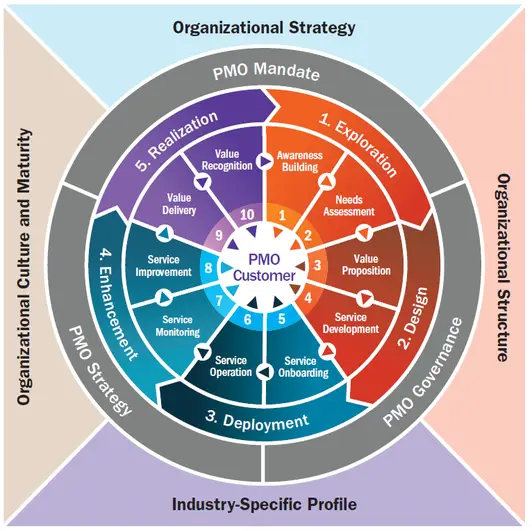
10-Step Value-Generating PMO Flywheel
This table captures one of the core frameworks from the PMO Practice Guide (PMI, 2025) and the PMO Value Ring™ methodology:
the 10-Step Value-Generating PMO Flywheel. The Flywheel represents a continuous improvement model for PMOs — a cyclical, data-driven approach to creating, delivering, and demonstrating value. Each step builds momentum for the next, ensuring the PMO remains strategically aligned, customer-focused, and improvement-oriented.
| Phase | Step | Name / Focus Area | Purpose / Description | Key Deliverables | Example Activities | Value Outcome |
|---|---|---|---|---|---|---|
| Exploration | 1. Awareness Building | Educate stakeholders about the PMO’s purpose, capabilities, and strategic relevance. | Build understanding and support for the PMO as a value enabler. | PMO Charter, Communication Plan, Stakeholder Map | Town halls, PMO introduction briefings, leadership roadshows | Increases visibility, builds sponsorship, and sets expectations. |
| Exploration | 2. Needs Assessment | Identify organizational pain points and improvement opportunities aligned with strategic goals. | Understand where the PMO can make the greatest impact. It is essential to "Use outcome-oriented language in all interactions. Instead of asking about desired PMO functions, focus on the results customers want to achieve". | Needs Assessment Report, Customer Segmentation Matrix | Interviews, surveys, workshops, gap analyses | Clarifies stakeholder priorities and defines service demand. |
| Design | 3. Value Proposition | Define the measurable benefits and outcomes the PMO will deliver to its customers. | Position the PMO as a solution to identified needs. | PMO Value Statement, Customer Value Agreement | Develop measurable KPIs, align PMO goals with enterprise OKRs | Creates a clear linkage between PMO outcomes and business value. |
| Design | 4. Service Development | Design PMO structure, processes, and service portfolio tailored to needs and maturity. | Translate value proposition into service offerings. | Service Catalog, RACI Matrix, Process Maps | Define roles, workflows, governance model, and performance metrics | Establishes a structured and customer-focused PMO design. |
| Deployment | 5. Service Onboarding | Prepare and launch PMO services to customers, ensuring readiness and alignment. | Transition from design to operational delivery. | Onboarding Plan, Communication Templates, SLAs | Conduct pilot rollouts, train end users, launch service portal | Ensures smooth adoption and stakeholder engagement. |
| Deployment | 6. Service Operation | Deliver PMO services consistently and manage daily operations effectively. | Maintain execution excellence and standardization. | PMO Operations Manual, Delivery Schedules, Status Reports | Manage project intake, run governance meetings, track performance | Provides consistent, high-quality service delivery and oversight. |
| Enhancement | 7. Service Monitoring | Measure service performance and gather feedback to evaluate effectiveness. | Ensure data-driven continuous improvement. | KPIs Dashboard, Service Scorecards, Maturity Assessments | Track SLAs, collect feedback, perform audits | Identifies strengths, inefficiencies, and opportunities for optimization. |
| Enhancement | 8. Service Improvement | Enhance PMO processes and services based on data insights and stakeholder input. | Drive iterative, customer-centric improvements. | Improvement Backlog, Lessons Learned Repository, Action Plans | Conduct retrospectives, apply Lean/Kaizen methods | Boosts service maturity, efficiency, and customer satisfaction. |
| Realization | 9. Value Delivery | Ensure PMO services and projects generate measurable business outcomes. | Convert PMO activities into tangible results. | Value Realization Reports, Benefit Tracking Models | Link service KPIs to business metrics and strategic outcomes | Demonstrates business impact and strategic contribution. |
| Realization | 10. Value Recognition | Communicate, celebrate, and institutionalize PMO achievements and lessons learned. | Close the loop by showing stakeholders the realized value. | Value Reports, Case Studies, Executive Dashboards | Quarterly value updates, success story presentations | Reinforces trust, secures future sponsorship, and fuels the next cycle. |
Flywheel Dynamics
-
The PMO Flywheel is iterative — completing Step 10 naturally feeds back into Step 1.
-
Each iteration enhances PMO maturity, visibility, and business alignment.
-
The Flywheel complements the PMO Customer Experience Cycle (Exploration → Design → Deployment → Enhancement) but focuses on organizational value flow.
Study / Application Tips
-
For PMI-PMOCP® exam: Be ready to identify which Flywheel step corresponds to an exam scenario.
-
Example: “The PMO is collecting post-service survey data” → Step 7 (Service Monitoring).
-
Example: “The PMO is redefining its authority after leadership change” → Step 4 (Mandate Definition).
-
-
For PMO maturity planning: Use the Flywheel as an assessment framework — determine which step your PMO consistently performs and which need reinforcement.
-
For executive communication: Present the Flywheel as a “PMO continuous value loop”, emphasizing its cyclic nature of Listen → Design → Deliver → Measure → Improve → Communicate.
Phase Overview Summary
| Macro-Phase | Intent / Strategic Focus | Representative Steps | Outcome Theme |
|---|---|---|---|
| Exploration | Discover needs and build awareness | Steps 1–2 | Visibility & Demand Definition |
| Design | Develop PMO framework and service model | Steps 3–4 | Value Proposition & Service Readiness |
| Deployment | Operationalize PMO services | Steps 5–6 | Execution & Service Adoption |
| Enhancement | Measure, refine, and optimize PMO performance | Steps 7–8 | Continuous Improvement & Maturity Growth |
| Realization | Deliver and communicate measurable value | Steps 9–10 | Impact Demonstration & Stakeholder Confidence |
Key Insights
-
The Flywheel emphasizes continuous momentum — each Realization phase fuels the next Exploration cycle.
-
Exploration and Design lay the groundwork for strategic alignment; Deployment converts strategy into action; Enhancement ensures adaptation; Realization delivers proof of value.
-
It integrates seamlessly with PMO Customer Experience Cycle (Explore → Design → Deploy → Enhance → Realize).
-
PMOs that sustain the full Flywheel gain higher maturity, resilience, and long-term stakeholder confidence.
Five Key Elements of the PMO Value Ring™ Framework
| Element | Description / Purpose |
|---|---|
| 1. PMO Functions (or Services) | Define what the PMO does — its portfolio of services that deliver value to stakeholders (e.g., governance, reporting, capability development, strategic alignment). |
| 2. PMO Stakeholders (or Customers) | Identify who the PMO serves — executives, project managers, business units — and understand their expectations and perception of value. |
| 3. PMO Results (or Outcomes) | Specify what the PMO delivers — tangible benefits and performance improvements tied to strategic objectives (e.g., faster delivery, cost savings, risk reduction). |
| 4. PMO Processes (or Practices) | Outline how the PMO operates — the procedures, tools, and governance mechanisms enabling service consistency and quality. |
| 5. PMO Competencies (or Capabilities) | Represent who delivers the value — the skills, behaviors, and maturity level of PMO staff and leadership required to sustain performance. |
Primary Reference Point
PMO Stakeholders (Customers) — serve as the central reference point for continuously shaping PMO strategies and operations.
In the PMO Value Ring™ philosophy, value is defined by the customer, not the PMO.
Stakeholder needs, maturity, and perception of value drive:
-
which services the PMO should offer,
-
how processes are structured, and
-
what competencies must be developed.
Key Insight
The PMO Value Ring™ promotes a customer-centric, adaptive PMO — where stakeholder expectations are not static inputs but an ongoing feedback loop that continuously refines PMO services, performance metrics, and value communication.
Key Terms, Definitions, and Related Framework / Section
| Term | Definition | Related Framework / Section | Example Application |
|---|---|---|---|
| Agility-Driven PMO | A PMO that applies business agility principles to remain flexible and responsive to change. | Value-Driven PMO, Agile Integration | Supports both Waterfall and Agile teams using hybrid methods. |
| Awareness Building | First step in the Value-Generating PMO Flywheel focused on educating stakeholders about PMO’s purpose and value. | Flywheel Step 1 | Hosting “What the PMO Does” workshops for executives. |
| Benefits Realization | Ensuring that project outcomes deliver intended business benefits. | PMO Outcomes / Value Delivery | Measuring ROI of strategic initiatives post-implementation. |
| Business Case | A formal justification for a project or program, outlining benefits, costs, and risks. | PMO Governance / Portfolio Management | Used to evaluate whether a project should proceed. |
| Customer Perception of Value | Stakeholders’ subjective view of the value received from PMO services. | Value Ring Step 7 (Service Monitoring) | Conducting post-service surveys to assess satisfaction. |
| Customer Value Agreement | A document outlining outcomes and value commitments between the PMO and customers. | Value Ring Step 6 (Service Operation) | PMO commits to quarterly delivery metrics with IT Ops. |
| Deployment Stage | The third phase in the PMO Customer Experience Cycle where services are rolled out. | Customer Experience Cycle | Launching a new project intake workflow across teams. |
| Design Stage | The second phase where insights from exploration are turned into service designs. | Customer Experience Cycle | Designing templates for demand management services. |
| Enhancement Stage | The fourth phase, focusing on continuous service improvement and adaptation. | Customer Experience Cycle | Reviewing KPIs quarterly to refine reporting processes. |
| Evidence of Need | Indicators showing where customers struggle, revealing opportunities for PMO support. "The ‘evidence of need’ highlights signs or symptoms suggesting a customer may grapple with challenges in a specific area." | Value Ring Step 2 (Needs Assessment) | Identifying repeated delays across departments as a need for scheduling tools. |
| Exploration Stage | The initial phase to understand customer needs and opportunities. | Customer Experience Cycle | Conducting interviews to discover project prioritization issues. |
| Governance | Structure defining roles, responsibilities, and decision-making processes. | PMO Governance Framework | Establishing escalation paths for project issues. |
| Industry-Specific Profile | Sector characteristics and practices that shape PMO operations. | Organizational Baseline Elements | PMO adapts to healthcare regulatory needs. |
| Key Performance Indicator (KPI) | Quantitative metric used to evaluate PMO or project performance. | Value Delivery / Service Monitoring | Tracking “On-time delivery rate” monthly. |
| Needs Assessment | Identifying and prioritizing customer requirements and pain points. | Value Ring Step 2 | Performing stakeholder interviews to define gaps in project support. |
| Organizational Baseline Elements | Foundational aspects like strategy, structure, and culture that shape PMO design. | Value Ring Step 10 / Baseline Elements | Mapping PMO services to organizational maturity. |
| Organizational Contextual Scenarios | Eight distinct organizational states (potential, kickoff, growing, thriving, crisis, decline, collapse, resurgence) that affect PMO strategy. | Section 4: Navigating Organizational Landscapes | Adapting PMO focus during a “crisis” scenario to recovery planning. |
| Organizational Project Maturity | The degree to which an organization consistently applies standardized project, program, and portfolio management practices to achieve strategic goals. Higher maturity reflects integrated governance, proactive risk control, and measurable value realization. | PMO Practice Guide (PMI, 2025) — Organizational Baseline Elements; PMO Value Ring™ Step 8: Capability Development; aligned with OPM3® and PMI-PMOCP® Maturity Domains. | The PMO performs a maturity assessment, identifies process gaps, and implements a roadmap to advance from Developing to Managed maturity by standardizing templates, governance, and reporting. |
| PMO as a Service Provider | Viewing the PMO as an internal business partner focused on value delivery. | Section 5: Value-Driven PMO | Shifting from compliance audits to consultative support. |
| PMO Capability Building | Developing PMO team competencies and skills to enhance service quality. | Section 8: Developing Competencies | Implementing a PMO training roadmap. |
| PMO Charter | A foundational document that defines the PMO’s vision, objectives, authority, and alignment with organizational strategy. The PMO Charter formalizes the PMO Mandate from a preliminary perspective. | PMO Mandate / Governance | Used to establish a new enterprise PMO. |
| PMO Competency Domains | Key capability areas: Design, Operation, and Improvement. | Section 8: PMO Competencies | Defining clear roles across PMO service leads. |
| PMO Customer | Stakeholders who directly receive or benefit from PMO services. | Customer-Centric PMO | IT Directors receiving portfolio dashboards. |
| PMO Customer Experience Cycle | A model showing how PMOs interact with customers from exploration to enhancement. | Section 12 | Designing service feedback loops after onboarding. |
| PMO Customer Segmentation | Grouping customers by shared characteristics or needs. | Section 6: Customer Centricity | Grouping “Executive Sponsors” separately from “Delivery Teams.” |
| PMO Governance | Framework defining accountability and decision rights. The component that "sets forth the decision-making processes, roles, responsibilities, and accountability mechanisms. Governance guides PMO operations, maintaining consistency in its practices". | PMO Governance Model | Establishing PMO Steering Committees. |
| PMO Mandate | A formal declaration defining PMO’s scope, authority, and responsibilities. The PMO mandate is defined as the component that "defines the PMO’s purpose, coverage scope, and responsibilities in the organizational context". | PMO Governance / Foundational Elements | Used to set boundaries for project oversight. |
| PMO Maturity | The sophistication level of PMO processes, services, and outcomes. | PMO Service Maturity Model | Evaluating improvement across maturity levels 1–5. |
| PMO Outcomes | Specific, measurable benefits expected by PMO customers. | PMO Value Ring Step 9 | Delivering transparency through real-time dashboards. |
| PMO Risk Management Plan | Framework for identifying, assessing, and mitigating PMO-level risks. | PMO Governance | Assessing risks of delayed service launches. |
| PMO Service Approaches | Methods for service delivery (consultative, supportive, directive). | Section 7: PMO Services | Using consultative approach for mentoring project leads. |
| PMO Service Catalog | A structured list of services, benefits, and delivery methods. | Section 7 | Publishing “PMO Services Menu” on the intranet. |
| PMO Service Maturity | Assessment of individual service efficiency and sophistication. "PMO maturity is a distinct and equally crucial aspect" from Organizational Project Management maturity, focusing on the "level of sophistication and effectiveness" of individual PMO services, such as risk management. | Section 7 / Appendix X3 | Measuring maturity of risk management vs. scheduling services. |
| PMO Service Performance Metrics | Quantitative indicators to assess service efficiency. | Table 20-1 | Tracking service adoption rates. |
| Portfolio Management | Centralized coordination of projects/programs for strategic alignment. | PMO Structural Components | Balancing investment across IT and business initiatives. |
| Program Management | Coordinating related projects for collective benefit realization. | PMO Structural Components | Overseeing ERP rollout programs. |
| Project Charter | A formal document authorizing a project and assigning a project manager. | PMBOK Alignment / PMO Governance | Used to initiate each new project formally. |
| Project Governance | Framework ensuring that projects comply with strategic direction and constraints. | PMO Governance | PMO monitors governance gates at phase transitions. |
| Project Lifecycle | The structured progression from initiation to closure. | PMO Service Delivery | PMO defines checkpoints per lifecycle phase. |
| Stakeholder Engagement | Active participation of individuals who affect or are affected by PMO services. | Customer-Centric PMO | Including stakeholders in quarterly portfolio reviews. |
| Strategic Alignment | Ensuring PMO goals and activities support organizational strategy. | PMO Value Ring / Baseline Elements | Aligning PMO KPIs with corporate OKRs. |
| Value Delivery | Translating PMO and project outcomes into measurable business value. | Flywheel Step 9 | Demonstrating ROI for improved cycle times. |
| Value Recognition | Capturing and communicating PMO’s delivered value to stakeholders. | Flywheel Step 10 | Publishing an annual PMO Value Report. |
Organizational Project Maturity (OPM) - Additional Notes
-
Low maturity organizations typically have ad hoc project processes, limited governance, and reactive management.
-
High maturity organizations operate with standardized methodologies, strategic portfolio alignment, and data-driven decision-making.
-
PMOs evolve their role with maturity — shifting from control and compliance (low maturity) to strategic enablement and innovation (high maturity).
-
Maturity assessments often leverage models such as PMO Value Ring Maturity Scale, CMMI, or OPM3®, depending on industry and size.
PMO Service Approach Table
| Service Approach | Definition | Primary Focus | Best Fit / Use Case | Example Activities | Value Contribution |
|---|---|---|---|---|---|
| Directive PMO | The PMO has high authority and directly manages projects, enforces governance, and ensures compliance with standards. | Control and Execution | Best for organizations with low project management maturity or during crisis recovery where consistency and compliance are critical. | Approving charters, assigning PMs, enforcing templates, overseeing budgets and timelines. | Ensures standardization, reduces project failure rates, strengthens governance and reporting. |
| Supportive PMO | Provides guidance, best practices, and resources without enforcing compliance. Acts as an advisor to projects. | Advisory and Enablement | Works best in mature organizations where teams have strong project capabilities and need light-touch governance. | Offering templates, mentoring project leads, providing optional training and dashboards. | Builds trust and collaboration, encourages self-sufficiency, accelerates learning. |
| Controlling PMO | Balances oversight with support—defines standards and monitors compliance but does not manage projects directly. | Compliance and Consistency | Ideal for medium-maturity organizations transitioning toward standardization or scaling governance. | Conducting health checks, reviewing project status, auditing against PMO standards. | Ensures accountability and quality without overstepping autonomy. |
| Consultative PMO | Operates as an internal consultant or business partner, co-creating solutions with customers. | Partnership and Co-Design | Best for customer-centric or agile enterprises focused on innovation, collaboration, and value creation. | Facilitating workshops, tailoring methodologies per team, co-developing improvement plans. | Strengthens stakeholder engagement, drives cultural alignment, promotes adaptive value delivery. |
| Center of Excellence (CoE) | Focuses on continuous improvement, developing standards, methodologies, and knowledge-sharing. | Capability and Innovation | Works best for mature or federated PMOs that want to scale best practices and thought leadership across business units. | Building playbooks, benchmarking performance, developing PM competency frameworks. | Enhances organizational maturity, scales best practices, fosters innovation and learning. |
| Enterprise PMO (EPMO) | Aligns portfolios, programs, and projects with enterprise strategy, integrating governance at the C-suite level. | Strategic Alignment | Ideal for organizations seeking to translate strategic goals into measurable portfolio outcomes. | Coordinating cross-department initiatives, managing investment governance, aligning KPIs with OKRs. | Maximizes business value and ensures strategic coherence across all change initiatives. |
| Agile PMO (Agility-Driven) | Adapts PMO services using Lean-Agile principles—promotes flexibility, iterative delivery, and value flow optimization. | Business Agility | Best for hybrid or agile enterprises that require adaptability and speed of delivery. | Supporting Scrum/Kanban teams, facilitating retrospectives, removing impediments, managing flow metrics. | Enhances responsiveness, accelerates delivery, and enables continuous feedback loops. |
| Hybrid PMO | Integrates predictive (Waterfall) and adaptive (Agile) service models based on project type and risk. | Flexibility and Balance | Suited for organizations managing both regulated and dynamic initiatives simultaneously. | Providing both stage-gate and sprint-based reporting, defining dual governance models. | Ensures control without sacrificing adaptability, balances risk and speed. |
| Transformational PMO | Acts as a strategic change agent leading enterprise transformation initiatives. | Change Leadership | Ideal for organizations undergoing digital, cultural, or structural transformations. | Leading digital programs, managing transformation roadmaps, measuring adoption KPIs. | Drives enterprise agility, aligns transformation efforts with long-term strategy. |
| Temporary / Project-Specific PMO | Established to oversee a large program or temporary initiative, disbanded post-delivery. | Program Oversight | Used in major, time-bound initiatives such as M&A, ERP rollout, or regulatory compliance programs. | Creating short-term governance models, managing dependencies, closing with lessons learned. | Provides focused control for high-impact programs without long-term overhead. |
Additional Notes
-
Adaptability: PMOs often combine multiple approaches — for example, a Directive PMO for compliance programs and a Consultative PMO for innovation projects.
-
PMO Value Ring™ Alignment:
-
Step 3 – Service Portfolio Definition determines which service approach is most suitable.
-
Step 6 – Service Operation ensures approach alignment with stakeholder needs and maturity.
-
-
Customer Experience Cycle Tie-In:
-
Exploration → Design → Deployment → Enhancement phases often adjust PMO approach over time based on maturity feedback loops.
-
Study Tip
For PMI-PMOCP® or PMO leadership interviews:
-
Be ready to differentiate between “Directive” and “Consultative” PMOs using organizational maturity and contextual scenarios (e.g., “crisis” → directive; “thriving” → consultative).
-
Emphasize the evolution path:
Directive → Controlling → Supportive → Consultative → Enterprise/Agile PMO as organizations mature.
PMO Organizational Contextual Scenarios Table
based on the PMO Practice Guide (PMI, 2025) and the PMI-PMOCP framework.
These eight scenarios represent the distinct organizational states that shape how a PMO should operate, evolve, and deliver value. Each scenario is defined by its organizational characteristics, PMO focus, leadership posture, recommended service approach, and key PMO priorities.
| Scenario | Description / Organizational State | PMO Focus | Leadership Posture | Recommended PMO Service Approach | Key PMO Priorities / Actions |
|---|---|---|---|---|---|
| 1. Potential | The organization is in an early stage of maturity. Projects are ad hoc, with limited governance, unclear processes, and inconsistent results. | PMO Formation & Awareness | Evangelical – build visibility, educate leaders on PMO value. | Supportive or Directive (Light) | Establish PMO charter, define mandate, start awareness-building campaigns, pilot basic templates and reporting. |
| 2. Kickoff | The organization has acknowledged the need for structured project management and has initiated PMO setup or project governance. | PMO Establishment & Buy-in | Influential – create alignment among executives and early adopters. | Directive → Controlling | Formalize governance framework, build stakeholder engagement, define portfolio intake process, set initial KPIs. |
| 3. Growing | The PMO is operational and gaining traction; project consistency improves, but scalability and service expansion are challenges. | Process Standardization & Service Expansion | Coaching – nurture adoption, train project managers, and improve consistency. | Controlling → Supportive | Develop service catalog, introduce metrics dashboards, expand PMO competency development. |
| 4. Thriving | The PMO is well-integrated into strategic operations, recognized for value delivery, and actively supports business growth. | Strategic Enablement & Value Delivery | Collaborative – partner with business leaders to co-create strategy. | Consultative / Agile / CoE | Mature service portfolio, implement continuous improvement, align portfolio management to strategic objectives. |
| 5. Crisis | The organization faces performance decline, project failures, or loss of trust in PMO effectiveness. Urgent recovery or turnaround is required. | Stabilization & Credibility Recovery | Directive – take control, enforce standards, restore confidence. | Directive or Enterprise PMO (Crisis Mode) | Conduct health checks, reset project priorities, communicate quick wins, reestablish governance rigor. |
| 6. Decline | PMO relevance is questioned; leadership changes or external pressures cause reduced investment or visibility. | Repositioning & Value Re-Justification | Persuasive – demonstrate value and rebuild executive sponsorship. | Consultative / Supportive (Selective) | Redefine PMO value proposition, focus on measurable benefits, streamline redundant processes. |
| 7. Collapse | PMO has lost executive support or was disbanded; projects operate independently with little coordination. | Reassessment & Renewal Planning | Advisory – act as a consultant to rebuild confidence and advocate for PMO re-establishment. | Supportive / Temporary PMO | Conduct post-collapse analysis, build lessons-learned repository, prepare roadmap for PMO reactivation. |
| 8. Resurgence | Organization recognizes the lost benefits of PMO and initiates reformation under new leadership or context. | Rebuilding & Modernization | Transformational – apply lessons learned to design an evolved, value-driven PMO. | Hybrid / Agile / Consultative PMO | Create a redefined mandate, integrate agile and digital practices, rebrand PMO as a strategic enabler. |
Key Insights
-
Scenario Evolution Path:
Organizations typically evolve from Potential → Kickoff → Growing → Thriving, and may regress under pressure to Crisis → Decline → Collapse, followed by Resurgence if renewed. -
Maturity and Service Correlation:
-
Early Scenarios (1–2): Directive or Controlling PMOs stabilize project practices.
-
Mid Scenarios (3–4): Supportive or Consultative PMOs drive strategic alignment.
-
Late Scenarios (5–8): Agile, Hybrid, or Enterprise PMOs restore or expand strategic value.
-
-
Value Ring Integration:
-
Scenario defines Step 1: Definition of PMO Mandate and influences Step 3: Service Portfolio Design.
-
PMOs should revisit contextual scenario annually as part of Step 10: Value Recognition.
-
Study / Application Tip
For the PMI-PMOCP® exam or leadership interviews:
-
Be ready to map organizational maturity levels to PMO actions.
-
Expect scenario-based questions like:
-
“Your PMO has lost executive sponsorship and projects are bypassing governance. Which scenario best describes this context, and what actions should you take?” → Decline or Collapse → focus on rebuilding credibility and demonstrating value.
-
-
Link each scenario to specific leadership behaviors (Evangelical, Directive, Coaching, Transformational) and service strategy shifts (from enforcement to enablement).
Organizational Baseline Elements
The Organizational Baseline Elements that shape the context in which a PMO is designed, operates, and evolves are listed below. These baseline elements define the environmental DNA of the organization — its structure, strategy, culture, and industry profile — and directly influence PMO mandate, governance, and service model selection. The first 4 are considered critical.
| Baseline Element | Definition | Influence on PMO Design and Operation | Key Considerations / Indicators | Example PMO Adaptation |
|---|---|---|---|---|
| 1. Organizational Strategy | The enterprise’s mission, vision, goals, and strategic priorities that determine direction and success criteria. | Shapes PMO purpose, scope, and alignment; determines whether the PMO is tactical, operational, or strategic. | - Clarity of business objectives - Portfolio alignment with strategy- C-suite sponsorship maturity | Strategic PMO integrates with corporate OKRs, aligning portfolio decisions to strategic outcomes. |
| 2. Organizational Structure | The formal hierarchy and distribution of authority within the organization (e.g., functional, matrix, projectized, hybrid). | Defines PMO reporting lines, authority level, and integration with business units. | - Centralized vs. decentralized decision-making - Project manager placement- Level of matrix complexity | In a strong matrix, PMO operates as a coordinating hub; in a projectized firm, PMO owns delivery governance. |
| 3. Organizational Culture | The collective mindset, values, behaviors, and risk tolerance influencing how people work and respond to change. | Determines PMO change management style, communication approach, and leadership posture. | - Openness to governance - Collaboration vs. silos- Innovation tolerance | In a hierarchical culture, PMO uses structured governance; in a learning culture, it promotes Agile and experimentation. |
| 4. Industry-Specific Profile | The external context, regulatory constraints, and operational practices unique to the organization’s industry sector. | Impacts compliance, process rigor, tool selection, and PMO service maturity levels. | - Regulatory standards (HIPAA, FDA, ISO, SOX) - Risk and audit expectations- Market competitiveness | In healthcare, PMO enforces documentation rigor; in tech startups, PMO focuses on agility and time-to-market. |
| 5. Organizational Maturity | The current level of process standardization, governance discipline, and delivery capability across portfolios. | Determines the PMO’s service approach (directive vs. consultative) and the level of automation or standardization. | - Existence of PM methods - Process adoption rate- Lessons learned utilization | Low maturity → Directive PMO enforcing standards; high maturity → Consultative PMO optimizing value. |
| 6. Leadership and Governance Philosophy | The style, tone, and involvement of leadership in governance, decision-making, and accountability. | Defines how empowered the PMO is and how decisions are escalated or enforced. | - Centralized vs. distributed control - Risk appetite- Leadership engagement | Hands-on leadership → PMO aligns tightly with steering committees; autonomous teams → PMO acts as facilitator. |
| 7. Technology and Data Environment | The digital tools, systems, and data infrastructure supporting project and portfolio management. | Enables automation, analytics, and real-time reporting that enhance PMO effectiveness. | - Integration across PPM tools - Data governance quality- Cloud readiness | PMO implements Power BI dashboards and ServiceNow workflows for enterprise reporting. |
| 8. Change Readiness and Capacity | The organization’s ability and willingness to adopt new practices and absorb change. | Determines the PMO’s pace of transformation and communication approach. | - Historical change fatigue - Employee engagement- Training capability | PMO introduces change incrementally using quick wins and champions networks. |
| 9. External Environment | Market dynamics, competition, regulations, and stakeholder expectations outside the organization. | Affects PMO focus areas such as risk management, compliance, and strategic agility. | - Market volatility - Emerging technologies- Socioeconomic pressures | PMO in regulated sectors adopts stronger compliance PMO governance; in startups, agility is prioritized. |
| 10. Talent and Capability Landscape | Availability and competency of project, program, and portfolio talent within the organization. | Determines PMO’s role in capability development and mentoring. | - Skill distribution - Certification levels (PMP, PMI-ACP)- Workforce retention | PMO establishes a PM CoE and professional development roadmap. |
Critical Competency Profiles required for high-performing PMOs
These profiles represent the distinct capability areas and behavioral strengths that PMO leaders and teams must develop to design, operate, and continuously improve a value-driven PMO. They align with the PMO Competency Domains (Design, Operation, and Improvement) and are foundational to the PMI-PMOCP® exam and PMO Value Ring™ Step 8: PMO Capability Development.
| Competency Profile | Definition / Description | Primary Domain Alignment | Key Capabilities & Skills | Example Application in PMO Context |
|---|---|---|---|---|
| 1. Strategic Alignment Leader | Ensures PMO services and portfolios directly support enterprise strategy and deliver measurable business outcomes. | Design Domain | - Strategic planning - Portfolio alignment- Benefits realization- Executive communication | Facilitates portfolio prioritization sessions ensuring project investments align with corporate OKRs and KPIs. |
| 2. Value Delivery Champion | Focuses on translating outputs into measurable value through effective outcomes tracking and stakeholder engagement. | Operation Domain | - Value measurement - KPI tracking- Customer feedback loops- Benefit realization mapping | Implements PMO value dashboards to demonstrate contribution to organizational ROI and efficiency. |
| 3. Governance and Control Expert | Designs and enforces structures, standards, and decision-making processes ensuring consistency and accountability. | Operation Domain | - Governance framework design - Policy enforcement- Risk and compliance management- Audit readiness | Establishes standardized phase-gate reviews and risk registers across all programs. |
| 4. Service Design Architect | Builds and customizes PMO service offerings, ensuring they address customer needs and organizational context. | Design Domain | - Service portfolio design - Process modeling- Customer experience analysis- Continuous improvement planning | Designs a PMO service catalog segmented by business unit maturity and strategic priority. |
| 5. Customer Relationship Builder | Acts as liaison between PMO and business stakeholders, fostering trust and collaboration through communication and service quality. | Operation Domain | - Stakeholder engagement - Negotiation and influence- Communication strategy- Empathy and active listening | Conducts stakeholder satisfaction surveys and adapts PMO services based on feedback. |
| 6. Change and Transformation Leader | Drives organizational transformation, ensuring adoption of new processes, systems, and culture aligned to business change. | Improvement Domain | - Change management - Leadership agility- Communication and coaching- Transformation roadmap planning | Leads enterprise digital transformation PMO initiatives and manages change impacts across teams. |
| 7. Agile and Adaptive Facilitator | Integrates Agile principles into PMO operations to promote responsiveness, continuous delivery, and innovation. | Operation / Improvement Domain | - Agile frameworks (Scrum, Kanban, SAFe) - Iterative delivery- Value stream management- Servant leadership | Supports hybrid governance, enabling both Scrum teams and Waterfall projects to report within one PMO model. |
| 8. Data-Driven Decision Maker | Leverages analytics, dashboards, and KPIs to enable objective decision-making and transparency. | Operation Domain | - Power BI / PPM tools - Data visualization- Metrics governance- Predictive analytics | Develops data-driven executive dashboards for project performance and portfolio health. |
| 9. Organizational Relationship Navigator | Builds cross-functional alignment and influences without authority across business units and leadership levels. | Design / Operation Domain | - Political awareness - Stakeholder mapping- Facilitation and diplomacy- Conflict resolution | Navigates between IT, Finance, and Operations leaders to balance project priorities and dependencies. |
| 10. Innovation and Continuous Improvement Advocate | Promotes experimentation, learning, and incremental enhancement of PMO processes and services. | Improvement Domain | - Lean / Kaizen mindset - Lessons learned management- Process optimization- Retrospective facilitation | Conducts quarterly PMO retrospectives to refine service quality and eliminate waste. |
| 11. Capability Development Coach | Strengthens organizational project management maturity by mentoring, training, and developing PM talent. | Improvement Domain | - Coaching and mentoring - Training program design- Competency assessments- Career path frameworks | Creates a Project Manager Academy for internal PM talent development. |
| 12. Communication and Influence Strategist | Crafts clear, targeted messaging to influence stakeholders and sustain PMO visibility. | Cross-Domain (Design + Operation) | - Executive storytelling - Communication planning- Presentation design- Stakeholder influence | Delivers executive briefings showing PMO impact using storytelling and visualization. |
| 13. Risk and Compliance Steward | Identifies, assesses, and mitigates risks across projects and PMO operations. | Operation Domain | - Risk frameworks - Compliance management- Scenario planning- Issue escalation | Implements enterprise risk registers and conducts compliance audits. |
| 14. Financial and Resource Steward | Ensures financial governance, resource optimization, and cost-benefit alignment across portfolios. | Operation Domain | - Budget forecasting - Resource capacity planning- ROI analysis- Cost optimization | Develops resource utilization dashboards for portfolio managers. |
| 15. Technology and Tool Integrator | Implements and optimizes PPM tools and automation systems to improve PMO efficiency. | Operation / Improvement Domain | - ServiceNow, Jira, ADO, Power BI integration - Workflow automation- Data management | Leads rollout of an integrated PPM tool to unify project reporting and resource tracking. |
How These Profiles Connect
| PMO Competency Domain | Example Profiles Aligned | Primary Outcome |
|---|---|---|
| Design | Strategic Alignment Leader, Service Design Architect, Organizational Relationship Navigator | PMO structure, mandate, and service design aligned to business context. |
| Operation | Governance and Control Expert, Customer Relationship Builder, Data-Driven Decision Maker, Risk Steward | Consistent, measurable, and value-driven PMO service delivery. |
| Improvement | Change Leader, Capability Development Coach, Innovation Advocate, Agile Facilitator | Continuous learning and adaptation to sustain PMO relevance. |
Key Takeaways
-
Balance is essential: A mature PMO demonstrates strength across all three domains — Design, Operation, and Improvement.
-
Evolving emphasis:
-
Early PMOs prioritize Governance and Control.
-
Mature PMOs emphasize Strategic Alignment, Value Delivery, and Customer Experience.
-
-
PMO Value Ring™ Integration:
-
Step 8 (Capability Development) uses these profiles to build a PMO Skills Roadmap aligned with service performance goals.
-
PMO Competency Heatmap
Designed as a visual-style reference table that connects:
-
The eight Organizational Contextual Scenarios (from Potential to Resurgence)
-
The fifteen Critical Competency Profiles (from Strategic Alignment to Technology Integration)
It illustrates how competency emphasis evolves as the PMO matures and adapts to changing organizational contexts.
PMO Competency Heatmap: Organizational Scenarios vs. Critical Competencies
| Competency Profile | Potential | Kickoff | Growing | Thriving | Crisis | Decline | Collapse | Resurgence |
|---|---|---|---|---|---|---|---|---|
| 1. Strategic Alignment Leader | ⚪ Low (strategy not yet defined) | 🟡 Emerging | 🟢 Strong | 🟢🟢 Core | 🟡 Rebuilding | 🟢 Strong (realignment phase) | ⚪ Low | 🟢🟢 Core |
| 2. Value Delivery Champion | ⚪ Low | 🟡 Building awareness | 🟢 Moderate | 🟢🟢 Core | 🟡 Refocusing | 🟢 Strong | ⚪ Low | 🟢🟢 Core |
| 3. Governance & Control Expert | 🟢🟢 Core | 🟢🟢 Core | 🟢 Core | 🟡 Supportive | 🟢🟢 Core (stabilization) | 🟡 Selective | ⚪ Minimal | 🟢 Core (rebuilt rigor) |
| 4. Service Design Architect | ⚪ Conceptual | 🟡 Initiating | 🟢 Building | 🟢🟢 Core | 🟡 Simplifying | 🟢 Rebuilding | ⚪ Low | 🟢🟢 Core |
| 5. Customer Relationship Builder | ⚪ Minimal | 🟡 Building trust | 🟢 Core | 🟢🟢 Core | 🟡 Repairing relationships | 🟢 Core (re-engagement) | ⚪ Low | 🟢🟢 Core |
| 6. Change & Transformation Leader | ⚪ Not active | 🟡 Light influence | 🟢 Growing | 🟢🟢 Core | 🟢🟢 Core | 🟢 Repositioning | ⚪ Low | 🟢🟢 Core |
| 7. Agile & Adaptive Facilitator | ⚪ Not introduced | ⚪ Minimal | 🟡 Emerging | 🟢🟢 Core | 🟡 Adaptive recovery | 🟢 Strong (reinvention) | ⚪ Low | 🟢🟢 Core |
| 8. Data-Driven Decision Maker | ⚪ Low maturity | 🟡 Initial metrics | 🟢 Core | 🟢🟢 Core | 🟢🟢 Core (risk tracking) | 🟢 Core | ⚪ Minimal | 🟢🟢 Core |
| 9. Organizational Relationship Navigator | 🟡 Early influence | 🟢 Growing | 🟢🟢 Core | 🟢🟢 Core | 🟡 Repairing alignment | 🟢 Core | ⚪ Low | 🟢🟢 Core |
| 10. Innovation & Continuous Improvement Advocate | ⚪ Not yet active | 🟡 Light experimentation | 🟢 Core | 🟢🟢 Core | ⚪ Deprioritized | 🟢 Core (value recovery) | ⚪ Minimal | 🟢🟢 Core |
| 11. Capability Development Coach | ⚪ Low | 🟡 Training begins | 🟢 Core | 🟢🟢 Core | 🟡 Retooling workforce | 🟢 Core | ⚪ Minimal | 🟢🟢 Core |
| 12. Communication & Influence Strategist | 🟡 Building narrative | 🟢 Core | 🟢🟢 Core | 🟢🟢 Core | 🟢🟢 Core (reassurance) | 🟢 Core | 🟡 Rebuilding visibility | 🟢🟢 Core |
| 13. Risk & Compliance Steward | 🟢 Core | 🟢🟢 Core | 🟢 Core | 🟢🟢 Core | 🟢🟢 Core (stabilization) | 🟡 Reduced oversight | ⚪ Low | 🟢🟢 Core |
| 14. Financial & Resource Steward | 🟡 Limited tracking | 🟢 Building capacity | 🟢🟢 Core | 🟢🟢 Core | 🟢🟢 Core (budget stabilization) | 🟢 Core | ⚪ Minimal | 🟢🟢 Core |
| 15. Technology & Tool Integrator | ⚪ Minimal tooling | 🟡 Initial setup | 🟢 Core | 🟢🟢 Core | 🟡 Simplified dashboards | 🟢 Core | ⚪ Low | 🟢🟢 Core (modernization) |
Legend:
⚪ = Low or not yet present 🟡 = Emerging / Developing 🟢 = Established 🟢🟢 = Core / Critical Focus
Interpretation Guide
| Scenario Type | PMO Competency Focus | Leadership Tone | Primary PMO Objective |
|---|---|---|---|
| Potential / Kickoff | Governance, Control, Communication, Early Design | Directive / Evangelical | Establish foundation, secure sponsorship, standardize practices. |
| Growing / Thriving | Strategic Alignment, Value Delivery, Innovation, Relationship Building | Coaching / Collaborative | Scale impact, integrate strategy, co-create value with business. |
| Crisis / Decline | Governance, Risk, Change Leadership, Communication | Directive / Persuasive | Stabilize performance, regain trust, demonstrate measurable value. |
| Collapse / Resurgence | Strategic Alignment, Service Design, Agile, Technology Integration | Transformational | Rebuild PMO credibility, modernize tools, drive enterprise agility. |
PMO Competency Maturity Matrix
| Level | Description/Focus | Done Well ✅ | Not Done Well ❌ | Key Competencies / Skills | Example of Application |
|---|---|---|---|---|---|
| 1 – Basic (Operational PMO) | Provides administrative/project support. Focus on templates, document control, and visibility. Focus: Project compliance Templates Status tracking | Maintains project documentation Shares basic templates Tracks milestones and due dates | No strategic alignment Minimal process enforcement No performance metrics or ROI | Attention to detail Basic project tracking Tool proficiency (Excel, SharePoint) Communication skills | Generating weekly status reports, maintaining template library, logging issues manually. |
| 2 – Intermediate (Supportive PMO) | Supports PMs with tools, coaching, and guidance. Starts standardizing processes. Focus: Methodology support Mentorship Consistency | Shares PM best practices Offers PM mentoring Promotes standardized processes | Low PMO authority Processes may still be optional No clear benefits management | Coaching/mentoring Facilitation skills Methodology knowledge (Agile, Waterfall) Change management awareness | Hosting PM training, onboarding new PMs, refining project intake processes. |
| 3 – Advanced (Controlling PMO) | Implements governance, reporting, and portfolio controls. Mandates standards and compliance. Focus: Governance Portfolio oversight Risk/control | Enforces standardized methodologies Tracks portfolio-level KPIs Establishes governance model | Seen as overly bureaucratic Compliance-focused vs. outcome-driven Still lacks strong business voice | Governance & compliance KPI dashboard creation Risk and portfolio management Tool expertise (e.g., PPM tools, Power BI) | Conducting portfolio reviews, ensuring risk escalation process, leading PM audits. |
| 4 – Strategic (Directive PMO) | Integrates PMO into enterprise strategy. Manages programs and aligns value delivery. Focus: Strategic alignment Program mgmt Benefits realization | Aligns initiatives to strategy Supports executive prioritization Tracks business value | May stretch too far into operations Can face resistance from senior leadership Risk of losing PM focus | Strategic planning Executive communication Benefits management Stakeholder engagement | Leading business-case reviews, supporting portfolio steering committee, roadmapping quarterly goals. |
| 5 – Transformational (Value-Driven PMO) | Operates as a change agent. Drives innovation, agility, digital transformation, and enterprise ROI. Focus: Value delivery Enterprise agility Innovation | Measures & communicates enterprise ROI Drives strategic execution Promotes continuous improvement & agility | Challenging to sustain sponsorship High expectations may create burnout Requires constant innovation & re-skilling | Value creation mindset Innovation management Advanced change leadership Agile portfolio strategy Executive influence | Leading digital transformation, quantifying PMO ROI, using AI/BI to monitor enterprise value outcomes. |
Key Insights
-
Competencies are dynamic: Each scenario demands a different blend — not all profiles are equally weighted at all times.
-
Thriving and Resurgence scenarios emphasize strategic integration and agility, combining leadership, analytics, and innovation.
-
Crisis and Decline focus on stabilization, communication, and fast recovery of confidence.
-
Early PMOs (Potential/Kickoff) rely on Governance, Financial, and Communication strength before expanding to value-centric capabilities.
How to Use This Heatmap
-
✅ For PMI-PMOCP® prep: Memorize which competencies dominate per scenario — exam case studies often mirror these contexts.
-
🧩 For PMO design: Use the heatmap to build a PMO Capability Roadmap — advancing from governance-centric to value-centric maturity.
-
🎯 For presentations: Color-code the heatmap (as shown) in Power BI, PowerPoint, or Canva to visualize capability evolution.

About the Author
Kimberly Wiethoff, MBA, PMP, PMI-ACP is a Senior Program Manager specializing in enterprise digital transformation, AI-enabled delivery, PMO leadership, and Agile program execution. Through Managing Projects the Agile Way, she helps project leaders prepare for the future of work by combining proven program management practices with emerging AI technologies.
Download the Document, PDF, or Presentation
PMI-PMOCP™ References
You will need to be a member of PMI.org to download and view these documents.
- Project Management Offices: A Practice Guide: https://www.pmi.org/standards/pmo
- PMI Authorized On-Demand Project Management Office Certified Professional (PMI-PMOCP) Exam Prep Course: https://www.pmi.org/dcpdp/sku/el175
- PMBOK Guide 7th Edition: https://www.pmi.org/pmbok-guide-standards/foundational/pmbok
- The Standard for Organizational Project Management: https://www.pmi.org/pmbok-guide-standards/foundational/organizational-project-management
- Practice Standard for Project Configuration Management: https://www.pmi.org/pmbok-guide-standards/framework/practice-standard-project-configuration-management
- Benefits Realization Management: https://www.pmi.org/pmbok-guide-standards/practice-guides/benefits-realization
- Standards Plus: https://standardsplus.pmi.org/
- The Evolution of PMOs: https://www.pmi.org/learning/thought-leadership/value-delivery
Author: Kimberly Wiethoff