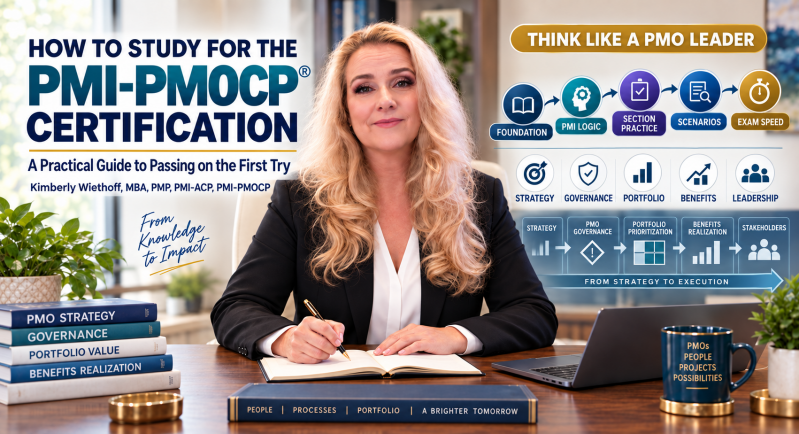
How to Study for the PMI-PMOCP® Certification: A Practical Guide to Passing on the First Try

Published on 12 January 2026 at 08:45

Preparing for the PMI-PMOCP® (PMO Certified Practitioner) exam requires a unique blend of strategic thinking, governance knowledge, delivery frameworks, business acumen, and strong PMO leadership skills. Unlike the PMP®, which focuses on project execution, the PMOCP focuses on aligning enterprise strategy with governance, value delivery, and portfolio-level decision-making — all through the lens of a modern PMO.

If you’re planning to earn this increasingly in-demand certification, the good news is that your study path is completely manageable with the right tools and structure. Below is a proven approach based on best practices, scenario-driven reasoning, and the study aides you’ve uploaded.

Why the PMOCP Exam Is Different

The PMOCP exam is not testing your memory of definitions — it is testing how you think like a PMO leader.

Expect questions that ask:

  • “What should the PMO do first?”
  • “What is the best strategic approach?”
  • “Which governance adjustment solves this?”
  • “How should the PMO influence executives?”

This means you must master not only the content, but the logic pattern behind PMI’s preferred answers.

Your uploaded cheat sheets and study documents support this beautifully because they break the exam into recognizable logic clusters.

Step-By-Step Study Strategy

Step 1 — Build Your Foundation (Week 1)

Start with the PMOCP Study Guide by Section to understand:

  • PMO mission, vision, purpose
  • Governance structures
  • Portfolio alignment
  • Benefits realization
  • Delivery models (Agile, Hybrid, Predictive)
  • PMO operations & service catalog
  • Stakeholder leadership
  • Value delivery

Then reinforce the structure visually with the mind maps.

This builds a mental model of what the exam expects you to know.

Step 2 — Recognize PMI’s Logic Pattern (Week 2)

The Master Memory Hooks document is essential here.

Example patterns you must memorize:

If the question says “too many projects” → the answer is portfolio prioritization.

If the question says “unclear roles” → the answer is RACI.

If the question says “no benefits delivered” → the answer is benefits realization plan.

If the question says “what is the NEXT step after PMO charter” → the answer is executive sponsorship.

These recurring logic patterns appear constantly in PMOCP scenarios.

Step 3 — Begin Practice With Section-Based Questions (Week 2–3)

Use the 100 Practice Questions by Section to test foundational knowledge.

This builds confidence and exposes weak areas before you move into full scenarios.

Step 4 — Master Scenario-Based Thinking (Week 3–4)

Next, use the 200 Scenario-Based Questions.

This is where you truly learn to think like PMI.

Each scenario gives:

  • The correct answer
  • Key trigger words
  • The memory hook
  • Why PMI prefers that answer

This builds instinctive recognition of PMI logic cues.

Step 5 — Use the Cheat Sheets for Exam Speed (Final Week)

Right before the exam, focus on:

✔ PMOCP Exam Cheat Sheet

✔ “When the Question Says…” Decoder

These help you:

  • Scan quickly for key trigger words
  • Map them instantly to the correct answer theme
  • Move confidently through scenario items

This dramatically reduces decision fatigue during the exam.

How to Approach the Exam Questions

The PMOCP exam rewards the answer that is:

✔ Strategic

Not tactical or reactive.

✔ Aligned

Tied to value delivery and enterprise strategy.

✔ Governance-driven

Clarify escalation, decision rights, or stage gates first.

✔ Consistent and standardized

PMI wants structure before improvisation.

✔ Stakeholder-focused

Influence, communication, and engagement appear constantly.

✔ Value-centric

Benefits > outputs.

Your scenario practice files support exactly this style.

Common PMOCP Question Patterns (With Correct Logic)

Here are examples of patterns you’ll see repeatedly:

“What should the PMO do FIRST?”

→ Assess, align, clarify, or secure sponsorship.

“Which model should the PMO use?”

→ Agile = uncertainty, Predictive = compliance, Hybrid = mixed expectations.

“How can the PMO improve visibility?”

→ Dashboards, KPIs, trend reporting.

“How can the PMO reduce overload?”

→ Portfolio prioritization, resource capacity planning.

“Why were benefits not realized?”

→ Missing benefits realization plan.

These patterns are reinforced in the memory hook and scenario files.

Day-Before-Exam Checklist

Review:

✔ Master Memory Hooks

✔ PMOCP Cheat Sheet

✔ “When the Question Says…” sheet

✔ 20–40 scenario questions

✔ Mind maps for domain visualization

Avoid memorizing — focus on recognizing patterns and eliminating distractors.

Udemy Practice Tests For the PMI-PMOCP

Take practice tests until you are scoring in the 90%.

Course: The PMI- PMOCP Exam Simulations | Udemy

Course: PMI-PMOCP practice Questions (PMO-CP 2025 exam updates) | Udemy

Project Management Office PMO-CP Exam Prep: 100% Practice | Udemy

PMI-PMOCP Real Practice Exams, The New Version 2025 | Udemy

PMI PMOCP Project Management Office Professional Exams 2026 | Udemy

PMI-PMOCP Exam Prep | 500 PMO Certified Professional Q&A | Udemy

Final Advice For PMOCP Success

  • Study concepts first
  • Practice until patterns become automatic
  • Use memory hooks during scenarios
  • Choose strategic over tactical answers
  • Prioritize stakeholder engagement, governance, and alignment
  • Look for the “root cause,” not the surface symptom
  • Think like a PMO Director, not a project manager

With consistent practice and the study aides you’ve developed, you are positioned to not just pass — but to excel with confidence.

#PMOCP #PMOCertification #PMOLeadership #PMOExamPrep #PMI #ProjectManagement #ProgramManagement #PortfolioManagement #Governance #AgilePMO #HybridDelivery #PredictiveDelivery #BusinessAcumen #StrategicAlignment #BenefitsRealization #PMOOperations #PMOKPIs #PMOValue #PMOTransformation #StudyPlan #ExamStrategy #ScenarioBasedQuestions #MemoryHooks #PMOFrameworks #ManagingProjectsTheAgileWay
Your Core Study Resources

These uploaded study aides create a complete study system:

✔ PMOCP Study Guide by Section

Builds foundational knowledge across all exam topics.

📘 SECTION I — PMO STRATEGIC ELEMENTS

📘 SECTION I — PMO STRATEGIC ELEMENTS

Exam Weight ~18%

1.1 PMO Purpose, Mission, and Value Proposition

What to Know

  • How PMOs create value (execution enablement, governance, alignment).
  • PMO mission/vision statements tied to enterprise strategy.
  • Value drivers: predictability, transparency, delivery velocity, risk visibility.

Exam Signals

|If question mentions…| Look for answers about…|

| “Aligning PMO to strategy” |Business outcomes, strategic objectives|

| “Establishing PMO value”   |Measurable benefits, KPIs|

| “Defining PMO mission/vision” | Stakeholder needs + enterprise strategy|

Hot Topics

  • Types of PMOs: Directive, Supportive, Controlling, Hybrid.
  • PMO contextual maturity.
  • Business case for establishing a PMO.

1.2 PMO Operating Environment & Organizational Context

What to Know

  • How organizational structure affects PMO authority.
  • Enterprise environmental factors (EEFs).
  • Understanding culture, constraints, maturity, governance systems.

Exam Signals

| If question mentions… | Focus on… |
| “Resistance to PMO” | Change management & stakeholder alignment |
| “Different business units need different workflows” | Tailoring & contextualization |

Hot Topics

  • Tailoring PMO design to organizational maturity.
  • Cross-functional collaboration frameworks.

1.3 PMO Roles, Responsibilities, and Competency Models

What to Know

  • Skills needed at various PMO maturity levels.
  • Role clarity (PjM vs PgM vs PMO Director).
  • Competency models: leadership, strategy, delivery, analytics.

Exam Signals

| If question mentions… | Correct answer usually ties to… |
| “PMs unclear about roles” | RACI, role clarity workshops |
| “Capability uplift needed” | Competency framework + training roadmap |

📘 SECTION II — PMO GOVERNANCE & PORTFOLIO ALIGNMENT

📘 SECTION II — PMO GOVERNANCE & PORTFOLIO ALIGNMENT

Exam Weight ~18%

2.1 Governance Frameworks

What to Know

  • Governance tiers (portfolio → program → project).
  • Decision rights, escalation paths, stage gates.
  • Portfolio governance bodies (Steering Committee, EPMO, etc.).

Exam Signals

| If question contains… | Look for… |
| “Lack of decision escalation” | Governance model, decision rights |
| “Inconsistent approvals” | Standard stage gates |
| “Sponsors unsure of their role” | Clarifying governance responsibilities |

2.2 Portfolio Alignment & Prioritization

What to Know

  • Prioritization models: WSJF, scoring, weighted criteria.
  • Balancing strategic value vs risk vs resourcing.
  • Portfolio performance dashboards.

Exam Signals

| If question contains… | Look for… |
| “Too many active projects” | Portfolio rationalization |
| “Competing priorities” | Alignment workshops + prioritization model |

2.3 Benefits Management

What to Know

  • Benefits identification, mapping, realization, sustainment.
  • KPIs vs OKRs vs value metrics.
  • Tracking benefits over time post-deployment.

Exam Signals + Strategy

|Contains|Correct Answer Focus|

| “Realizing benefits”|Transition to operations + sustainment plans|

| “Benefits unclear”|Define KPIs + measurable metrics|

📘 SECTION III — PMO TOOLS, METHODS, & DELIVERY FRAMEWORKS

📘 SECTION III — PMO TOOLS, METHODS, & DELIVERY FRAMEWORKS

Exam Weight ~20%

3.1 Project Delivery Frameworks (Agile, Hybrid, Predictive)

What to Know

  • When to apply Agile vs Hybrid vs Predictive.
  • Tailoring approaches for mixed portfolios.

Exam Signals

| If question contains… | Answer leans toward… |
| “High uncertainty” | Agile |
| “Regulatory / high documentation” | Predictive |
| “Large enterprise transformation” | Hybrid + governance consistency |

3.2 PMO Standards, Processes & Methodologies

What to Know

  • PMO process libraries, templates, playbooks.
  • Ensuring consistency across teams.
  • Practice standardization + tailoring.

Exam Signals

|Contains|Correct Concept|

| “Inconsistent reporting”|Standard templates|

| “PMs follow different processes”|Process harmonization|

3.3 Resource Management & Capacity Planning

What to Know

  • Resource allocation models.
  • Role-based capacity forecasts.
  • Demand vs supply forecasting.

Exam Signals

| If question includes… | Correct answer likely… |
| “Overallocated resources” | Resource leveling + capacity planning |
| “Demand exceeding supply” | Prioritization + resource planning |

3.4 Financial Management for PMOs

What to Know

  • Budget vs forecast vs actual.
  • Financial tracking and ROI.
  • Chargeback models (if applicable).

Exam Signals

| Contains | Answer Focus

|  “Budget risk” | Reforecasting + variance analysis

|  “Exec wants to see financial predictability” | Financial reports + trend analysis

📘 SECTION IV — PMO OPERATIONS & PERFORMANCE

📘 SECTION IV — PMO OPERATIONS & PERFORMANCE

Exam Weight ~15%

4.1 PMO Service Delivery

What to Know

  • PMO as a service provider (consulting, governance, training, analytics).
  • PMO service catalog.

Exam Signals

| If question mentions… | Strategy |

| “PMO services unclear” | Define a PMO service catalog |

| “Customers don’t understand PMO value” | Communication + marketing the PMO

4.2 KPIs, Metrics, and Reporting

What to Know

  • Leading vs lagging indicators.
  • Executive dashboards.
  • Value metrics (not just activity metrics).

Exam Strategy

| Mentioned | Choose |

| “Visibility into project health is poor” | Health dashboards |

| “Execs overwhelmed with data” | Simplified visualization + key KPIs |

4.3 Quality Assurance & Continuous Improvement

What to Know

  • QA vs QC for PMO processes.
  • Audits, health checks, compliance.
  • Continuous improvement cycles.

Exam Signals

  • “Maturity uplift” → Improvement roadmap
  • “Process non-compliance” → Audits + training

📘 SECTION V — PMO LEADERSHIP & STAKEHOLDER ENGAGEMENT

📘 SECTION V — PMO LEADERSHIP & STAKEHOLDER ENGAGEMENT

Exam Weight ~18%

5.1 Stakeholder Engagement & Change Management

What to Know

  • Stakeholder mapping, power/influence grids.
  • Engagement plans.
  • Change adoption frameworks (ADKAR, Kotter).

Exam Signals

| If question contains… | Look for… |
| “Stakeholder resistance” | Communication + change mgmt |
| “Lack of buy-in” | Engagement plan + early involvement |

5.2 Executive Communication

What to Know

  • Executive presence; concise reporting.
  • Escalation management.
  • Framing information for senior leadership.

Exam Strategy

| Mentioned | Choose

| “Inform the exec board” | Highlight risk, options, recommendation |

5.3 Leadership Skills for PMO Professionals

What to Know

  • Coaching PMs.
  • Managing conflict.
  • Influencing without authority.

Exam Signals

  • “Cross-team friction” → Facilitation + collaboration frameworks
  • “Low morale” → Coaching + alignment to purpose

📘 SECTION VI — PMO BUSINESS ACUMEN & VALUE DELIVERY

📘 SECTION VI — PMO BUSINESS ACUMEN & VALUE DELIVERY

Exam Weight ~11%

6.1 Business Acumen & Strategic Thinking

What to Know

  • Understanding business drivers.
  • ROI-based decision making.
  • Product vs project mindset.

6.2 Value Delivery & Outcome-Based Management

What to Know

  • Focus on outcomes, not outputs.
  • Value hypothesis mapping.
  • Linking delivery to strategic value.

Exam Signals

| Contains | Correct Answer |

| “Output delivered but no value realized” | Benefits realization + business alignment |

| “PMO seen as administrative” | Shift to value-driven PMO capabilities |

🧠 EXAM QUESTION STRATEGIES

🧠 EXAM QUESTION STRATEGIES

Recognize the PMI-PMOCP “Logic Pattern”

The exam prefers answers that prioritize:

  1. Strategic alignment → business outcomes
  2. Governance before execution
  3. Stakeholder alignment before process changes
  4. Prevention over correction
  5. Systems thinking > tactical fixes
  6. Standardization + tailoring (never 100% prescriptive)
  7. Value delivery > bureaucracy

✔ 30-Day PMOCP Study Plan

Breaks down what to study each day: strategy, governance, methods, operations, KPIs, value delivery, and exam readiness.

PMI-PMOCP 30-DAY PMOCP STUDY PLAN

Focus: Master concepts + exam patterns + scenario practice

WEEK 1 — Foundation & Strategy

Day 1–2: PMO Mission, Purpose & Strategy

  • Review PMO types (directive, supportive, controlling, hybrid)
  • Study PMO value proposition
  • Learn “keyword mapping” patterns

Day 3: Organizational Context & Maturity

  • Organizational structures
  • PMO contextual maturity
  • Tailoring principles

Day 4–5: Governance Structures

  • Stage gates
  • Decision rights
  • Escalation paths

Day 6–7: Portfolio Alignment

  • Prioritization models
  • Strategic scoring
  • Demand vs capacity modeling

WEEK 2 — Methods, Tools & Delivery

Day 8–10: Agile vs Hybrid vs Predictive

  • When to use which model
  • PMO support for each method

Day 11–12: PMO Process Standardization

  • Process library
  • Templates and dashboards
  • Consistency across teams

Day 13–14: Resource & Financial Management

  • Capacity planning
  • Budget vs forecast vs actual
  • Variance analysis

WEEK 3 — Operations, Stakeholders & Leadership

Day 15–17: PMO Operations & Service Delivery

  • PMO service catalog
  • PMO as internal consultancy

Day 18–19: KPIs, Metrics, Dashboards

  • Leading vs lagging indicators
  • Executive reporting formats

Day 20–21: Stakeholder Engagement

  • Stakeholder mapping
  • Communication strategies
  • Resistance management

WEEK 4 — Business Value + Exam Readiness

Day 22–24: Business Acumen & Value Delivery

  • Outcomes vs outputs
  • Benefits realization
  • Value-linked governance

Day 25–27: Scenario Practice

  • Practice 40 scenario-style questions
  • Identify keyword patterns

Day 28: Full Mock Exam

  • Time-boxed 2-hour simulation

Day 29: Review Incorrect Answers

  • Review why answers were wrong
  • Identify weak areas

Day 30: Final Strategy

  • Read cheat sheet
  • Run flashcards
  • Take 20 mixed questions


✔ 100 Practice Questions by Section

Covers all exam domains with correct answers and explanations.

SECTION 1 — PMO Strategic Elements (18%)

SECTION 1 — PMO Strategic Elements (18%)

  1. After defining the PMO’s mission and vision, what is the next step?
    Secure executive sponsorship
  2. Your PMO is not aligned with enterprise strategy. What should you do first?
    Conduct a strategic alignment assessment
  3. PMs do not understand their roles. What is the best course of action?
    Clarify roles using a RACI model
  4. The organization has low maturity. What kind of PMO design is best?
    Supportive PMO
  5. PMO value is questioned by executives. What should you provide?
    A value realization plan with measurable outcomes

SECTION 1 — PMO STRATEGIC ELEMENTS (Additional 20 Questions)

  1. What is the FIRST step when designing a new PMO?

➡ Assess organizational strategy and current maturity

  1. You are tasked with defining PMO success. What should you focus on?

➡ Value-based KPIs aligned to business outcomes

  1. PMO is seen as bureaucratic. What should be done first?

➡ Review and streamline processes based on user feedback

  1. PMO lacks visibility in the organization. What action helps most?

➡ Develop a PMO communication and engagement plan

  1. Executives disagree on PMO purpose. What is required first?

➡ Facilitate strategic alignment workshop

  1. PMO needs to justify its existence. What tool is most effective?

➡ PMO value realization report

  1. Business units are using their own delivery methods. What is PMO’s role?

➡ Standardize frameworks and allow tailored guidance

  1. PMO must support innovation. What is the right approach?

➡ Introduce flexible, adaptive governance

  1. Leadership asks how PMO supports strategy. What should you present?

➡ Strategy-to-execution alignment roadmap

  1. PMO struggling to get buy-in. What should PMO do?

➡ Engage early with stakeholders to understand pain points

  1. PMO maturity assessment identifies gaps. What next?

➡ Create a maturity improvement roadmap

  1. PMO lacks credibility. What should you implement?

➡ Transparent performance reporting

  1. PMO must evolve with changing strategy. What do you do?

➡ Regular PMO mandate reviews

  1. PMO has too many services. What should you do?

➡ Prioritize based on value and organizational needs

  1. PMO needs to scale quickly. Where do you start?

➡ Strengthen governance and standards

  1. PMO charter drafted. What next?

➡ Secure executive sponsorship (PMI favorite answer)

  1. PMO failing to support cross-functional initiatives. What is missing?

➡ Enterprise integration framework

  1. PMO must shift from tactical to strategic. Focus on…

➡ Portfolio alignment + value metrics

  1. PMO receives conflicting expectations. First step?

➡ Conduct stakeholder expectation assessment

  1. PMO needs to define capabilities. What helps most?

➡ PMO capability model

SECTION 2 — Governance & Portfolio Alignment (18%)

SECTION 2 — Governance & Portfolio Alignment (18%)

  1. Governance approvals are inconsistent. What should the PMO implement?
    Standardized stage gate governance
  2. Too many projects are active at once. What is the PMO’s next step?
    Portfolio prioritization
  3. Teams escalate decisions poorly. What is needed?
    Clear escalation paths & decision rights
  4. Benefits have not materialized. What is missing?
    Benefits realization plan
  5. Portfolio lacks visibility. What should be implemented?
    Portfolio dashboard

SECTION 2 — GOVERNANCE & PORTFOLIO ALIGNMENT (Additional 15 Questions)

  1. Governance gates are often skipped. What’s the cause?

➡ Poorly defined decision rights

  1. Portfolio lacks visibility into risk. PMO should introduce…

➡ Portfolio-level risk register

  1. Executive sponsors request faster decisions. What is needed?

➡ Clear escalation matrix

  1. Projects compete for resources. What addresses this?

➡ Portfolio prioritization model

  1. Portfolio processes vary across units. Fix?

➡ Unified governance framework

  1. Leadership wants early indicators of project failure. Provide…

➡ Leading indicators dashboard

  1. Too many low-value initiatives approved. Introduce…

➡ Weighted scoring model

  1. Benefits are not measured post-delivery. Implement…

➡ Benefits tracking & sustainment phase

  1. Execs want greater predictability. What should PMO adjust?

➡ Governance controls + reporting cadence

  1. Constant firefighting indicates missing…

➡ Risk governance framework

  1. Portfolio goals unclear. PMO’s first step?

➡ Align objectives with strategic themes

  1. Some projects don’t support strategy. What is required?

➡ Portfolio rationalization

  1. Priorities frequently shift. PMO response?

➡ Create adaptive governance & rolling-wave planning

  1. Execs need faster funding decisions. PMO should create…

➡ Lightweight stage gate for early validation

  1. PMO lacks enterprise visibility. Implement…

➡ Integrated portfolio management system

SECTION 3 — Methods, Tools & Delivery Models (20%)

SECTION 3 — Methods, Tools & Delivery Models (20%)

  1. Uncertain requirements. What methodology fits best?
    Agile
  2. Regulatory documentation is required. What methodology?
    Predictive
  3. Teams using inconsistent templates. What do you implement?
    Standardized process library
  4. Overallocated resources. What do you do first?
    Capacity planning
  5. Execs want better forecasting. What do you provide?
    Trend analysis + forecast models

SECTION 3 — DELIVERY METHODS & TOOLS (Additional 15 Questions)

  1. Agile team lacks clarity. PMO role?

➡ Provide coaching and definition of done

  1. Hybrid delivery failing. What's missing?

➡ Integration points between Agile and Predictive teams

  1. Teams using outdated templates. Fix?

➡ Establish version-controlled process repository

  1. Forecast accuracy low. PMO should…

➡ Implement rolling forecasts

  1. PMs avoid using tools. PMO should…

➡ Provide training and simplify toolset

  1. Predictive teams resist Agile scaling. Best approach?

➡ Introduce hybrid governance with clear roles

  1. Execs ask for cross-team resource view. Implement…

➡ Resource capacity dashboard

  1. PMO cannot compare project health across frameworks. Solution?

➡ Standard health indicators regardless of delivery method

  1. Agile teams lack coordination. Introduce…

➡ Scrum of scrums / program increment planning

  1. Tools not integrated. PMO should…

➡ Build unified tooling strategy

  1. Poor estimation accuracy. PMO role?

➡ Introduce estimation frameworks + historical data

  1. Project reporting delayed. Solve with…

➡ Automated dashboards

  1. Agile execs want ROI tracking. PMO provides…

➡ Value-based metrics

  1. Teams resist documentation. PMO should…

➡ Implement right-sized documentation guidelines

  1. Teams struggle with risk management. PMO should…

➡ Provide risk frameworks + PM coaching

SECTION 4 — PMO Operations & Performance (15%)

SECTION 4 — PMO Operations & Performance (15%)

  1. PMO services unclear. What is the fix?
    Publish a PMO service catalog
  2. Execs overwhelmed with reports. What's needed?
    Simplify KPIs
  3. Poor adherence to PMO processes. First step?
    PMO compliance audit
  4. PMs lack process training. What do you introduce?
    PMO training and coaching program
  5. PMO performance is not measured. What should you implement?
    PMO scorecard

SECTION 4 — PMO OPERATIONS & PERFORMANCE (Additional 10 Questions)

  1. PMO services not understood. Fix?

➡ PMO service catalog + communication plan

  1. PMO workload unclear. Implement…

➡ PMO service demand tracking

  1. PMO not meeting SLAs. What next?

➡ Review capacity vs demand

  1. Stakeholders doubt PMO consistency. Introduce…

➡ PMO audits + quality checks

  1. PMO KPIs unclear. Fix?

➡ Define leading and lagging indicators

  1. PMO stretched thin. PMO should…

➡ Reprioritize services based on value

  1. PMO processes outdated. What now?

➡ Continuous improvement cycle

  1. PMO unable to support all teams. Approach?

➡ Tiered service delivery model

  1. Reports too complex. PMO should…

➡ Simplify visualizations + exec summaries

  1. PMO not improving. Missing?

➡ PMO maturity roadmap

SECTION 5 — Stakeholder Engagement & Leadership (18%)

SECTION 5 — Stakeholder Engagement & Leadership (18%)

  1. Stakeholder resistance is high. What is the next step?
    Engagement and communication plan
  2. Execs want high-level status. What format is best?
    Concise summary with risks & options
  3. Conflicts between PMs and SMEs. What skill is needed?
    Facilitation & conflict resolution
  4. PMO not trusted. What should PMO leadership focus on?
    Building relationships & transparency
  5. Sponsor disengaged. What should PMO do first?
    Re-engage with tailored communication

SECTION 5 — STAKEHOLDER ENGAGEMENT & LEADERSHIP (Additional 10 Questions)

  1. Stakeholder not responding. Best action?

➡ Adjust communication approach based on their style

  1. PM conflicts with SME. PMO step?

➡ Facilitate mediation

  1. Stakeholders want more involvement. PMO should…

➡ Create engagement plan

  1. PMO lacking trust. PMO must…

➡ Demonstrate transparency

  1. Sponsor disengaged. First step?

➡ Understand sponsor concerns

  1. Cultural resistance to PMO. Need…

➡ Change readiness assessment

  1. Leaders want more influence. Provide…

➡ Governance role clarity

  1. Teams misaligned on goals. PMO should…

➡ Facilitate alignment workshops

  1. Stakeholder complaints about visibility. Fix?

➡ Executive dashboards

  1. PMO communication ineffective. Remedy?

➡ Tailor messaging to stakeholder groups

SECTION 6 — Business Acumen & Value Delivery (11%)

SECTION 6 — Business Acumen & Value Delivery (11%)

  1. Team delivered output but not outcomes. What's missing?
    Benefits realization
  2. PMO is seen as administrative. What should it transform into?
    Value-driven PMO model
  3. Execs want cost justification for projects. What do you use?
    ROI & value analysis
  4. Strategic priorities changed mid-year. What should PMO do?
    Re-evaluate portfolio alignment
  5. Stakeholders request more value visibility. What to implement?
    Outcome-based KPIs

✔ 200 Scenario-Based Questions with Memory Hooks + Reasoning

This is your MOST powerful resource because the exam is scenario-heavy and logic-driven.

✅ SET 1 — PMO STRATEGY & DESIGN

  1. After defining the PMO’s mission and vision, what is the NEXT step?

➡ Correct Answer: Secure executive sponsorship
🔑 Memory Hook: After charter → Sponsorship
🧠 Why: PMI always wants executive support BEFORE PMO launches processes; without it, PMO has no authority.

  1. Your PMO is not aligned with enterprise strategy. What should you do first?

➡ Correct Answer: Conduct a strategic alignment assessment
🔑 Memory Hook: Misalignment = assess before act
🧠 Why: PMI requires understanding the gap before prescribing solutions.

  1. PMs do not understand their roles. What is the best action?

➡ Correct Answer: Define role clarity using RACI
🔑 Memory Hook: Unclear roles = RACI
🧠 Why: PMI always uses RACI for ambiguity in responsibilities.

  1. The organization has low maturity. What type of PMO should you implement?

➡ Correct Answer: Supportive PMO
🔑 Memory Hook: Low maturity = supportive guidance
🧠 Why: PMI matches PMO model to maturity (supportive → controlling).

  1. Executives question PMO value. What should you provide?

➡ Correct Answer: Value realization plan with measurable outcomes
🔑 Memory Hook: PMO value = benefits + metrics
🧠 Why: PMI ties value to measurable business outcomes.

  1. Business units complain PMO slows them down. What do you evaluate first?

➡ Correct Answer: Review processes for non–value-added steps
🔑 Memory Hook: Slow = Lean process check
🧠 Why: PMI expects root cause analysis before changing governance.

  1. Leadership disagrees on PMO purpose. What must you do?

➡ Correct Answer: Facilitate a strategic alignment workshop
🔑 Memory Hook: Conflicting views = facilitate alignment
🧠 Why: PMI favors collaboration over unilateral decisions.

  1. PMO lacks credibility. What increases trust fastest?

➡ Correct Answer: Deliver quick wins tied to business outcomes
🔑 Memory Hook: Trust = quick, visible value
🧠 Why: Demonstrated impact > long-term theoretical plans.

  1. PMO unsure how their work supports enterprise goals. What tool helps?

➡ Correct Answer: Strategy-to-execution alignment map
🔑 Memory Hook: Confusion = create strategy map
🧠 Why: PMI emphasizes visualizing alignment for clarity.

  1. A new CEO wants rapid transformation. PMO’s first move?

➡ Correct Answer: Re-align PMO roadmap to new priorities
🔑 Memory Hook: New leadership = new alignment
🧠 Why: Strategy always shifts with senior leadership.

  1. PMO lacking authority. What should you secure?

➡ Correct Answer: Executive sponsorship
🔑 Memory Hook: Authority comes from the top
🧠 Why: Without sponsorship, PMO cannot influence governance.

  1. PMO seen as bureaucratic. What’s the best approach?

➡ Correct Answer: Streamline and right-size processes
🔑 Memory Hook: Bureaucracy = simplify
🧠 Why: PMI wants PMO to enable—not burden—delivery.

  1. Different teams interpret PMO processes differently. Fix?

➡ Correct Answer: Standardize PMO process documentation
🔑 Memory Hook: Inconsistency = standardization
🧠 Why: PMO should unify practices across the enterprise.

  1. PMO leadership overwhelmed with tactical work. What should they do?

➡ Correct Answer: Delegate operations and focus on strategy
🔑 Memory Hook: PMO leaders = strategic, not tactical
🧠 Why: PMI expects PMO to operate at governance level.

  1. PMO needs to justify budget. What should they present?

➡ Correct Answer: Cost-to-value analysis
🔑 Memory Hook: Budget = value proof
🧠 Why: PMI emphasizes ROI-based justification.

  1. PMO needs to scale quickly across business units. What’s the priority?

➡ Correct Answer: Strengthen governance and reporting standards
🔑 Memory Hook: Scaling = governance first
🧠 Why: PMI wants the foundation before expansion.

  1. PMO must support highly regulated divisions. What is required?

➡ Correct Answer: Compliance-driven governance
🔑 Memory Hook: Regulatory = predictable controls
🧠 Why: Compliance is non-negotiable under PMI standards.

  1. PMO maturity stops improving. What should be reviewed?

➡ Correct Answer: PMO capability model + improvement roadmap
🔑 Memory Hook: Stagnation = reassess capabilities
🧠 Why: PMI expects continuous maturity evolution.

  1. PMO overloaded with services. What to do first?

➡ Correct Answer: Prioritize services based on strategic value
🔑 Memory Hook: Too much work = prioritize
🧠 Why: PMI wants PMO to focus on high-value offerings.

  1. PMO must evolve to support innovation. What is required?

➡ Correct Answer: Adaptive, lightweight governance
🔑 Memory Hook: Innovation = lighter governance
🧠 Why: Heavy processes kill innovation; PMI promotes tailoring.

✅ SET 2 — GOVERNANCE & PORTFOLIO ALIGNMENT

🔵 GOVERNANCE SCENARIOS (21–30)

  1. Governance gates are frequently skipped by project teams. What is the most likely root cause?

Correct Answer: Governance roles, ownership, and decision rights are unclear.
🔑 Memory Hook: Skipped gates = unclear governance
🧠 Why: PMI expects governance clarity before enforcement.

  1. Different business units use different governance models. What should PMO do?

Correct Answer: Create a unified governance framework with tailoring rules.
🔑 Memory Hook: Inconsistency = unify & tailor
🧠 Why: PMI promotes standardization with flexibility.

  1. Sponsors escalate issues too late. What is missing?

Correct Answer: Defined escalation paths and thresholds.
🔑 Memory Hook: Late escalation = unclear pathways
🧠 Why: PMI requires structured, proactive escalation.

  1. PMs complain that acceptance criteria are unclear across projects. How should PMO respond?

Correct Answer: Define standard deliverable acceptance criteria.
🔑 Memory Hook: Unclear deliverables = define acceptance
🧠 Why: PMI wants consistency in quality expectations.

  1. Governance reviews are slow and bureaucratic. What should PMO do?

Correct Answer: Streamline stage gate requirements.
🔑 Memory Hook: Slow governance = simplify controls
🧠 Why: Lean governance improves flow without losing control.

  1. PMs submit incomplete documentation for review. What should PMO implement?

Correct Answer: Governance checklists and pre-review criteria.
🔑 Memory Hook: Incomplete = checklists
🧠 Why: Checklists reduce friction and improve compliance.

  1. High audit failure rate across multiple projects. What should you do FIRST?

Correct Answer: Conduct a root cause analysis on governance gaps.
🔑 Memory Hook: Audit issues = analyze root cause first
🧠 Why: PMI always wants analysis BEFORE solutions.

  1. Conflicts arise during governance board meetings. What is likely missing?

Correct Answer: Clear governance role definitions and decision rights.
🔑 Memory Hook: Governance conflict = unclear roles
🧠 Why: Governance operates on defined authority, not negotiation.

  1. Governance board keeps approving low-value initiatives. What is the fix?

Correct Answer: Introduce a weighted scoring model aligned to strategy.
🔑 Memory Hook: Bad approvals = scoring model
🧠 Why: PMI demands objective criteria for decisions.

  1. PMs feel governance is too bureaucratic and slows them down. How should PMO respond?

Correct Answer: Right-size governance based on project risk.
🔑 Memory Hook: Over-governance = right-size
🧠 Why: One-size-fits-all frameworks reduce efficiency and morale.

🟢 PORTFOLIO MANAGEMENT SCENARIOS (31–40)

  1. There are too many active projects and resource strain. What should PMO do?

Correct Answer: Initiate portfolio prioritization.
🔑 Memory Hook: Too many projects = prioritize
🧠 Why: PMI says prioritization is the cure for overload.

  1. Teams escalate decisions poorly. What is needed?

Correct Answer: Define and publish clear escalation paths.
🔑 Memory Hook: Escalation issue = define path
🧠 Why: PMI stresses clarity in decision flow.

  1. Benefits from multiple projects are not realized. What is missing?

Correct Answer: Benefits realization plan and governance.
🔑 Memory Hook: No benefits = missing plan
🧠 Why: PMI requires benefits defined, tracked, sustained.

  1. Portfolio lacks visibility and alignment. What should PMO implement?

Correct Answer: Portfolio dashboard with KPIs and alignment metrics.
🔑 Memory Hook: No visibility = dashboard
🧠 Why: Execs need simple, at-a-glance insights.

  1. Business units disagree on portfolio priorities. What should PMO do?

Correct Answer: Facilitate alignment workshop with scoring model.
🔑 Memory Hook: Disagreement = facilitate
🧠 Why: PMI expects consensus-building, not dictating.

  1. Portfolio performance is unpredictable. What should PMO address?

Correct Answer: Improve governance + standard reporting cadence.
🔑 Memory Hook: Unpredictable = governance + cadence
🧠 Why: Predictability comes from consistent governance.

  1. Executives need early indicators of portfolio risk. What should PMO provide?

Correct Answer: Leading indicators and trend metrics.
🔑 Memory Hook: Early warning = leading indicators
🧠 Why: PMI focuses on proactive, not reactive, controls.

  1. Low-value initiatives continue being approved. What must PMO introduce?

Correct Answer: Strategic value scoring criteria.
🔑 Memory Hook: Low value = objective scoring
🧠 Why: Criteria remove bias and “pet projects.”

  1. Executives ask for faster funding decisions. What should PMO adjust?

Correct Answer: Implement lightweight early-stage gating.
🔑 Memory Hook: Slow approvals = lightweight gate 1
🧠 Why: Initial concept review = faster decision-making.

  1. Portfolio execution is slow due to cross-project dependencies. What should PMO create?

Correct Answer: Dependency mapping and resolution workflow.
🔑 Memory Hook: Slow due to dependencies = map & manage
🧠 Why: PMI emphasizes proactive dependency management.

✅ SET 3 — METHODS, DELIVERY MODELS & TOOLS

🔵 METHODS & DELIVERY MODEL SCENARIOS (41–50)

  1. Your team is dealing with constantly changing requirements. What delivery approach is MOST appropriate?

Correct Answer: Agile
🔑 Memory Hook: Uncertainty = Agile
🧠 Why PMI chooses this: Agile thrives in environments with evolving requirements and high volatility.

  1. A government project requires strict documentation and high predictability. What should PMO recommend?

Correct Answer: Predictive / Waterfall
🔑 Memory Hook: Compliance = Predictive
🧠 Why: Regulatory requirements demand structure and documentation.

  1. Teams are using Agile, but leadership demands detailed predictive reporting. What should PMO create?

Correct Answer: Hybrid governance model
🔑 Memory Hook: Predictability + flexibility = Hybrid
🧠 Why: Hybrid bridges Agile autonomy and leadership oversight.

  1. Agile ceremonies are performed, but delivery is inconsistent. What should PMO address first?

Correct Answer: Team stability, WIP limits, and impediments
🔑 Memory Hook: Agile inconsistency = check flow
🧠 Why: PMI focuses on flow metrics (WIP, cycle time), not rituals.

  1. A predictive project keeps missing deadlines due to unrealistic planning. What should PMO do?

Correct Answer: Improve estimation and planning accuracy
🔑 Memory Hook: Predictive failure = planning issue
🧠 Why: Predictive success depends on upfront planning accuracy.

  1. Teams frequently change methods mid-project. What is missing?

Correct Answer: Tailoring guidelines
🔑 Memory Hook: Inconsistent methods = tailoring guidance
🧠 Why: PMI expects method selection to be systematic, not random.

  1. Teams claim Agile means “no documentation.” What should PMO clarify?

Correct Answer: Agile requires right-sized documentation
🔑 Memory Hook: Agile ≠ no documentation
🧠 Why: PMI stresses documentation appropriate to risk—not eliminating it.

  1. Agile team velocity varies widely each sprint. What should PMO improve?

Correct Answer: Stability and consistent team composition
🔑 Memory Hook: Velocity variance = unstable team
🧠 Why: Velocity swings come from inconsistent team makeup or WIP.

  1. A predictive team resists Agile adoption. What should PMO do FIRST?

Correct Answer: Provide coaching + explain benefits of tailoring
🔑 Memory Hook: Resistance = coaching before enforcing
🧠 Why: PMI values education > forced adoption.

  1. Agile teams deliver increments, but integration fails across teams. What’s missing?

Correct Answer: Cross-team dependency management framework
🔑 Memory Hook: Scaling Agile = manage dependencies
🧠 Why: Dependencies destroy flow unless coordinated across teams.

🟢 TOOLS, STANDARDIZATION & REPORTING SCENARIOS (51–60)

  1. Different project teams use different templates. What should PMO do?

Correct Answer: Standardize templates and publishing location
🔑 Memory Hook: Inconsistency = standardization
🧠 Why: PMI stresses normalized processes across the organization.

  1. Project reporting varies widely and executives are frustrated. What should PMO implement?

Correct Answer: Unified reporting framework & dashboard
🔑 Memory Hook: Reporting pain = unify formats
🧠 Why: Consistency enables comparison and decision-making.

  1. PMO wants to improve forecast accuracy. What must they introduce?

Correct Answer: Rolling-wave forecasting
🔑 Memory Hook: Forecasting = rolling updates
🧠 Why: PMI expects continuous reforecasting in all models.

  1. Teams avoid using the PMO project management tool. What is the PMO’s best action?

Correct Answer: Provide enablement + simplify usage
🔑 Memory Hook: Tool resistance = training + simplicity
🧠 Why: Adoption follows ease of use + training, not mandates.

  1. Executives say project data is unreliable. What should PMO fix first?

Correct Answer: Establish a single source of truth repository
🔑 Memory Hook: Bad data = one source of truth
🧠 Why: PMI emphasizes data governance and consistency.

  1. Teams struggle with estimation accuracy. What should PMO implement?

Correct Answer: Estimation framework + historical data
🔑 Memory Hook: Estimation problem = historical calibration
🧠 Why: Data-driven estimation reduces subjective guesswork.

  1. Teams are reporting late, causing dashboard delays. How should PMO fix this?

Correct Answer: Automate reporting where possible
🔑 Memory Hook: Delayed reporting = automate
🧠 Why: Automation increases consistency + timeliness.

  1. Executives want more ROI visibility. What should PMO track?

Correct Answer: Value-based and benefits-based metrics
🔑 Memory Hook: ROI = value metrics
🧠 Why: PMI ties value to strategy and measurable benefits.

  1. Teams resist documentation standards. How should PMO respond?

Correct Answer: Provide right-sized documentation aligned to project risk
🔑 Memory Hook: Documentation pain = tailor to risk
🧠 Why: Too much documentation kills agility; too little kills governance.

  1. Agile teams struggle with risk management. What should PMO introduce?

Correct Answer: Risk frameworks and coaching
🔑 Memory Hook: Agile + weak risk mgmt = framework + coaching
🧠 Why: PMI expects PMO to support—not replace—team risk management.

✅ SET 4 — PMO OPERATIONS & PERFORMANCE

  1. Your PMO services are unclear to the business. Stakeholders don’t know what the PMO actually provides. What should you do first?

Correct Answer: Create and publish a PMO service catalog.
🔑 Memory Hook: Unclear PMO = Service Catalog
🧠 Why PMI likes this: Clarity of services is essential for adoption and value perception.

  1. PMO is overwhelmed by random requests from multiple departments. What should PMO implement?

Correct Answer: Intake and triage process.
🔑 Memory Hook: Chaos = Intake System
🧠 Why: PMI wants structured flow before execution.

  1. Executives are not using the PMO reports because they are too detailed. What is the right adjustment?

Correct Answer: Provide high-level dashboards with key KPIs.
🔑 Memory Hook: Execs = summary view
🧠 Why: Executives want decisions, not noise.

  1. PMO maturity has not improved after a full year of operation. What should PMO do next?

Correct Answer: Create a PMO maturity improvement roadmap.
🔑 Memory Hook: Stagnation = roadmap
🧠 Why: PMI expects structured, progressive maturity improvements.

  1. PMO team is overworked and struggling to meet deadlines. What is the first step?

Correct Answer: Reprioritize PMO services based on strategic value.
🔑 Memory Hook: Overload = prioritize services
🧠 Why: PMO shouldn’t support everything — only what drives strategic outcomes.

  1. PMO metrics are unclear and inconsistent. What is the best way to correct this?

Correct Answer: Establish leading and lagging indicators.
🔑 Memory Hook: KPIs = leading + lagging
🧠 Why: PMI emphasizes balanced performance measurement.

  1. PMO cannot demonstrate performance to leadership. What should PMO present?

Correct Answer: PMO scorecard aligned with KPIs.
🔑 Memory Hook: Performance = scorecard
🧠 Why: Scorecards give clear, standardized visibility.

  1. PMs are not following PMO processes consistently. What is the FIRST action?

Correct Answer: Conduct a compliance audit to identify root causes.
🔑 Memory Hook: Noncompliance = audit first
🧠 Why: PMI requires diagnosis before prescribing solutions.

  1. PMO’s processes are outdated and cause unnecessary work. What is the next step?

Correct Answer: Initiate continuous improvement cycle.
🔑 Memory Hook: Outdated = CI loop
🧠 Why: PMI expects PMO to evolve systematically.

  1. Stakeholders complain that PMO takes too long to respond to requests. What should PMO implement?

Correct Answer: Service-level expectations and workflow tracking.
🔑 Memory Hook: Slow response = define SLAs
🧠 Why: Formal service levels increase predictability and trust.

  1. PMO is providing too many services with limited staff. What is the correct strategic adjustment?

Correct Answer: Reduce or phase out low-value services.
🔑 Memory Hook: Too many services = value filter
🧠 Why: PMI stresses value-driven services.

  1. PMO operational costs are rising sharply. What should PMO do first?

Correct Answer: Analyze which services consume the most effort and cost.
🔑 Memory Hook: Cost spike = root cause analysis
🧠 Why: PMI wants measurement before action.

  1. PMO reporting is inconsistent across project teams. How should PMO fix it?

Correct Answer: Standardize the reporting structure and cadence.
🔑 Memory Hook: Inconsistency = standard cadence
🧠 Why: Consistency enables portfolio-wide insights.

  1. PMO sponsors request more visibility into delivery risk. What should PMO do?

Correct Answer: Introduce risk-based dashboards.
🔑 Memory Hook: Visibility = dashboards
🧠 Why: Risk dashboards provide quick, actionable insights.

  1. PMO receives complaints about the quality of deliverables. What should PMO implement?

Correct Answer: PMO quality management framework (QA + QC).
🔑 Memory Hook: Quality issue = QA/QC
🧠 Why: Quality must be built into PMO processes.

  1. There is confusion about which PMO services are mandatory versus optional. What’s needed?

Correct Answer: Categorize services by mandatory/optional and communicate.
🔑 Memory Hook: Confusion = service classification
🧠 Why: PMI stresses clarity around governance vs support services.

  1. PMO is not meeting its commitments due to poor time tracking. What should PMO implement?

Correct Answer: PMO-level workload and capacity tracking.
🔑 Memory Hook: Capacity issues = track capacity
🧠 Why: PMO must model its own resource planning.

  1. Teams claim PMO processes do not add value. What is PMO’s first step?

Correct Answer: Gather feedback to identify pain points.
🔑 Memory Hook: Feedback → validate first
🧠 Why: PMI requires understanding user needs before changing processes.

  1. PMO wants to improve efficiency. What framework should PMO apply?

Correct Answer: Lean process optimization.
🔑 Memory Hook: Efficiency = Lean
🧠 Why: Lean eliminates waste and accelerates flow.

  1. PMO has outdated workflows, conflicting templates, and duplicated documents. What should PMO do?

Correct Answer: Create a standardized process library.
🔑 Memory Hook: Standardize = process library
🧠 Why: Centralization eliminates duplication and confusion.

✅ SET 5 — DELIVERY FRAMEWORKS (AGILE, HYBRID, PREDICTIVE)

📌 81. Agile teams escalate too many issues to PMO. What is the root cause?

Lack of empowerment and defined decision boundaries

Memory Hook: Agile = empowered teams
Why PMI likes this: PMO should not micromanage Agile; the team should own decisions up to a threshold.

📌 82. Predictive teams repeatedly miss major deadlines. What should PMO address first?

Planning accuracy through root cause analysis

Memory Hook: Predictive = planning discipline
Why: You don’t fix deadlines before you fix planning.

📌 83. A compliance-heavy project is being forced into Agile. What should PMO recommend?

Hybrid or Predictive due to regulatory requirements

Memory Hook: Regulation = predictive/hybrid
Why: Compliance must be documented consistently.

📌 84. Business wants speed, engineering wants stability. What should PMO do?

Facilitate alignment to define cadence + governance balance

Memory Hook: Conflict = facilitate
Why: PMO acts as mediator, not dictator.

📌 85. Agile velocity fluctuates wildly. What’s the FIRST step?

Review team stability, WIP levels, and impediments

Memory Hook: Velocity ≠ performance; check WIP
Why: PMI emphasizes systems over individual output.

📌 86. Scrum Masters report constant scope creep. What’s missing?

Strong product ownership + backlog prioritization

Memory Hook: Scope creep = weak PO
Why: PO discipline is the #1 control mechanism for Agile scope.

📌 87. Agile ceremonies are followed, but no value delivered. What’s the problem?

Agile mechanics without Agile mindset

Memory Hook: Doing Agile ≠ Being Agile
Why: PMI wants cultural adoption, not rituals.

📌 88. Predictive PM refuses hybrid adoption. PMO approach?

Coach on tailoring benefits and expectations

Memory Hook: Resistance = education
Why: Coaching > enforcement for adoption.

📌 89. Program Increment planning keeps failing. What’s the root cause?

Dependencies not mapped before PI planning

Memory Hook: PI planning = dependency prep
Why: PMI stresses pre-work for scaled environments.

📌 90. Agile teams produce no documentation. What should PMO do?

Define right-sized documentation aligned to risk

Memory Hook: Documentation = risk-based
Why: Agile doesn’t eliminate documentation; it prevents waste.

📌 91. Waterfall team overwhelmed by change requests. PMO fix?

Introduce change control board (CCB)

Memory Hook: Change overload = CCB
Why: Predictive requires formal scope governance.

📌 92. Executives demand more visibility into Agile. PMO should implement…

Agile dashboards with flow metrics (CFT, WIP, cycle time)

Memory Hook: Agile = flow metrics
Why: PMI moves away from velocity as a primary KPI.

📌 93. Developers say “PMO has no role in Agile.” PMO response?

Clarify governance + alignment support (not control)

Memory Hook: PMO = enabler, not controller
Why: PMO protects alignment + value, not execution details.

📌 94. Predictive plan is accurate early but fails mid-project. What’s missing?

Rolling-wave planning and updated forecasting

Memory Hook: Predictive ≠ static; refresh plan
Why: PMI requires ongoing refinement even in Waterfall.

📌 95. Agile teams generate too many cross-team dependencies. What should PMO do?

Implement cross-team dependency management framework

Memory Hook: Scaling Agile = dependency visibility
Why: Dependencies kill flow; PMO must manage them systemically.

📌 96. Agile adoption is failing because teams follow the ceremonies but nothing improves. PMO must focus on:

Culture, mindset, and coaching

Memory Hook: Agile = mindset
Why: PMI favors cultural transformation over mechanics.

📌 97. Hybrid delivery mandated, but teams are confused. PMO should:

Publish hybrid playbook with tailored guidance

Memory Hook: Hybrid = playbook
Why: Rules must be clear across groups.

📌 98. Agile team delivers fast but quality is poor. PMO should:

Strengthen Definition of Done + QA gates

Memory Hook: Quality = DoD control
Why: In Agile, quality is built into increments.

📌 99. PMO unsure how to integrate Agile metrics into existing dashboards. Solution?

Map Agile metrics to portfolio-level KPIs

Memory Hook: Translate Agile → executive KPIs
Why: Executives don’t need Kanban detail—just value signals.

📌 100. Agile team refuses estimation. PMO’s next step?

Introduce lightweight estimation (T-shirt sizing)

Memory Hook: No estimates = simplify first
Why: PMI prefers incremental adoption over forcing methods.

✅ SET 6 — STAKEHOLDER ENGAGEMENT & EXECUTIVE COMMUNICATION

  1. A key stakeholder becomes disengaged mid-project and stops attending meetings. What should PMO do first?

Correct Answer: Reassess stakeholder needs and adjust communication strategy.
🔑 Memory Hook: Disengagement = adjust comms
🧠 Why PMI likes this: Engagement starts with understanding — not escalation, not enforcement.

  1. Your executive sponsor is frequently unavailable for decisions. What should PMO clarify?

Correct Answer: Delegated authority and backup decision roles.
🔑 Memory Hook: Unavailable sponsor = delegated authority
🧠 Why: PMI stresses governance clarity to prevent bottlenecks.

  1. Stakeholders complain they lack transparency into project health. What do you implement?

Correct Answer: Improve reporting cadence + provide visibility dashboards.
🔑 Memory Hook: No visibility = dashboards
🧠 Why: PMI wants clear, proactive communication at the right frequency.

  1. Two business units disagree on priorities for a critical program. What should PMO do?

Correct Answer: Facilitate a cross-functional alignment workshop.
🔑 Memory Hook: Disagreement = facilitation
🧠 Why: PMI discourages PMO from dictating; they mediate alignment.

  1. Executives demand monthly updates but ignore current reports. What’s the best adjustment?

Correct Answer: Provide concise executive summaries with risks and decision needs.
🔑 Memory Hook: Executives = summary + decisions
🧠 Why: Execs do not want detail — they want insights.

  1. Sponsor challenges the PM’s risk description. What is PMO’s best action?

Correct Answer: Facilitate fact-based discussion using objective data.
🔑 Memory Hook: Conflict = facilitate facts
🧠 Why: PMI values objective, data-driven alignment.

  1. Stakeholders resist adopting new PMO processes. What did PMO overlook?

Correct Answer: Change management planning and stakeholder involvement.
🔑 Memory Hook: Resistance = missing change management
🧠 Why: Adoption requires communication + engagement upfront.

  1. Executive asks PMO for a recommendation on a strategic decision. What should PMO do?

Correct Answer: Provide options, impacts, risks, and preferred recommendation.
🔑 Memory Hook: Executives want: options + recommendation
🧠 Why: PMI expects PMO to guide decision-making, not just report data.

  1. Stakeholder demands overly detailed reports that consume hours to produce. What is PMO’s response?

Correct Answer: Use layered reporting (executive-level + detailed drill-down).
🔑 Memory Hook: Detail overload = layered reporting
🧠 Why: PMI supports tailoring information by audience.

  1. PMO communications are ineffective across teams. What is missing?

Correct Answer: Stakeholder persona analysis and tailored messaging.
🔑 Memory Hook: One-size-fits-all fails → persona mapping
🧠 Why: PMI emphasizes customized communication, not generic updates.

  1. A subject matter expert repeatedly skips governance meetings. What does PMO need to clarify?

Correct Answer: Role expectations and accountability in governance.
🔑 Memory Hook: Skipping meetings = unclear roles
🧠 Why: PMI stresses clear expectations, not punishment.

  1. Sponsor frequently changes priorities and confuses the team. What must PMO implement?

Correct Answer: Formal prioritization process and change control.
🔑 Memory Hook: Shifting priorities = prioritization model
🧠 Why: PMI demands governance to stabilize demand.

  1. Team feels the PMO isn’t listening to their concerns. What should PMO do?

Correct Answer: Conduct feedback sessions and adjust services.
🔑 Memory Hook: Perception issue = listen + adjust
🧠 Why: Listening builds trust and partnership.

  1. Stakeholder requests unrealistic deadlines. What should PMO provide?

Correct Answer: Impact analysis and alternative options.
🔑 Memory Hook: Unrealistic = impact analysis
🧠 Why: PMI prefers data-driven negotiation over refusal.

  1. Sponsor doesn’t understand Agile metrics. What should PMO do?

Correct Answer: Educate with simplified visual metrics.
🔑 Memory Hook: Agile confusion = educate visually
🧠 Why: PMI values communication that meets the audience’s level.

  1. Project manager escalates trivial issues to executives. What is missing?

Correct Answer: Clear escalation thresholds and criteria.
🔑 Memory Hook: Over-escalation = define thresholds
🧠 Why: PMI emphasizes structured escalation, not ad-hoc.

  1. Cross-functional team is misaligned and confused about goals. What should PMO do first?

Correct Answer: Facilitate a project chartering session.
🔑 Memory Hook: Misalignment = chartering workshop
🧠 Why: Clear purpose + roles resets alignment.

  1. Executives want trend insights rather than point-in-time updates. What should PMO provide?

Correct Answer: KPI trend analysis dashboards.
🔑 Memory Hook: Trend = KPIs over time
🧠 Why: Trend data provides better strategic decision support.

  1. Stakeholders send duplicate requests to the PMO. What is the likely root cause?

Correct Answer: No centralized communication or intake channel.
🔑 Memory Hook: Duplication = missing centralized channel
🧠 Why: PMI emphasizes structured communication flow.

  1. Sponsor feels out of the loop. What is the PMO’s best corrective action?

Correct Answer: Increase tailored communication frequency and format.
🔑 Memory Hook: Out of loop = adjust comms + frequency
🧠 Why: PMI stresses proactive communication and relationship maintenance.

✅ SET 7 — RISK, ISSUE & DEPENDENCY MANAGEMENT

  1. Teams are repeatedly surprised by risks emerging late in projects. What should PMO do first?

Correct Answer: Strengthen risk identification processes and cadence.
🔑 Memory Hook: Surprises = weak risk identification
🧠 Why PMI prefers this: The PMO should enable early detection to avoid fire-fighting.

  1. Critical issues are not being escalated until deadlines are jeopardized. What’s missing?

Correct Answer: Clear escalation thresholds and criteria.
🔑 Memory Hook: Late escalation = missing thresholds
🧠 Why: Without thresholds, teams guess when to escalate.

  1. Dependencies between teams are not being tracked. What should PMO implement?

Correct Answer: Centralized dependency mapping.
🔑 Memory Hook: Dependencies = map them
🧠 Why: PMI emphasizes cross-team visibility in scaled environments.

  1. Risks are identified but not mitigated or acted upon. What is likely missing?

Correct Answer: Assigned risk ownership and accountability.
🔑 Memory Hook: No action = no owner
🧠 Why: Accountability drives mitigation.

  1. Teams escalate issues too late in the lifecycle. What should PMO introduce?

Correct Answer: Early warning indicators and triggers.
🔑 Memory Hook: Late issues = early indicators
🧠 Why: PMI expects proactive detection, not reactive firefighting.

  1. Teams maintain risk registers, but no decisions are made from them. What’s the gap?

Correct Answer: Integrate risk discussions into governance boards.
🔑 Memory Hook: Risk ignored = not in governance
🧠 Why: Risks must connect to decision-making, not sit in documents.

  1. New risks continue to appear late. What PMO action helps most?

Correct Answer: Run cross-team risk workshops.
🔑 Memory Hook: Late risks = collaborative identification
🧠 Why: Cross-functional review reveals systemic risks early.

  1. Unresolved dependencies are impacting delivery. What should PMO implement?

Correct Answer: Dependency resolution workflow.
🔑 Memory Hook: Unresolved = missing workflow
🧠 Why: PMI requires formal resolution paths for systemic blockers.

  1. Vendor poses a high delivery risk. What should PMO do?

Correct Answer: Conduct vendor risk assessment + mitigation planning.
🔑 Memory Hook: Vendor risk = assessment first
🧠 Why: Understanding external risk precedes contracts/escalation.

  1. Risk response plans fail repeatedly. What’s the real cause?

Correct Answer: Risk categorization was incorrect.
🔑 Memory Hook: Bad plans = misclassified risk
🧠 Why: Wrong category → wrong response → repeated failure.

  1. Similar issues occur on multiple projects. What should PMO introduce?

Correct Answer: Centralized lessons learned repository.
🔑 Memory Hook: Repeated issues = lessons learned
🧠 Why: PMI emphasizes learning across the portfolio.

  1. Teams use inconsistent risk scoring. How can PMO fix this?

Correct Answer: Standardize risk scoring methodology.
🔑 Memory Hook: Inconsistent scoring = standard model
🧠 Why: Comparable risk scoring → better portfolio decisions.

  1. High-probability risks are ignored because impact seems low. What’s missing?

Correct Answer: Risk appetite & tolerance definition.
🔑 Memory Hook: Risk ignored = unclear appetite
🧠 Why: Without appetite defined, teams minimize threats incorrectly.

  1. Executives struggle to understand cross-project dependencies. What should PMO provide?

Correct Answer: Visual dependency maps.
🔑 Memory Hook: Confusion = visualize it
🧠 Why: PMI favors visuals to support strategic decisions.

  1. Teams don’t take ownership of risks. What should PMO implement?

Correct Answer: Accountability assignments for risks.
🔑 Memory Hook: Ownership = RISK RACI
🧠 Why: Assigning ownership ensures action and follow-through.

  1. Risk burndown chart trends upward despite controls. What should PMO do?

Correct Answer: Re-evaluate risk mitigation strategies.
🔑 Memory Hook: Rising risk = mitigation failing
🧠 Why: PMI expects adaptive risk response.

  1. Teams underestimate risk impact during planning. What is the PMO fix?

Correct Answer: Facilitate impact analysis with objective data.
🔑 Memory Hook: Underestimation = guided analysis
🧠 Why: Data-based evaluation prevents optimism bias.

  1. Vendor consistently misses deadlines. What should PMO do FIRST?

Correct Answer: Enforce vendor SLAs and escalation clauses.
🔑 Memory Hook: Vendor miss = enforce SLA
🧠 Why: Contractual actions precede adding resources or replacing vendors.

  1. Projects constantly react to problems instead of preventing them. What’s missing?

Correct Answer: Proactive risk governance framework.
🔑 Memory Hook: Reactive culture = proactive governance
🧠 Why: PMO must transition from reactive to preventive control.

  1. Team identifies 200+ risks and is overwhelmed. What should PMO suggest?

Correct Answer: Prioritize critical few using scoring model.
🔑 Memory Hook: Too many risks = prioritize top threats
🧠 Why: PMI emphasizes focusing on high-impact, high-likelihood items.

✅ SET 8 — RESOURCE & CAPACITY MANAGEMENT

  1. Teams report they are overallocated and cannot meet deadlines. What should PMO do first?

Correct Answer: Conduct capacity analysis to compare demand vs availability.
🔑 Memory Hook: Overload = capacity check first
🧠 Why PMI prefers this: You must measure capacity before adjusting assignments or scope.

  1. A key SME is assigned to 10 projects simultaneously. What is the correct PMO response?

Correct Answer: Rebalance workload and prioritize projects using portfolio criteria.
🔑 Memory Hook: SME overload = prioritize + redistribute
🧠 Why: PMI expects PMO to manage enterprise-level resource risk, not let individuals drown.

  1. PMs constantly fight for the same resources. What is the root cause?

Correct Answer: Lack of centralized resource management.
🔑 Memory Hook: Resource conflict = centralize
🧠 Why: PMI stresses the need for enterprise resource governance.

  1. Resource forecasts are wildly inaccurate. What should PMO improve?

Correct Answer: Use historical data and trend analysis to improve forecasting.
🔑 Memory Hook: Forecasting = history + trends
🧠 Why: Forecasting accuracy depends on data-driven estimates.

  1. Teams suffer burnout due to long hours. What must PMO implement?

Correct Answer: Sustainable workload balancing and capacity planning.
🔑 Memory Hook: Burnout = unsustainable capacity
🧠 Why: PMI focuses on sustainable delivery, not heroics.

  1. A project was approved without confirming resource availability. What is missing?

Correct Answer: Resource validation in the intake process.
🔑 Memory Hook: Approval without resources = broken intake
🧠 Why: Intake must include feasibility checks before approval.

  1. Hiring decisions are delayed because leadership lacks visibility into resource needs. PMO should:

Correct Answer: Provide resource gap analysis for current + future periods.
🔑 Memory Hook: Hiring delay = show the gap
🧠 Why: PMI expects data-driven staffing decisions.

  1. High turnover among PMs is impacting delivery. What's the underlying cause?

Correct Answer: Workload imbalance and unclear expectations.
🔑 Memory Hook: Turnover = workload problem
🧠 Why: Overload + poor clarity causes burnout and turnover.

  1. Contractors are overused even when internal capacity seems available. What should PMO do?

Correct Answer: Reassess resource allocation model.
🔑 Memory Hook: Overuse contractors = misallocation
🧠 Why: PMI expects PMO to optimize internal vs external resources.

  1. Demand for resources exceeds supply. What should PMO do?

Correct Answer: Reprioritize portfolio work based on strategic importance.
🔑 Memory Hook: Resource limits = portfolio reprioritization
🧠 Why: PMI prefers portfolio-level prioritization over random juggling.

  1. Skills mismatch causes project delays. What should PMO implement?

Correct Answer: Skills and competency matrix.
🔑 Memory Hook: Mismatch = competency matrix
🧠 Why: PMI emphasizes aligning skills to work—not forcing people into tasks.

  1. Team capacity fluctuates due to varying non-project work. PMO must:

Correct Answer: Track planned vs unplanned time to refine capacity modeling.
🔑 Memory Hook: Fluctuation = track all time categories
🧠 Why: Accurate capacity requires visibility into all work types.

  1. Critical resources are always unavailable during planning. What should PMO do?

Correct Answer: Involve resource managers earlier in planning cycles.
🔑 Memory Hook: Unavailable = engage earlier
🧠 Why: Early engagement ensures realistic planning.

  1. PMO cannot track resource utilization effectively. What should they implement?

Correct Answer: Enterprise resource management tool.
🔑 Memory Hook: No tracking = tool needed
🧠 Why: Manual spreadsheets fail at scale.

  1. Skill gaps are affecting delivery quality. PMO should:

Correct Answer: Initiate capability uplift plan and targeted training.
🔑 Memory Hook: Skill gaps = capability uplift
🧠 Why: PMI promotes long-term capability development.

  1. Teams hoard resources and won't release them for other projects. What is the cause?

Correct Answer: Lack of enterprise-wide resource visibility.
🔑 Memory Hook: Hoarding = no visibility
🧠 Why: Transparency reduces silo behavior.

  1. Portfolio load far exceeds capacity. What should PMO do FIRST?

Correct Answer: Reduce WIP (work in progress) and reprioritize.
🔑 Memory Hook: Too much work = reduce WIP
🧠 Why: PMI recognizes WIP overload as a major flow killer.

  1. PMs consistently underestimate effort. What is needed?

Correct Answer: Standardized estimation techniques.
🔑 Memory Hook: Underestimate = estimation standard
🧠 Why: Standardization improves predictability.

  1. No visibility into future resource needs beyond current quarter. PMO should:

Correct Answer: Implement multi-quarter resource forecasting.
🔑 Memory Hook: Short horizon = extend forecast
🧠 Why: Multi-quarter planning aligns capacity with strategic roadmaps.

  1. Teams consistently miss deadlines due to overcommitment. What is the first PMO action?

Correct Answer: Validate capacity before committing to deadlines.
🔑 Memory Hook: Deadlines missed = capacity validation
🧠 Why: PMI insists capacity must drive commitments — not wishful planning.

✅ SET 9 — ORGANIZATIONAL CHANGE, CULTURE & COACHING

  1. PMO introduces new processes, but teams resist adoption. What is the most likely root cause?

Correct Answer: Lack of change management planning and communication.
🔑 Memory Hook: Resistance = missing change plan
🧠 Why PMI prefers this: Processes don’t fail — adoption does. PMI emphasizes change leadership.

  1. PMO processes are rejected because they don’t match how the organization operates. What did PMO overlook?

Correct Answer: Alignment with organizational culture and maturity.
🔑 Memory Hook: Culture eats process
🧠 Why: PMI stresses cultural tailoring, not enforcing templates blindly.

  1. Teams fear PMO oversight and avoid engaging. What is the FIRST corrective action?

Correct Answer: Communicate PMO purpose and how it supports—not polices—teams.
🔑 Memory Hook: Fear = clarify purpose
🧠 Why: PMI wants PMO positioned as an enabler, not a compliance cop.

  1. Agile transformation is failing because teams "go through the motions" but don’t change behavior. Why?

Correct Answer: Leadership is not modeling Agile behaviors.
🔑 Memory Hook: Transformation = leadership first
🧠 Why: Culture cascades from leadership; PMI stresses role modeling.

  1. Teams are confused by new PMO processes and apply them incorrectly. What is missing?

Correct Answer: Proper training and enablement.
🔑 Memory Hook: Confusion = training gap
🧠 Why: Processes require capability-building, not documentation alone.

  1. PMO rolled out changes too quickly and teams are overwhelmed. What should PMO do?

Correct Answer: Introduce phased implementation.
🔑 Memory Hook: Too fast = phase it
🧠 Why: PMI expects staged rollouts to reduce change shock.

  1. PMs avoid attending coaching sessions because they feel judged. What should PMO adjust?

Correct Answer: Shift to supportive, collaborative coaching approach.
🔑 Memory Hook: Coaching = supportive, not punitive
🧠 Why: PMI wants coaching perceived as development, not punishment.

  1. Culture avoids accountability and blames others for issues. What should PMO reinforce?

Correct Answer: Ownership expectations through governance.
🔑 Memory Hook: No accountability = governance reinforcement
🧠 Why: Governance sets boundaries and defines responsibility.

  1. PMO fails to influence decision-making. What is missing?

Correct Answer: Relationship-building with key stakeholders.
🔑 Memory Hook: Influence = relationships first
🧠 Why: PMI emphasizes influence without authority.

  1. Teams reject standardized PMO templates. What should PMO do?

Correct Answer: Co-create templates with end-user input.
🔑 Memory Hook: Rejection = co-create
🧠 Why: Engagement improves ownership and adoption.

  1. PMO did not identify change champions. What is the impact?

Correct Answer: Lack of local advocacy reduces adoption.
🔑 Memory Hook: No champions = weak adoption
🧠 Why: PMI recommends a distributed change network.

  1. Teams are unclear about performance expectations. What should PMO create?

Correct Answer: Competency and expectations framework.
🔑 Memory Hook: Unclear expectations = competency model
🧠 Why: PMI expects clarity in skills + behavioral expectations.

  1. PMO training efforts are ineffective. What is most likely the issue?

Correct Answer: Training not tailored to audience skill levels.
🔑 Memory Hook: Ineffective training = wrong level
🧠 Why: PMI stresses tailoring learning to competency levels.

  1. Project managers are afraid to escalate issues. What should PMO do?

Correct Answer: Create a safe escalation environment.
🔑 Memory Hook: Fear of escalation = psychological safety
🧠 Why: PMI promotes transparency and early escalation culture.

  1. Teams resist PMO processes due to lack of transparency. PMO should:

Correct Answer: Increase communication about purpose, benefits, and impact.
🔑 Memory Hook: Resistance = communicate benefits
🧠 Why: Understanding reduces fear and increases adoption.

  1. Organizational silos block cross-functional collaboration. What should PMO establish?

Correct Answer: Cross-functional collaboration model + shared goals.
🔑 Memory Hook: Silos = create cross-team structure
🧠 Why: PMI stresses integration over silo optimization.

  1. Teams feel overloaded by new processes. How should PMO respond?

Correct Answer: Right-size processes based on feedback.
🔑 Memory Hook: Process overload = simplify
🧠 Why: PMI promotes proportional governance to reduce friction.

  1. Organization punishes failure, limiting innovation. What should PMO promote?

Correct Answer: Learning culture and safe experimentation.
🔑 Memory Hook: Fear culture = learning focus
🧠 Why: Innovation requires psychological safety and iterative learning.

  1. Coaching isn't effective because PMO focuses only on enforcing rules. What should PMO change?

Correct Answer: Shift to collaborative and developmental coaching.
🔑 Memory Hook: Coaching ≠ enforcement
🧠 Why: PMI prefers enabling behaviors over enforcing compliance.

  1. Enterprise transformation is stalling. What should PMO do FIRST?

Correct Answer: Reassess strategic alignment, executive sponsorship, and governance readiness.
🔑 Memory Hook: Stall = recheck strategy + sponsorship
🧠 Why: Transformation depends primarily on strategic alignment and sponsorship—not tools or processes.

✅ SET 10 — PMO LEADERSHIP, VALUE & STRATEGY

  1. The CIO asks you to evaluate whether the PMO is delivering business value. What should PMO present?

Correct Answer: A PMO scorecard with value-based KPIs and benefits realization metrics.
🔑 Memory Hook: Value proof = scorecard + benefits
🧠 Why PMI prefers this: Value must be measurable, transparent, and tied to outcomes, not activity.

  1. Executives are unclear how projects support strategic goals. What should PMO implement?

Correct Answer: Strategy-to-execution alignment map.
🔑 Memory Hook: Alignment = visualize strategy linkage
🧠 Why: PMI emphasizes strategic traceability across the portfolio.

  1. PMO needs to define priorities for investment funding. What should be used?

Correct Answer: Weighted scoring model tied to strategic criteria.
🔑 Memory Hook: Funding decisions = scoring model
🧠 Why: Objective scoring prevents bias and “pet projects.”

  1. PMO wants to show benefit delivery over time. What is the correct tool?

Correct Answer: Benefits realization roadmap and heatmap.
🔑 Memory Hook: Benefits = roadmap + heatmap
🧠 Why: PMI expects ongoing tracking, not one-time reporting.

  1. The PMO must transition from tactical to strategic value. What is the FIRST step?

Correct Answer: Shift PMO services toward strategic alignment and governance.
🔑 Memory Hook: Strategic PMO = alignment + governance
🧠 Why: PMI says PMOs add value by aligning work to strategy — not by doing admin tasks.

  1. PMO leadership is asked to support enterprise transformation. What is PMO’s role?

Correct Answer: Provide governance, prioritization, and change leadership.
🔑 Memory Hook: Transformation = governance + prioritization
🧠 Why: PMI defines PMO as a stabilizing force during transformation.

  1. Executives complain PMO reports focus on activity, not outcomes. What should PMO track?

Correct Answer: Outcome-based KPIs and value measures.
🔑 Memory Hook: Outcomes > outputs
🧠 Why: PMI emphasizes delivering value, not delivering tasks.

  1. PMO wants to improve credibility quickly. What action is most effective?

Correct Answer: Deliver quick wins visible to executives.
🔑 Memory Hook: Credibility = fast wins
🧠 Why: Trust grows fastest through demonstrated results.

  1. Enterprise PMO is being questioned. What should PMO do first?

Correct Answer: Conduct PMO effectiveness assessment.
🔑 Memory Hook: Questioned PMO = assess first
🧠 Why: PMI always wants an analysis before recommending changes.

  1. PMO supports multiple business units with conflicting expectations. How should PMO respond?

Correct Answer: Standardize core services and tailor based on business unit needs.
🔑 Memory Hook: Standardize core + tailor locally
🧠 Why: Balance consistency and flexibility.

  1. Executive team wants better decision-making. What does PMO deliver?

Correct Answer: Decision-ready reporting (options, impacts, recommendations).
🔑 Memory Hook: Executives want: options + recommendation
🧠 Why: PMI expects PMO to enable decisions — not dump raw data.

  1. PMO needs to communicate long-term value. What should be presented?

Correct Answer: Portfolio value roadmap.
🔑 Memory Hook: Long-term = roadmap
🧠 Why: Roadmaps show strategic progress over time.

  1. PMO must increase agility without losing control. What should they establish?

Correct Answer: Hybrid governance model.
🔑 Memory Hook: Agility + control = hybrid
🧠 Why: PMI favors hybrid solutions in mixed environments.

  1. Executives want predictable delivery but teams are Agile. What should PMO provide?

Correct Answer: Forecasting using Agile metrics (cycle time, throughput).
🔑 Memory Hook: Predictability = Agile forecasting
🧠 Why: PMI stresses flow-based predictability, not velocity.

  1. PMO initiatives are stalled due to lack of sponsorship. What should PMO secure first?

Correct Answer: Engage and secure executive sponsors.
🔑 Memory Hook: Stalled = missing sponsorship
🧠 Why: Sponsorship is essential for authority and momentum.

  1. PMO wants to expand its responsibilities. What must it do first?

Correct Answer: Demonstrate consistent value in current services.
🔑 Memory Hook: Expand = earn trust first
🧠 Why: PMI expects proof of success before scaling scope.

  1. Executives challenge why the PMO exists. How should PMO respond?

Correct Answer: Present measurable business impact and success metrics.
🔑 Memory Hook: Justify PMO = show impact
🧠 Why: Facts and results quiet skepticism.

  1. PMO needs to support enterprise innovation initiatives. What approach is best?

Correct Answer: Introduce lightweight governance and rapid experimentation loops.
🔑 Memory Hook: Innovation = light governance
🧠 Why: Heavy governance kills innovation — PMI promotes adaptive controls.

  1. PMO must support enterprise-level risk management. What is the correct action?

Correct Answer: Aggregate risks into portfolio-level risk register and trend view.
🔑 Memory Hook: Enterprise risk = aggregate
🧠 Why: PMI expects risk to be rolled up for executive visibility.

  1. The organization wants the PMO to drive transformation success. What is the FIRST step?

Correct Answer: Reconfirm strategic alignment, governance readiness, and stakeholder sponsorship.
🔑 Memory Hook: Transformation = alignment + readiness check
🧠 Why: PMI requires verifying strategic foundation before executing change.

✔ Master Memory Hooks (All Domains)

Shows how to decode the phrasing of questions and map them to the correct PMI logic.

PMI PMOCP MASTER MEMORY HOOKS (All Domains)

By Kimberly Wiethoff, MBA, PMP, PMI-ACP

These are grouped by the exam’s core logic areas.

For each hook, you get:
Trigger words
What PMI wants you to pick
Why that answer is correct

🔵 1. STRATEGY & PMO DESIGN HOOKS

Memory Hook: Strategy First

If you see:

  • Align
  • Strategy
  • Business goals
  • Value
  • Outcomes

Correct answer leans toward:
➡ Aligning PMO to enterprise strategy
➡ Value-driven services
➡ Outcome-focused KPIs

Memory Hook: Executive Sponsorship

If the question says:

  • What is the next step after charter?
  • PMO lacking authority
  • PMO not accepted

Correct answer:
➡ Secure executive sponsorship
➡ Communicate mandate

Memory Hook: Maturity Assessment

If the question includes:

  • PMO needs improvement
  • Not performing well
  • Lacks credibility
  • Processes not working

Correct answer:
➡ Conduct PMO maturity assessment
➡ Build improvement roadmap

Memory Hook: Tailor, Don’t Copy-Paste

If you see:

  • Organization culture
  • Different teams
  • Context mismatch
  • One-size doesn’t fit all

Correct answer:
➡ Tailor processes based on maturity and environment

🟢 2. GOVERNANCE & PORTFOLIO HOOKS

Memory Hook: Governance Before Execution

Triggers:

  • Stage gates skipped
  • No escalation
  • Inconsistent decisions
  • Poor approvals

Correct answer:
➡ Strengthen governance framework
➡ Clarify decision rights
➡ Enforce stage gates

Memory Hook: Portfolio Prioritization

Triggers:

  • Too many projects
  • Overcapacity
  • Competing priorities
  • Work overload

Correct answer:
➡ Portfolio prioritization
➡ Rationalization
➡ Value scoring

Memory Hook: Benefits Realization

Triggers:

  • Value not realized
  • Delivered but benefits missing
  • Outputs ≠ outcomes

Correct answer:
➡ Benefits realization plan
➡ Sustainment ownership
➡ KPI mapping

Memory Hook: Early Indicators

Triggers:

  • Need more predictability
  • Want early warning signs
  • Issues escalate too late

Correct answer:
➡ Leading indicators
➡ Trend analysis dashboards

🟠 3. METHODS, DELIVERY & TOOLS HOOKS

Memory Hook: Choose Agile for Uncertainty

Triggers:

  • Unclear requirements
  • Fast-changing environment
  • Innovation

Correct answer:
➡ Agile or hybrid

Memory Hook: Choose Predictive for Compliance

Triggers:

  • Regulatory
  • Heavy documentation
  • High-risk, stable requirements

Correct answer:
➡ Predictive or hybrid with controls

Memory Hook: Hybrid Fixes Misalignment

Triggers:

  • Conflicting expectations
  • Compliance vs speed
  • Teams using different methods

Correct answer:
➡ Hybrid governance
➡ Tailored integration points

Memory Hook: Standardization Solves Inconsistency

Triggers:

  • Different templates
  • Inconsistent reporting
  • No common process

Correct answer:
➡ Standard process library
➡ Templates
➡ Governance enforcement

🟡 4. OPERATIONS & PERFORMANCE HOOKS

Memory Hook: PMO Service Catalog

Triggers:

  • PMO role unclear
  • Stakeholders confused
  • PMO doing random work

Correct answer:
➡ Publish PMO service catalog
➡ Communicate offerings

Memory Hook: PMO Scorecard

Triggers:

  • Execs want performance insight
  • PMO ROI unclear
  • No metrics

Correct answer:
➡ PMO scorecard + KPIs

Memory Hook: Continuous Improvement

Triggers:

  • Outdated processes
  • Noncompliance
  • Waste or rework

Correct answer:
➡ Perform audits
➡ Improve processes
➡ Update workflows

Memory Hook: Lean for Efficiency

Triggers:

  • Too much work in process
  • Slow PMO turnaround
  • Inefficient workflows

Correct answer:
➡ Lean optimization
➡ Remove non-value work

🔴 5. STAKEHOLDER ENGAGEMENT & LEADERSHIP HOOKS

Memory Hook: Communication First

Triggers:

  • Stakeholder resistance
  • Sponsor confusion
  • Misalignment
  • Complaints about visibility

Correct answer:
➡ Tailored communication
➡ Engagement plans

Memory Hook: Facilitation Solves Conflict

Triggers:

  • Misaligned teams
  • Business units disagree
  • PM vs SME conflict

Correct answer:
➡ Facilitate alignment workshop
➡ Mediate conflict

Memory Hook: Executive Summaries

Triggers:

  • Exec wants report
  • Sponsor wants progress
  • Too much detail

Correct answer:
➡ High-level summary + risks + decisions

Memory Hook: Stakeholder Mapping

Triggers:

  • Lack of buy-in
  • Stakeholder “not participating”
  • Communication ineffective

Correct answer:
➡ Power/influence analysis
➡ Tailored engagement

🟣 6. RISK, ISSUE & DEPENDENCY HOOKS

Memory Hook: Proactive Risk Governance

Triggers:

  • Risks emerge late
  • Surprise issues
  • Reactive environment

Correct answer:
➡ Strengthen risk identification
➡ Add risk workshops
➡ Add early warning indicators

Memory Hook: Ownership is Everything

Triggers:

  • Risks not mitigated
  • Issues unassigned
  • Dependencies unresolved

Correct answer:
➡ Assign ownership & accountability

Memory Hook: Standardize Risk Scoring

Triggers:

  • Inconsistent risk ratings
  • Teams score risks differently

Correct answer:
➡ Standard scoring method

Memory Hook: Dependency Mapping

Triggers:

  • Blockers between teams
  • Cross-team coordination issues
  • PI planning breakdown

Correct answer:
➡ Build dependency maps
➡ Define resolution paths

🟤 7. RESOURCE & CAPACITY MANAGEMENT HOOKS

Memory Hook: Capacity Before Commitment

Triggers:

  • Overallocated teams
  • Work overload
  • Unrealistic schedules

Correct answer:
➡ Resource capacity planning

Memory Hook: Centralized Resource Management

Triggers:

  • PMs fighting for SMEs
  • Resource conflicts

Correct answer:
➡ Resource management system

Memory Hook: Skills & Competency Gaps

Triggers:

  • Wrong people on tasks
  • Rework
  • Low-quality output

Correct answer:
➡ Skills assessment + capability uplift

Memory Hook: Prioritization Reduces Overload

Triggers:

  • Too many active projects
  • Teams stretched thin

Correct answer:
➡ Reduce WIP
➡ Reprioritize portfolio

🟢 8. CHANGE MANAGEMENT & CULTURE HOOKS

Memory Hook: Change Resistance = Communication Failure

Triggers:

  • Process rejection
  • Team frustration
  • Complaints “PMO adds work”

Correct answer:
➡ Improve change management
➡ Clarify benefits

Memory Hook: Culture Eats Process

Triggers:

  • Culture mismatch
  • Process adoption fails
  • PMO pushing too fast

Correct answer:
➡ Align PMO approach to culture maturity

Memory Hook: Training Fixes Confusion

Triggers:

  • Teams don’t understand new PMO processes
  • Misinterpretation
  • Inconsistent usage

Correct answer:
➡ Tailored training and enablement

Memory Hook: Safe Escalation

Triggers:

  • PMs avoid escalation
  • Fear of speaking up
  • Problems hidden

Correct answer:
➡ Establish safe environment and escalation rules

🌟 ULTIMATE ONE-PAGE MEMORY GRID (PRINT THIS)

🌟 ULTIMATE ONE-PAGE MEMORY GRID (PRINT THIS)

If question says “NEXT STEP” → Executive sponsorship or governance alignment

If question says “TOO MANY PROJECTS” → Portfolio prioritization

If question says “NO BENEFITS” → Benefits realization plan

If question says “UNCLEAR ROLES” → RACI

If question says “REGULATORY” → Predictive method

If question says “UNCERTAINTY” → Agile or Hybrid

If question says “INCONSISTENT REPORTING” → Standard templates

If question says “RESISTANCE” → Stakeholder engagement + communication

If question says “NO VISIBILITY” → Dashboards and KPIs

If question says “FIRE-FIGHTING” → Risk governance + early indicators

If question says “OVERALLOCATED” → Capacity planning

If question says “CONFLICTING PRIORITIES” → Portfolio alignment workshop

If question says “POOR ADOPTION” → Change management & training

If question says “TOO SLOW” → Lean / process optimization

If question says “PMO NOT TRUSTED” → Transparency + quick wins

🧠 THE UNIVERSAL PMOCP ANSWER PATTERN (THE “PMI BIAS”)

🧠 THE UNIVERSAL PMOCP ANSWER PATTERN (THE “PMI BIAS”)

When in doubt:

  1. Align to strategy
  2. Strengthen governance
  3. Engage stakeholders
  4. Improve communication
  5. Add benefits realization
  6. Prioritize portfolio work
  7. Assign clear ownership
  8. Tailor processes
  9. Use hybrid for conflict
  10. Use Agile for uncertainty
  11. Use Predictive for compliance

Complete MEMORY HOOK MAP

This is a master key that turns every question into a recognizable pattern.

To keep this usable, the mapping is organized into:

✅ HOW TO USE THIS MEMORY HOOK MAP

For each block of questions:

  • I list the question numbers
  • The trigger words or scenario pattern
  • The correct PMI logic (what to choose)
  • The name of the memory hook

This lets you quickly decode any PMOCP scenario question.

🔵 SECTION 1 → STRATEGY & PMO DESIGN

Trigger Words PMI Logic Answer Memory Hook
Align, value, strategy, outcomes Align PMO to strategic objectives Strategy First
Buy-in, adoption, unclear expectations Stakeholder workshops, understand needs Stakeholder Engagement
Authority, mandate, credibility Secure executive sponsorship Exec Sponsorship
Scale, evolution, transformation Strengthen governance and process foundation Governance Before Execution
PMO unclear, roles unclear Define service catalog, clarify roles PMO Service Clarity
Maturity gap, underperformance PMO maturity assessment Maturity Assessment
Conflicting expectations Facilitate alignment workshops Facilitation Solves Conflict
Bureaucratic PMO Streamline processes, remove waste Tailor + Lean
Strategic shift Re-align PMO services to strategy Strategy Alignment
PMO vision, mission, purpose Define mission + value proposition PMO Design Logic

🟢 SECTION 2 → GOVERNANCE & PORTFOLIO

Trigger Words PMI Logic Hook
Skipped gates, inconsistent approvals Strengthen governance Governance First
No visibility, too many projects Portfolio prioritization Prioritization Saves Capacity
Low-value initiatives Weighted scoring model Value Scoring
Missing benefits Benefits realization plan Outcomes Not Outputs
Slow approvals Lightweight gating Right-Sized Governance
Governance conflicts Clarify decision rights Decision Authority
High risk + low control Risk governance Proactive Risk Governance
Agile + governance conflict Hybrid governance Hybrid Fixes Misalignment
Requirements volatility Agile method Agile for Uncertainty
Documentation-heavy Predictive method Predictive for Compliance

🟠 SECTION 3 → METHODS, DELIVERY & TOOLS

Trigger PMI Logic Memory Hook
Teams vary reporting/templates Standardized process library Standardization Solves Inconsistency
Overloaded PMO or teams Process improvement + prioritization Lean Optimization
Tool misuse, outdated templates Training + enablement Training Fixes Confusion
Cross-team coordination issues Dependency mapping Dependency Hook
Agile performance issues Evaluate impediments + cadence Agile Flow Metrics
PM refusing governance Coaching + enforcement Governance + Coaching
Agile reporting unclear Dashboard integration Agile Metrics Mapping
Agile/Predictive conflict Introduce hybrid system Hybrid Integration

🟡 SECTION 4 → PMO OPERATIONS & PERFORMANCE

Trigger PMI Logic Memory Hook
PMO unclear role PMO service catalog PMO Service Clarity
Execs don’t see value PMO scorecard PMO Value Proof
Data inconsistencies Standardize reporting Single Source of Truth
Inefficiency, delays Lean process improvement Lean Flow
High PMO workload Prioritize PMO services PMO Resource Optimization
PMO irrelevant Strategy alignment Strategy First
Slow adoption Training + communication Communication First
Outdated processes Continuous improvement Maturity Evolution

🔴 SECTION 5 → STAKEHOLDER ENGAGEMENT & LEADERSHIP

Trigger PMI Logic Memory Hook
Resistance, confusion Change management Change Resistance = Communication Failure
Misalignment, conflict Facilitation Facilitation Solves Conflict
Execs overwhelmed Summary + risks Executive Summary View
Sponsor not engaged Tailored communication Persona-Based Communications
Communication ineffective Stakeholder mapping Stakeholder Power Grid
Behavior issues Coaching + influence Influence Without Authority
Sponsor changing priorities Prioritization framework Portfolio First
Teams siloed Cross-functional alignment Collaboration Framework

🟣 SECTION 6 → RISK, ISSUE & DEPENDENCY MANAGEMENT

Trigger PMI Logic Memory Hook
Surprise risks Improve risk identification Proactive Risk Governance
Unassigned risks/issues Assign owners Ownership is Everything
Inconsistent scoring Standardize scoring Risk Scoring Model
Late escalations Early warning indicators Early Warning System
Repeated issues Lessons learned repository Feedback Loop
Blocking dependencies Dependency resolution path Dependency Mapping

🟤 SECTION 7 → CAPACITY & RESOURCE MANAGEMENT

Trigger PMI Logic Memory Hook
Teams overloaded Capacity planning Capacity Before Commitment
PMs fighting for resources Centralized resource mgmt Resource Pooling
Skills mismatch Competency matrix Skills Mapping
Demand > Supply Portfolio reprioritization Prioritization Saves Capacity

🟢 SECTION 8 → CULTURE, CHANGE & COACHING

Trigger PMI Logic Memory Hook
Cultural resistance Align to culture + phased rollout Culture Eats Process
PMO processes rejected Communicate value, engage early Communication First
PM not escalating Safe escalation Safe Escalation Culture
Transformation failing Reassess strategy + engage leadership Strategy + Sponsorship

✔ PMOCP Section-Based Mind Maps

Provides a visual structure to the exam domains.

MIND MAP 1 — PMO STRATEGIC ELEMENTS

MIND MAP 1 — PMO STRATEGIC ELEMENTS

PMO Strategy

 ├── Mission & Vision

 │     ├── Value proposition

 │     ├── Alignment to strategy

 │     └── Stakeholder needs

 ├── PMO Types

 │     ├── Directive

 │     ├── Supportive

 │     └── Controlling

 ├── Maturity

 │     ├── Assessment

 │     ├── Roadmap

 │     └── Evolution

 └── Organizational Context

       ├── Culture

       ├── Structure

       ├── Constraints

       └── Tailoring

MIND MAP 2 — GOVERNANCE & PORTFOLIO

MIND MAP 2 — GOVERNANCE & PORTFOLIO

Governance & Portfolio

 ├── Governance

 │     ├── Decision rights

 │     ├── Stage gates

 │     ├── Escalation

 │     └── Roles

 ├── Portfolio

 │     ├── Prioritization

 │     ├── Resource allocation

 │     ├── Risk visibility

 │     └── Alignment

 └── Benefits Realization

       ├── Identification

       ├── Tracking

       └── Sustainment

Or add subheadings to create an overview

Write a description for this subheader or change it to your liking.

MIND MAP 3 — METHODS & TOOLS

MIND MAP 3 — METHODS & TOOLS

Methods & Frameworks

 ├── Agile

 │     ├── Scrum

 │     ├── Kanban

 │     └── Scaling

 ├── Predictive

 │     ├── WBS

 │     ├── Documentation

 │     └── Stage gates

 ├── Hybrid

 │     ├── Tailoring

 │     ├── Governance alignment

 │     └── Integration points

 └── Tools

       ├── Dashboards

       ├── Templates

       ├── Capacity planning

       └── Forecasting

MIND MAP 4 — PMO OPERATIONS

MIND MAP 4 — PMO OPERATIONS

PMO Operations

 ├── Service Catalog

 │     ├── Governance

 │     ├── Coaching

 │     └── Reporting

 ├── Metrics

 │     ├── KPIs

 │     ├── Leading indicators

 │     └── Lagging indicators

 ├── Performance

 │     ├── Scorecards

 │     ├── Health checks

 │     └── Audits

 └── Continuous Improvement

       ├── Feedback loops

       ├── Optimization

       └── Maturity roadmap

MIND MAP 5 — STAKEHOLDER & LEADERSHIP

MIND MAP 5 — STAKEHOLDER & LEADERSHIP

Stakeholder Engagement

 ├── Mapping

 │     ├── Power/Influence

 │     ├── Expectations

 │     └── Concerns

 ├── Communication

 │     ├── Executive reporting

 │     ├── Tailored messaging

 │     └── Engagement plans

 └── Leadership Skills

       ├── Influence

       ├── Coaching

       └── Conflict resolution

MIND MAP 6 — BUSINESS VALUE

MIND MAP 6 — BUSINESS VALUE

Business Value

 ├── Strategy Alignment

 │     ├── Portfolio themes

 │     ├── Roadmaps

 │     └── Prioritization

 ├── Benefits Realization

 │     ├── KPIs

 │     ├── Monitoring

 │     └── Sustainment

 └── Value Delivery

       ├── Outcome focus

       ├── ROI analysis

       └── Continuous alignment

✔ Ultra-Condensed PMOCP Exam Cheat Sheet

Gives instant “keyword → correct answer” correlation.

PMOCP EXAM CHEAT SHEET (Ultra-Condensed)

THE PMI-PMOCP LOGIC PATTERN

PMI always prefers answers that:
✔ Are strategic, not tactical
✔ Improve governance before execution
✔ Improve communication before process changes
✔ Focus on long-term value, not short-term fixes
✔ Promote alignment, not siloed action

THE BIG 6 EXAM SECTIONS

  1. PMO Strategy
  2. Governance & Portfolio
  3. Methods & Frameworks
  4. PMO Operations
  5. Stakeholder Leadership
  6. Value Delivery

KEYWORDS → ANSWER MAP

If question says…                          Correct answer is…

“Next step after PMO charter”  Executive sponsorship

“Too many projects”                       Portfolio prioritization

“Inconsistent reporting”              Standard templates

“Resistance to change”               Stakeholder engagement

“Different methods used”          Process harmonization

“No realized benefits”                   Benefits management

“Unclear roles”                                 RACI

“High uncertainty”                          Agile

“Heavy compliance”                      Predictive

“Execs need summary”               Dashboard w/ KPIs

PMO VALUE DRIVERS

  • Transparency
  • Predictability
  • Velocity
  • Alignment
  • Benefits realization
  • Stakeholder engagement

RAPID DECISION FRAMEWORK

G-R-A-S

  • Governance
  • Resourcing
  • Alignment
  • Stakeholders

PORTFOLIO PRIORITIZATION CHECKLIST

  • Strategic alignment
  • Risk
  • Value
  • Dependencies
  • Budget
  • Capacity

TOP 10 REASONS PMOs FAIL (EXAM FOCUS)

  1. No strategic alignment
  2. Weak governance
  3. Poor communication
  4. Lack of stakeholder buy-in
  5. Inconsistent delivery frameworks
  6. No benefits tracking
  7. Resource overload
  8. Poor role clarity
  9. No PMO service catalog
  10. Not showing value

✅ SCENARIO-BASED EXAM SIMULATIONS

SCENARIO 1 — Governance Breakdown

Your PMO notices that projects are bypassing stage gates and moving directly to execution, causing high risk and rework.

What should you do FIRST?

  1. Train PMs on documentation
    B. Conduct a governance assessment
    C. Escalate to the Steering Committee
    D. Introduce Agile methods

Correct Answer: B
Because PMI always wants governance assessment before escalation or training.

SCENARIO 2 — Portfolio Overload

The CIO complains that 132 projects are active and staff are overallocated. PMs are fighting for resources.

What is the best first step?

  1. Add contractors
    B. Reprioritize portfolio
    C. Conduct performance reviews
    D. Cancel all low-priority work

Correct Answer: B
Capacity decisions must follow portfolio reprioritization.

SCENARIO 3 — Stakeholder Resistance

A major business unit refuses to adopt PMO reporting templates, claiming they create “extra work.”

Next step?

  1. Mandate compliance
    B. Escalate to executives
    C. Conduct a stakeholder alignment workshop
    D. Remove reporting requirements

Correct Answer: C
Engage—not dictate—first.

SCENARIO 4 — Value Not Realized

A project was delivered on time and on budget, but executives say it “did not deliver business value.”

What did the PMO miss?

  1. Detailed WBS
    B. Benefits realization planning
    C. More governance reviews
    D. Risk register updates

Correct Answer: B
Classic exam theme: outputs ≠ outcomes.

SCENARIO 5 — Agile Adoption Misalignment

Teams want to “go Agile,” but leadership expects strict documentation and compliance.

What should PMO do?

  1. Block Agile adoption
    B. Adopt hybrid governance
    C. Move everyone to Agile immediately
    D. Reduce documentation requirements

Correct Answer: B
Hybrid = predictable + flexible.

✔ “When the Question Says…” Keyword Decoder

Maps exam language to the correct concept or action.

Together, these materials match the full lifecycle of exam mastery — foundation → practice → pattern recognition → readiness.

🔍 “WHEN THE QUESTION SAYS…” CHEAT SHEET

Use this to instantly match question keywords to correct themes.

Question includes…                                                           Look for answer about…

“Next step to establish PMO”                                          Executive sponsorship

“Too many active projects”                                               Portfolio prioritization

“PMs using different methods”                                       Standardization & process harmonization

“Lack of strategic alignment”                                          Portfolio governance + roadmap alignment

“Teams unclear about expectations”                           Role clarity + governance

“Stakeholder resistance”                                                   Change management + communication

“Measuring success”                                                           KPIs, benefits, dashboard

“Missing documentation / inconsistent reporting”             Templates + process maturity

“Underutilized resources / bottlenecks”                    Resource capacity planning

“Need predictable delivery”                                             Governance + standard PMO frameworks

“Managing innovation + compliance”                          Hybrid governance


✔ PMOCP Answer Strategy Playbook

✅ PMOCP Answer-Strategy Playbook

Entry #1 – Customer Surveys / Perceived Value Assessment

Sample Question

To conduct regular customer surveys to assess perceived PMO value, which of the following actions would be most effective?

  1. Establishing a continuous improvement process focused on enhancing PMO value delivery
  2. Creating case studies demonstrating PMO contributions to the organization
  3. Implementing a value tracking system to monitor PMO impact over time
  4. Developing a comprehensive survey that includes both quantitative and qualitative questions

D is correct

Overall explanation  - Developing a comprehensive survey that includes both quantitative and qualitative questions is the most effective action. This ensures that the surveys capture detailed and nuanced feedback from customers Domain Domain V: PMO Enhancement and Effectiveness – 18%

Trigger Phrase(s) in Questions

Look for wording such as:

  • conduct surveys
  • customer surveys
  • assess perceived value
  • measure perception
  • capture feedback
  • evaluate stakeholder satisfaction
  • determine PMO value perception
  • collect input from stakeholders

These words indicate the question is about building a data-collection mechanism, not analyzing or improving yet.

Correct Answer Pattern to Look For

When these trigger phrases are present, choose answers that include:

designing/creating a comprehensive survey instrument
quantitative and qualitative questions
structured feedback collection
systematic measurement approach
capturing detailed and actionable input
balanced scoring + narrative feedback
repeatable and measurable process for collecting data

Answers to Avoid

Eliminate answers that focus on:

✘ continuous improvement (happens after feedback gathered)
✘ marketing PMO value (case studies, storytelling)
✘ implementing tools or dashboards (not survey-specific)
✘ tracking value trends (this is AFTER you gather data)

These are good PMO activities but not the most effective action for conducting surveys.

Memory Hook (Quick Tip)

When you see “survey” + “assess value” → choose “build the right survey.”

Entry #2 – Performance Measurement / Continuous Improvement Cycle

Trigger Phrases in the Question

When you see wording such as:

  • “You have implemented a performance measurement system”
  • “What is the next step?”
  • “ensure continuous improvement”
  • “ongoing evaluation”
  • “sustain performance gains”
  • “monitor and adjust performance”

…it signals the question is about the PMO performance management lifecycle, specifically AFTER measurement is already in place.

Correct Answer Pattern to Look For

When these triggers appear, choose answers that reference:

regular performance review cycles
structured, recurring evaluation
ongoing monitoring cadence
periodic reviews
feedback loops for improvement

These phrases directly tie to the “review” step in the continuous improvement cycle:

Measure → Review → Analyze → Improve → Repeat

Since the question states the measurement system already exists, the next appropriate step is the review phase.

Why Answer C Is Correct

Establish regular performance review cycles is correct because:

  • The measurement system is already implemented
  • KPIs (A) would have been developed before implementation
  • Dashboards (B) support monitoring but do not establish a cycle
  • Developing improvement processes (D) happens after issues are identified in review cycles

Thus, C aligns with the next logical step in a continuous improvement loop.

Incorrect Answer Patterns to Eliminate

Look for and avoid answers that describe:

pre-implementation activities (e.g., setting KPIs)
support tools rather than processes (dashboards)
actions that come later in the cycle (addressing gaps)

These are valid actions but not the next step.

Memory Hook

When the question says “you already implemented the measurement system”,
look for “establish review cycles” as the next step.


Entry #2 – Performance Measurement / Continuous Improvement Cycle

Sample Question

You have implemented a performance measurement system. What is the next step to ensure continuous improvement in PMO service performance?

  1. Develop key performance indicators (KPIs) for each PMO service
  2. Create a dashboard for real-time monitoring of service performance
  3. Establish regular performance review cycles for PMO services
  4. Develop a process for addressing performance gaps and implementing improvements

C is correct

Overall explanation - The next step is to establish regular performance review cycles for PMO services. This ensures that performance is consistently monitored and reviewed, allowing for timely identification and resolution of issues Domain Domain V: PMO Enhancement and Effectiveness – 18%

Trigger Phrases in the Question

When you see wording such as:

  • “You have implemented a performance measurement system”
  • “What is the next step?”
  • “ensure continuous improvement”
  • “ongoing evaluation”
  • “sustain performance gains”
  • “monitor and adjust performance”

…it signals the question is about the PMO performance management lifecycle, specifically AFTER measurement is already in place.

Correct Answer Pattern to Look For

When these triggers appear, choose answers that reference:

regular performance review cycles
structured, recurring evaluation
ongoing monitoring cadence
periodic reviews
feedback loops for improvement

These phrases directly tie to the “review” step in the continuous improvement cycle:

Measure → Review → Analyze → Improve → Repeat

Since the question states the measurement system already exists, the next appropriate step is the review phase.

Why Answer C Is Correct

Establish regular performance review cycles is correct because:

  • The measurement system is already implemented
  • KPIs (A) would have been developed before implementation
  • Dashboards (B) support monitoring but do not establish a cycle
  • Developing improvement processes (D) happens after issues are identified in review cycles

Thus, C aligns with the next logical step in a continuous improvement loop.

Incorrect Answer Patterns to Eliminate

Look for and avoid answers that describe:

pre-implementation activities (e.g., setting KPIs)
support tools rather than processes (dashboards)
actions that come later in the cycle (addressing gaps)

These are valid actions but not the next step.

Memory Hook

When the question says “you already implemented the measurement system”,
look for “establish review cycles” as the next step.


Entry #3 – Quality Control Measures / Consistency in Service Delivery

Sample Question

To develop quality control measures to maintain consistency in service delivery, which of the following actions would be most effective?

  1. Creating detailed checklists and standards for each service
  2. Implementing a phased approach for rolling out complex or high-impact services
  3. Developing a customer feedback system to continuously improve service delivery
  4. Establishing clear service delivery processes and workflows

A is the Correct answer

Overall explanation - Creating detailed checklists and standards for each service is the most effective action. This ensures that quality control measures are in place to maintain consistency in service delivery. Domain - Domain IV: PMO Operation and Performance – 15%

Trigger Phrases in the Question

Look for keywords such as:

  • develop quality control measures
  • maintain consistency
  • ensure uniform service delivery
  • standardized execution
  • repeatable processes
  • quality assurance / quality control
  • consistency across PMO services

These signal the question is about preventing variation and creating standardization—not improvement, rollout strategies, or feedback.

Correct Answer Pattern to Look For

When these triggers appear, the correct answer will usually involve:

checklists
standards
templates
quality criteria
defined controls
repeatable steps
service-level consistency mechanisms

These are the core tools of quality control (QC), ensuring consistency across each occurrence of the service.

Why Answer A Is Correct

Creating detailed checklists and standards:

  • ensures consistency
  • provides step-by-step instructions
  • reduces variability
  • supports auditability
  • aligns with PMBOK-style QC tools

Quality control = standardize the steps, not design the process (option D) or gather feedback (option C).

Incorrect Answer Patterns to Eliminate

Avoid answers that focus on:

✘ Process definition (Option D)  “Establishing clear processes” is a step before you create actual control measures.
Process definition ≠ Quality control.

✘ Customer feedback (Option C) Feedback supports service improvement but not consistency of delivery.

✘ Rollout approach (Option B) Phased rollout is a delivery strategy, unrelated to quality control measures.

 Memory Hook

When you see “quality control” + “consistency”, look for
“checklists and standards.”

This mirrors PMBOK’s definition of QC tools: checklists, inspection criteria, defined standards.

Entry #4 – Service Delivery Processes Established → What Is the NEXT Step?

Sample Question

You have established clear service delivery processes and workflows. What is the next step to ensure efficient service delivery?

  1. Create a customer feedback system to continuously improve service delivery
  2. Develop quality control measures to maintain consistency in service delivery
  3. Implement performance metrics to track and optimize service delivery efficiency
  4. Implement a resource allocation system to ensure efficient service delivery

D is correct, Overall explanation - The next step is to implement a resource allocation system to ensure efficient service delivery. This system helps in effectively managing resources and ensuring that they are allocated where needed.  Domain IV: PMO Operation and Performance – 15%

Trigger Phrases in the Question

Watch for wording like:

  • “You have established clear service delivery processes and workflows”
  • “What is the next step?”
  • “ensure efficient service delivery”
  • “after defining processes”
  • “post-process definition”

These indicate the question is about what happens after process design is complete.

The important sequence implied here is:

Define processes → Allocate resources → Measure → Improve

The question places you at the process definition stage and asks for the next logical action to enable efficiency.

Correct Answer Pattern to Look For

When the question says the PMO already has clear processes and workflows, the correct answer will involve:

resource allocation systems
capacity management
ensuring resources are deployed efficiently
getting the right people/tools in place to execute the process

Because once you define a process, the next step is ensuring you have resources aligned to actually execute it efficiently.

Why Answer D Is Correct

Implementing a resource allocation system is correct because:

  • Processes tell you how work should flow
  • Resource management ensures the work can be performed efficiently
  • Efficiency is achieved when:
    • the right people are available
    • workloads are balanced
    • resources are not over/underutilized

This is the natural progression in PMO operations:

1️⃣ Define workflow
2️⃣ Allocate resources to the workflow (efficiency)
3️⃣ Add metrics to measure performance
4️⃣ Add feedback loops for improvement

Incorrect Answer Patterns to Avoid

  • ✘ Option A – Customer feedback system, Feedback improves quality and satisfaction, not efficiency.
  • ✘ Option B – Quality control measures, These improve consistency, not resource efficiency.
  • ✘ Option C – Implement performance metrics, Metrics come after resource allocation, not before. You must align resources first so that performance can be accurately measured.

Memory Hook

When the question says “processes are already established”,
the next step to ensure efficiency is to
“implement a resource allocation system.”

Process → Resource Allocation → Metrics → Improvement

Entry #5 – PMO Charter Completed → What Is the NEXT Step?

Sample Question

You have developed a PMO charter that outlines the PMO's purpose, objectives, and key functions. What is the next step to ensure the PMO's mandate is effectively implemented?

  1. Secure executive sponsorship and support for the PMO mandate
  2. Implement a stakeholder engagement plan to build buy-in for the PMO's mandate
  3. Create a framework for regularly reviewing and updating the PMO mandate
  4. Conduct a comprehensive assessment of current OPM competencies

A Correct answer - Overall explanation - After developing the PMO charter, the next step is to secure executive sponsorship and support for the PMO mandate. Executive sponsorship is crucial for providing the necessary authority and resources for the PMO to succeed -Domain II: PMO Strategic Elements – 18%

Trigger Phrases in the Question

Look for wording such as:

  • “You have developed a PMO charter”
  • “outlines purpose, objectives, key functions”
  • “What is the next step?”
  • “ensure the PMO’s mandate is effectively implemented”
  • “after charter creation”

These keywords signal that the exam question is about the early stage of PMO establishment, specifically the transition from defining the PMO to gaining authority to execute.

Correct Answer Pattern to Look For

Once the PMO charter is written, the PMO needs:

executive sponsorship
formal mandate authorization
leadership endorsement
support and authority to act
resource commitment

The PMO charter alone is not enough. It becomes effective only once executive leaders endorse it and provide legitimacy.

So the correct answer will always reference obtaining leadership authority or backing.

Why Answer A Is Correct

Secure executive sponsorship and support is the correct next step because:

  • Sponsorship unlocks:
    • political authority
    • budget
    • organizational alignment
    • stakeholder attention
    • cross-functional cooperation
  • A PMO charter without executive sponsorship is just a document—no one is obligated to comply.

This aligns with Domain II: PMO Strategic Elements—establishing PMO legitimacy and organizational alignment.

Incorrect Answer Patterns to Avoid

These distract from the immediate next step and occur later in PMO rollout:

  • ✘ Option B – Stakeholder engagement plan - Engagement is important, but without executive sponsorship, stakeholders won’t take it seriously.
  • ✘ Option C – Regular review/updates - Reviewing the charter is a maturity step, not the immediate next step after initial development.
  • ✘ Option D – OPM competency assessment - Assessments are part of strategy alignment and planning, not charter activation.

Memory Hook

When the question says “charter developed”,
the next step is always “secure executive sponsorship.”

The sequence for PMO establishment is:

1️⃣ Develop PMO charter
2️⃣ Secure executive sponsorship
3️⃣ Engage stakeholders
4️⃣ Assess capabilities and maturity
5️⃣ Implement PMO services
6️⃣ Measure and improve


Download the Document, PDF, or Presentation

How To Study For The Pmi Pmocp Certification A Practical Guide To Passing On The First Try Docx
Word – 20.8 KB 0 downloads
How To Study For The Pmi Pmocpr Certification Pdf
PDF – 1.0 MB 0 downloads
How To Study For The Pmi Pmocpr Certification Pptx
PowerPoint – 11.2 MB 0 downloads

Pmi Pmocp 30 Day Pmocp Study Plan Docx
Word – 17.9 KB 0 downloads
Pmi Pmocp 100 Practice Questions By Section Docx
Word – 22.3 KB 0 downloads
Pmi Pmocp 200 Scenario Based Questions With Memory Hook And Reasoning Docx
Word – 53.2 KB 0 downloads

Pmi Pmocp Master Memory Hooks Docx
Word – 31.4 KB 0 downloads
Pmi Pmocp Mind Maps For Each Section Docx
Word – 16.5 KB 0 downloads
Pmi Pmocp Study Guide By Section Docx
Word – 23.6 KB 0 downloads

Pmi Pmocp Playbook Docx
Word – 27.9 KB 0 downloads
Pmocp Exam Cheat Sheet Docx
Word – 19.4 KB 0 downloads
When The Question Says Cheat Sheet Docx
Word – 15.1 KB 0 downloads

Author: Kimberly Wiethoff

New blogs, straight to your inbox. Join the list!